Prebble: Island
pp. 43-44 · Read in the full issue
Affairs At Heart
The man who is making the welfare of islanders a top
priority.
By Jack Kelleher.
Richard Prebble The Dy
namic, overloaded, fifth-ranking minister in New Zealand’s Labour Government holds portfolios that don’t include foreign affairs or immigration, but he is seen as having the most influence on the welfare of Pacific islanders in the country.
He cultivated islanders in Auckland Central electorate before they made it the hub of the largest Polynesian settlement in the South Pacific, and before he was elected MP for the area. He worked in Fiji as a lawyer for two years. He accepted island affairs as his first portfolio interest, and married a Fijian Labour Party worker.
As Minister of Pacific Island Affairs (in addition to major portfolios such as the controversial State-Owned Enterprises, the Post Office, Works, Railways and Broad casting), he has a unit rather than a de partment but accepts full Government responsibility for the welfare of more than 100,000 Pacific islanders estimated to be living in New Zealand.
“I think I’ve had more personal satis faction out of the Pacific Island Affairs ministry than all the other areas and port folios I hold,” he says. Prebble helped pro mote the idea of the ministry through party councils and into manifestos, and had it offered to him by Prime Minister David Lange as the first act of the new govern ment in 1984. An example of the small unit at work? “On three different Cabinet pa pers today (all to do with social issues) there was one on a Committee on Equal Opportunities within the Civil Service. I was able to suggest Pacific Islands com munities needed to have their opportun ities watched by the committee: the Cabinet agreed and invited my ministry to appoint a representative. I’ll make such an appointment,” he told Pacific Islands Monthly.
The issue of islander involvement in New Zealand has for years centred on the Immigration Ministry (currently under Stan Rodger) and its handling of work and permanent residence permit applications.
The Prebble unit participated in the overhaul of the 1966 Act, in particular with a submission that many islanders had be come over-stayers without any intention of doing so and should be given a period of grace to get their papers straight. This
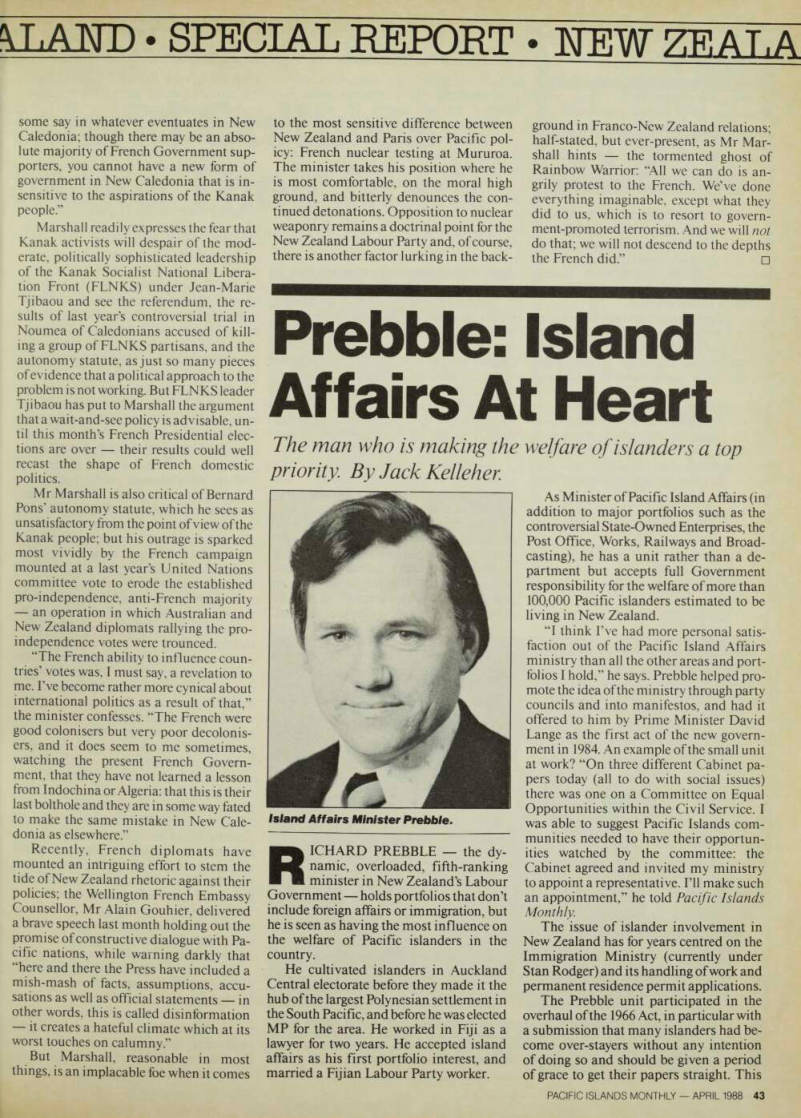
Island Affairs Minister Prebble.
was the origin of the new Act’s provision for temporary permits for those who wanted to make formal application for permanent residence. Some Pacific is landers were said to have felt misled into thinking the immediate permits were a form of “amnesty” rather than temporary protection during the consideration of applications.
Prebble acknowledges “some debate” about the “accuracy of some of the trans lations” of the offer, but understands Pa cific islanders are sophisticated in their understanding of immigration proce dures, that a “good proportion” of the ap plications will be granted.
“In order to qualify for registration you have to have been in New Zealand for two years: if you’ve done that, you’ve not bro ken the law and you’ve got accommoda tion and a job, you’re more than halfway there.”
He emphasises that the vast majority of Pacific islanders in New Zealand have had no problems with illegal residence.
One basic problem has been their collec tive identification as “islanders” and not by the islands or groups of islands from which they come.
For example, Cook Islanders, Toke lauans and Niue people are New Zealand citizens; Samoans think of themselves as Samoans, not as “islanders”, and may meet other groups only in serving on com mittees such as Labour Party electorate branches.
Of 120,000 settlers or their descendants
in New Zealand, “only about three thou sand would have had an immigration dif ficulty,” Prebble asserts. It’s mainly a success story: “I think it’s part of the Pa cific islands migration story, which has never really been told. Those who have settled here have done remarkably well.
“On my electorate committee I have a Samoan who could speak no English when he came here. Now he speaks fluent Eng lish. He owns his own house. He has a son who owns a house across the road they renovated it. Three months ago his neigh bours elected him a city councillor at a ward by-election.”
Prebble, in shirt-sleeves in his office, speaks in an amiable mumble away from the debating chamber. He likes to point out that once shabby Grey Lynn in Auckland Central has become “trendy” after years of Pacific islander occupation. “Specula tors have moved in, thinking they can buy up the properties. They knock on the door, find there’s a Pacific islander family living there. They ask who the landlord is and the occupants say, we haven’t got one, mate ... we own this property. Would they like to sell it? That’ll be the day, they say we moved into this neighbourhood and it has gone up in value with us in it.”
How does that square, he asks, with people who say of areas that this part was great “until the blacks moved into it”?
Richard Prebble’s colleague, Foreign Minister Russell Marshall, is “the premier minister” in the development of foreign policy. “I’ve got a good personal working
relationship with Russell,” Prebble says.
“He wouldn’t mind me saying he often sends over interesting telexes he’s had from the Pacific and asks for comments. Our views would be close in any event.”
A number of Labour Cabinet members have personal knowledge of the Pacific is lands or have significant island popula tions in their electorates he says. They include Prime Minister Lange “he and I have the biggest Pacific islander popu lations” but Prebble acknowledges that he has to point out to some visiting poli ticians from the Pacific that he does not have a foreign affairs role. He notices, however, how many come to see him, put their case*; then make it clear that they think he, as Minister of Pacific Island Affairs, should tell Civil Aviation (or whichever department they are having discussions with) what should be done.
When he was also Minister for Trans port and for Civil Aviation his extra re sponsibilities fitted neatly alongside Pacific Island Affairs, which is greatly concerned with improving transport links.
Asked if he feels frustrated by the long process of diplomacy, which requires measured thaws before New Zealand can recognise the regime in Fiji, Mr Prebble replies that he sees no reason to feel frus trated. “One reality to accept is that Fiji is our nearest neighbour” he says. “Another is that one of our permanent interests is Fiji’s permanent interest to continue a good working relationship between stable, peaceful, law-abiding countries.”
One thing he would note about rela tions between New Zealand and Fiji in the past two months is that they have been shown to be deeply intertwined. This is demonstrated by “how few things were ac tually broken off’. New Zealand never withdrew its High Commission, for ex ample, and continued with most of its aid programs. The only thing it really sus pended was military aid. . . and he thinks that was an appropriate move.
“Our criticism of things we didn’t like puts us under a moral obligation to iden tify things we do like. The decrees issued recently, which established a High Court, appear to have restored a genuinely inde pendent judiciary. The Chief Justice is a man for whom I have considerable per sonal regard. I think it would be a further step forward to promulgate an interim constitution to safeguard basic civil lib erties. But I’m not a foreign policy min ister ... that is my own view,” he adds.
The minister talks about the pace of di plomacy and his capacity to put up with it. “I enjoy the change of pace,” he says, “as in a meeting of Pacific islands people where, I guess, some would say nothing is happening, but people find all kinds of subtle ways to say a lot. The European way simply doesn’t suit everyone.” □
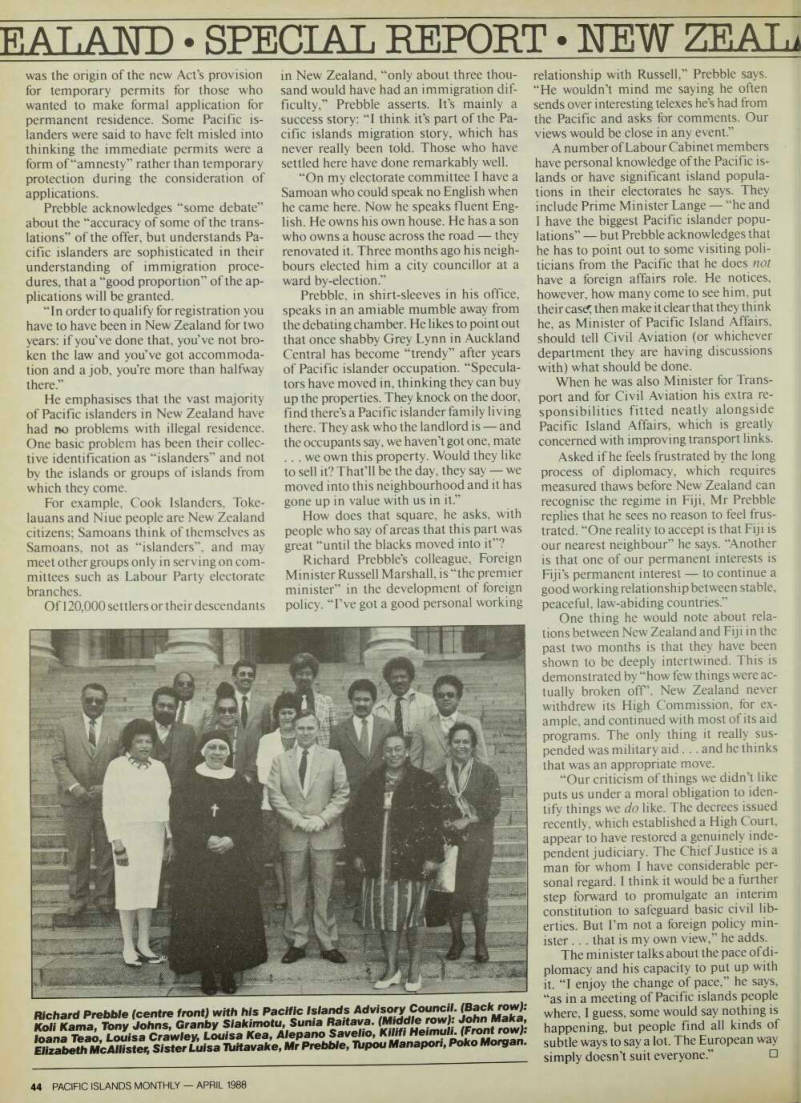
Richard Prebble (centre front) with his Pacific Islands AdviMry Council. (Bfek row): Koli Kama, Tony Johns, Granby Siakimotu, Sunia Raitave. (Middle row): John Maka, loana Teao, Louuisa Crawley, Louisa Kea, Alepano Savelio, Kilifi Heimuli. (Front row): Elizabeth McAllister, Sister Luisa Tuitavake, Mr Prebble, Tupou Manapori, Poko Morgan.