Island Cultures
pp. 45-47 · Read in the full issue
Make Their Mark
Art and religion , literature and sport .
By Jack Kelleher
OUT OF the darkness of the street they come, family groups drawn to the dim lights of the church. Press ing inside for the Christmas midnight mass, the youngest children are wide-eyed with wonder as they are allowed to stay up well past their usual bedtime hours.
I am wide-eyed, too, tonight at the Church of the Holy Family here in Pori rua. I seem to be stepping back 50 years to a time of cloud-white shirts and blouses, Sunday best; and to the church not as an outpost but as an extension of house and home.
Mothers whose features speak of Sa moa, the Cooks and Tonga, together with some Maoris, nurse the very young. Hus bands with the strong arms of bulldozer drivers, busmen and storemen hold aloft older children, also in white, in the over flowing aisles at the back of the church.
This hilly suburb at the northern edge of Wellington has hardly emerged from an era of state housing. It is only beginning to recover from lack of amenities, lack of pri vacy, lack of tree cover, porches, or ga rages that would invite house occupants to keep their cars off front lawns. Porirua was once originally the refuge of anyone of slender means: Pacific islanders preferred Newtown, one of the older inner suburbs of Wellington, as they have preferred Pon sonby in central Auckland or Sydenham in Christchurch.
A Samoan leader told me how town planners drive cultural and socio-eco nomic groups into particular areas. Coun cils do it with the public transport they organise, the rates they levy. Wiri and Mangere were developed in Auckland, as Porirua was here, but Porirua was pro vided for an earlier, indigenous genera tion of renters dignified by visits and blessings from the Queen. In the past few years Porirua has begun to acquire a new sense of dignity and a diversification of its Maori-Pakeha culture since the islanders joined the population.
The groups come together at the Sun day mass, to demonstrate that religion re mains a basic element in their lives.
Teenagers in particular are exposed to other influences, as are some of the older males. But in the homes of parents and grandparents traditional influences re-
main paramount and none of the gen erations want to damage that stability.
The arts of music, dress, design are ex pressed through the islanders’ religious commitment, along with the rituals of marriage, birth and death.
Fatu Feu’u is a Samoan-born, Auck land resident who recreates tapa through the modern art of lithography. In the is lands his art aspirations may have caused him to develop no further than the other village painters who have become known locally: he was born in 1946 and grew up in the village of Poutasi. He was educated at Samoa College, Apia, and knew the kind of mark he wanted to make when he came to New Zealand at the age of 20.
He continued to paint while working in factories, then took a job in industrial de sign, carrying on with his art even when he was partly incapacitated by a hip injury at which time he produced a series of large abstracts using a cloth wrapped around a golf club.
At art school he learned to produce lithographs, then to sublimate lithogra phy’s technicalities to a realisation of his Samoan heritage. He translated the leg ends of old Samoa to a new art form and a series of his lithographs is about to com plete a record-breaking exhibition at the Dowse Art Museum, in the Wellington satellite city of Lower Hutt. There, is lands-descended school children from
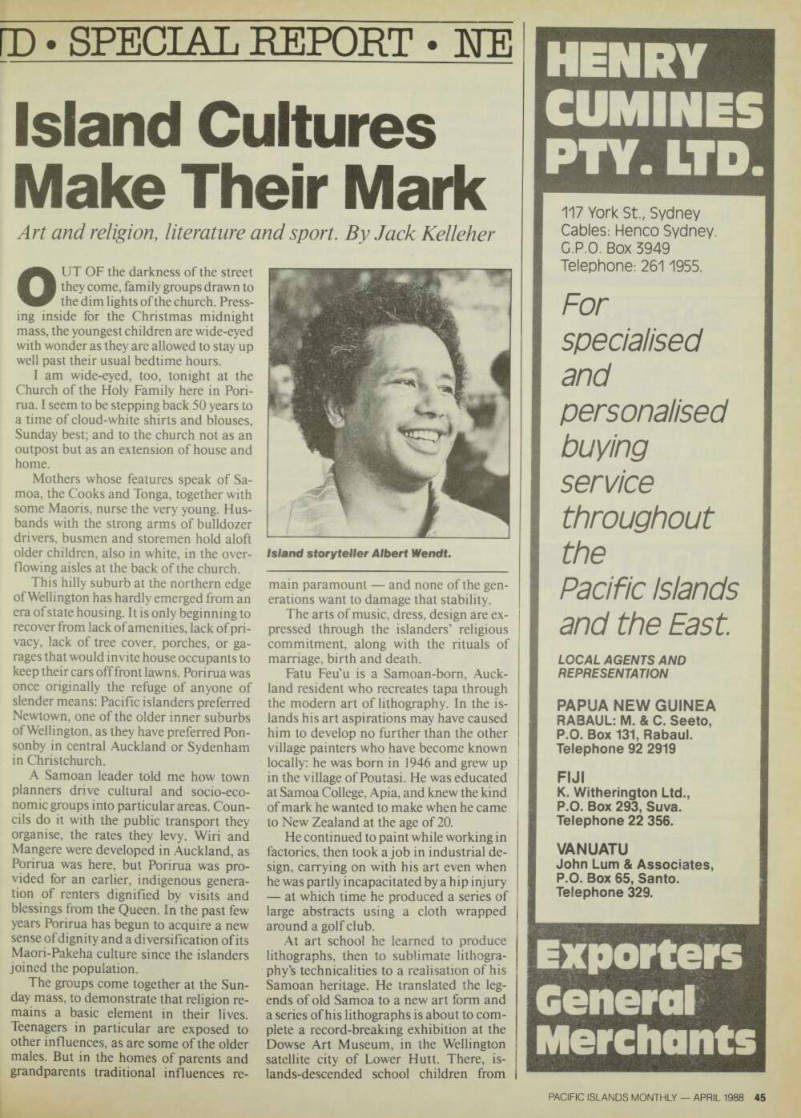
Island storyteller Albert Wendt.
throughout the region are being shown his work.
Fatu Feu’u’s lithographs reconstruct the beginning of the Samoan legend of the Nine-Headed Pigeon. Lupe Uluiva. The legend involves a manaia (son of a high chief) and his infatuation with a taupou (woman of supernatural origins). It is set in Vaimo’oi’a, or sacred bathing waters, that are the exclusive sanctuary of matais.
He says all the art forms of the Polynesian people, whether they be Samoan, Raro tongan or Maori, have a meaning a love story, a message, a genealogy or a cata logue. The messages are carved in wood or carved on their bodies. “If you read all the lines of the tattoo,” Feu’u says, “it will tell you a story. By reading the number of lines, and their shapes, you find a genealogy, and you can make out the titles of all the families.”
The example of this Samoan artist’s in stinct, sense of tradition and talent, all given technique and release by scholar ship in New Zealand, moved the Dowse to assemble and exhibit the NZ National Museum’s collection of tapa (so called in the Solomons, New Britain, Futuna and Santa Cruz; it is masi in Fiji, ngatu in Tonga, kapa in Hawaii and siapo in PNG and the Cook Islands), which includes a kapa room-divider believed to have been presented to Captain Cook when he was in the Hawaiian Islands.
Luseane Kiloi, a Tongan tapa-maker, followed in March by demonstrating the processing the bark of the hiapo (mul berry) in which narrow strips are beaten to paper thinness and overlaid with others to make a strong fabric, then dye-printed with stencils.
All of the island groups have their sto rytellers. If they are not as celebrated as Samoa’s Albert Wendt, established on New Zealand bookshelves for such novels as Sons For The Return Home, some are keeping the legends of the island home alive for succeeding generations; others are still savouring the experiences that will form the latest saga of the Polynesian mi gration. Poets, too, are still an important part of the literature.
No art form has had such mass appeal in establishing Polynesians throughout New Zealand as pop music. When the NZ National Youth Council introduced a mental health project to Parliament, the musical accompaniment was from the band Quabax, comprising Anne and Mar tha Samasoni and Suzanne Lyons.
The Polynesian preference for bright colours and cool styles in clothing has been taken up by Maori and by Pakeha women; indeed, women’s art is blending as artists from different island groups join together in a movement called Pacifica. New Zea land has long been the great coming-to-
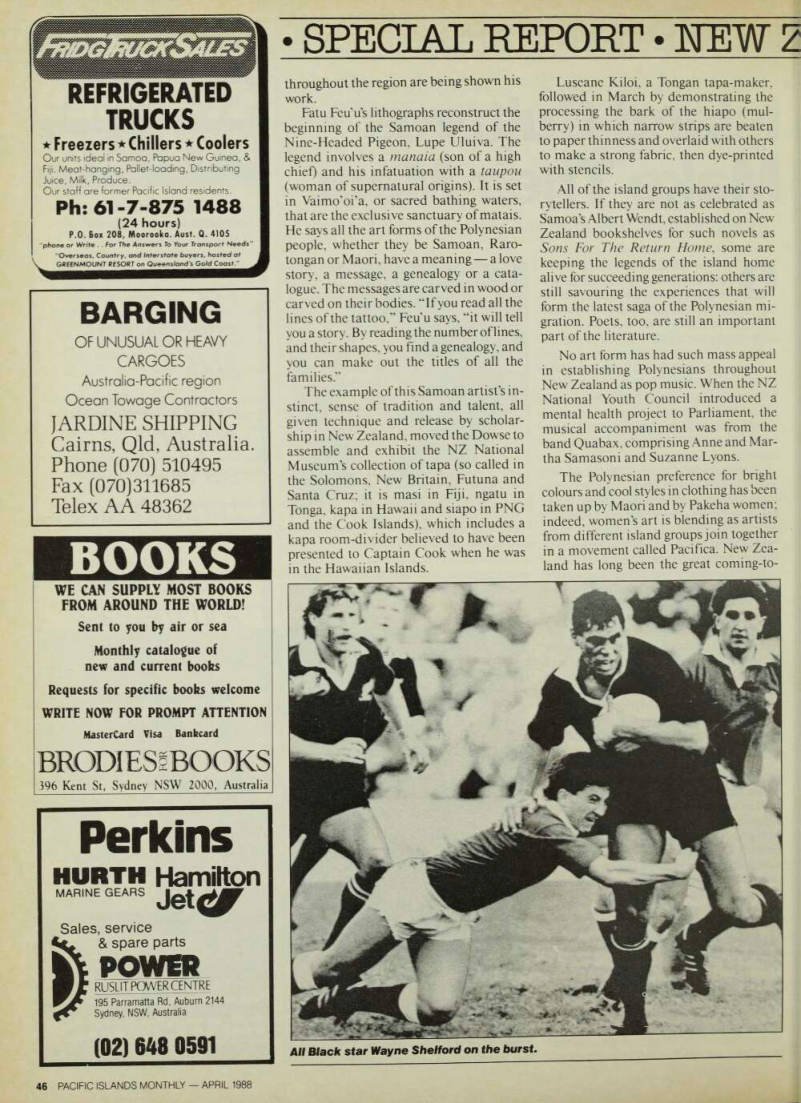
All Black star Wayne Shelford on the burst.
gether place of island people, and could produce something entirely new.
Pacific Islanders have also introduced New Zealand to a more exuberant version of the Maori’s extended family, which has been under great pressure as cousins and further generations are accommodated in limited space and with small resources, Hospitality has developed as an art form, rising above the pressures.
Left to themselves, the new settlers entertain each other with nothing more complicated than an islands-style cricket bat or a pack of cards. Nothing bridges the generations more effectively, Polynesians say, than cards. Elders teach the youngsters new tricks, such as the universal “suipi”, or sweep.
But in New Zealand the islanders have also become sports page heroes. Rugby union, rugby league, softball and netball even bowls, at a Commonwealth Games tournament have shown how dedicated to excellence Pacific islanders can be.
Rugby union stars such as Michael Jones, following in the footsteps of Bernie Fraser and Bryan Williams, have elevated the national game to an art form, with a
grace of movement that is the aficionado’s delight. Jimmy Peau, New Zealand and Commonwealth boxing champion, also follows a long line of island fighters trained in Auckland.
The arts know no perimeters. Perhaps the different expressions of hospitality will take longest to blend as Pacific islanders merge in the New Zealand community, Louisa Crawley, deputy director of the Government’s Pacific Island Affairs Ad visory Unit, says the most difficult aspect of life in New Zealand is the different way of “accepting” people, “Islanders tend to welcome anyone, to like them immediately,” she says. “As they live with us we discover the less pleasant things. The tendency in New Zealand is to watch and observe first. If you make it, you’ll be accepted. Not before.”
Many questions remain. Will Pacific islanders in New Zealand preserve their traditional hospitality? Will they pick up long-lost pieces of their culture, as Maoris have done, in a renaissance? At this stage there are few answers. Polynesians and Pakehas, however, are confident that the process of integration is working well, n