The Marshall Scenario
pp. 42-43 · Read in the full issue
From Education Minister to Foreign Affairs New Zealand’s Foreign Minister Russell Marshall attacks Pacific problems with a principled zeal that makes him a man to be reckoned with, as the French nuclear lobby in particular has learned. By Nicolas Rothwell
New Zealand’s Foreign Minister, Russell Marshall, combines his principled approach to interna tional affairs with an engaging modesty and reticence. A man with Pacific priori ties, he speaks in a reflective, careful style on the problems and complexities of the region.
Mr Marshall held the important Edu cation portfolio before the re-election of the Labour Government last August. Many political observers interpret Prime Min ister David Lange’s decision to move Mar shall to Foreign Affairs as a favour to the party’s left wing, where the new minister unambiguously takes his stand. But Mar shall seems far more than just a politically astute choice to articulate New Zealand’s fiercely independent foreign policy agenda; this former Methodist minister clearly thinks through the Pacific’s problems with an intense, if somewhat naive, decency.
Slow to anger, but possessed of a righteous fury, he has no time at all for France’s pol icies in New Caledonia and French Poly nesia. Presiding over a talented New Zealand diplomatic staff in the region, he intends to keep the Pacific the chief con cern of his Government; he has opened New Zealand’s mission in Vanuatu, and the next post to open will be in Tarawa, Kiri bati, “giving us a Micronesian connec tion”. Last month he visited Paris for pacific discussions.
The minister has a special interest in the political debate in New Caledonia, continued French nuclear testing on Mu ruroa, and the evolution of the younger microstates of the region; but he is sur prisingly circumspect in his comments on Fiji, where he sees a developing and still fluid situation. Further, dogmatism is his enemy in discussing Pacific issues. Mr Marshall feels New Zealand’s history still interferes with his nation’s true regional role.
“We have to keep reminding ourselves this is where our major concerns lie. New Zealand is a South Pacific community and not a semi-European country off the coast between Britain and Spain,” he stresses.
Marshall identified a distinct ambiv-
alence in New Zealand society in connection with last year’s Fiji crisis, which proved to New Zealanders that, though they may be the largest Pacific island community their sphere of influence is limited by their history.
Marshall discounted the drift by Suva towards closer ties with nations such as Malaysia, Indonesia and Papua New Guinea, in preference to its traditional links with Australia and New Zealand, “Fiji’s destiny is where it is geographically,” he claims. “There may be a time when they are closer to or more amenable to the blandishments of the Indonesians and the French; but while I’m cynical about the latter, I’m not so cynical about the former. I think the Indonesians have
wanted to play a greater role in the South Pacific for some time, “We are not discouraging Indonesian participation: besides, I think a closer/Im logue between the Forum countries and the ASEAN countries is a sensible thing in any
event.” U 1 r
A more intractable Pacific problem tor New Zealand’s diplomats, and one with which their minister feels more contident of long-term success, is New Caledonia, where the September pro-French referen dum vote appears to have entrenched t e territory’s ties to Paris, “This is again an indigenous peoples issue, and the certainty to my mind is that sooner or later and I fervently hope sooner the Kanak people have to have
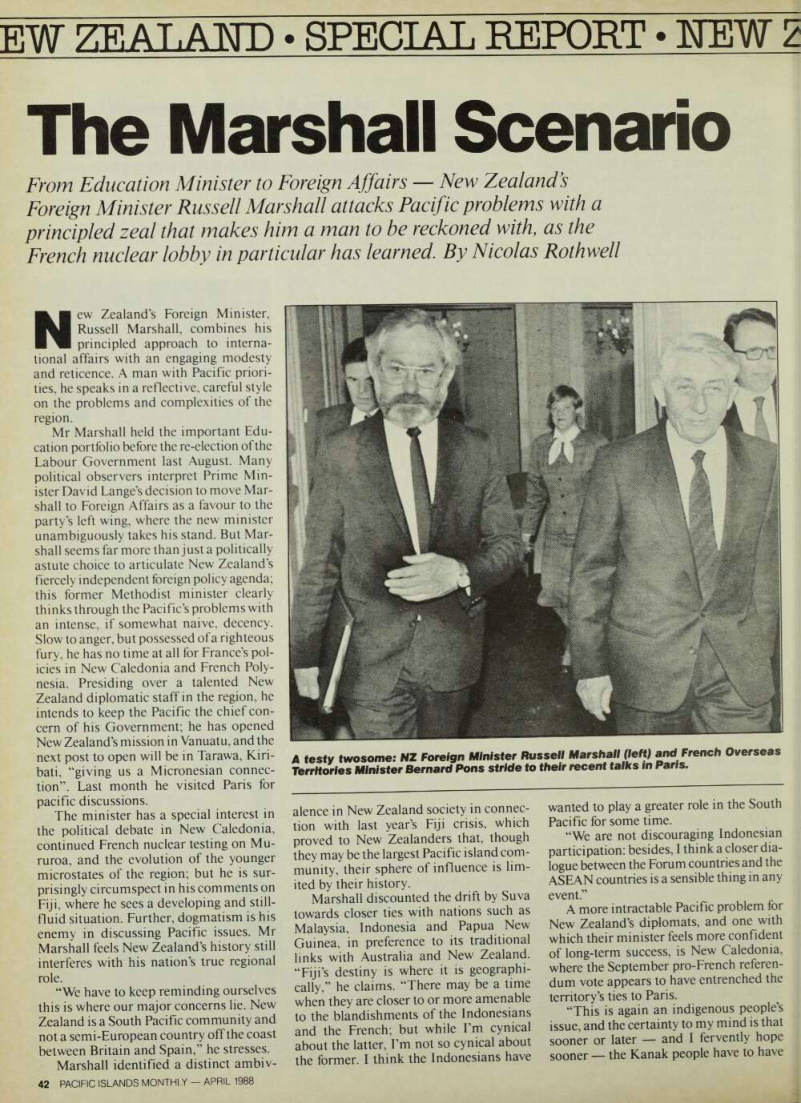
A testy twosome: NZ Foreign Minister Bus sell Marshall (left) and French Overseas Territories Minister Bernard Pons stride to their recent talks in Paris.
some say in whatever eventuates in New Caledonia; though there may be an abso lute majority of French Government sup porters, you cannot have a new form of government in New Caledonia that is in sensitive to the aspirations of the Kanak people.”
Marshall readily expresses the fear that Kanak activists will despair of the mod erate, politically sophisticated leadership of the Kanak Socialist National Libera tion Front (FLNKS) under Jean-Marie Tjibaou and see the referendum, the re sults of last year’s controversial trial in Noumea of Caledonians accused of kill ing a group of FLNKS partisans, and the autonomy statute, as just so many pieces of evidence that a political approach to the problem is not working. But FLNKS leader Tjibaou has put to Marshall the argument that a wait-and-see policy is advisable, un til this month’s French Presidential elec tions are over their results could well recast the shape of French domestic politics.
Mr Marshall is also critical of Bernard Pons’ autonomy statute, which he sees as unsatisfactory from the point of view of the Kanak people; but his outrage is sparked most vividly by the French campaign mounted at a last year’s United Nations committee vote to erode the established pro-independence, anti-French majority an operation in which Australian and New Zealand diplomats rallying the pro independence votes were trounced.
“The French ability to influence coun tries’ votes was, I must say, a revelation to me. I’ve become rather more cynical about international politics as a result of that,” the minister confesses. “The French were good colonisers but very poor decolonis ers, and it does seem to me sometimes, watching the present French Govern ment, that they have not learned a lesson from Indochina or Algeria: that this is their last bolthole and they are in some way fated to make the same mistake in New Cale donia as elsewhere.”
Recently, French diplomats have mounted an intriguing effort to stem the tide of New Zealand rhetoric against their policies; the Wellington French Embassy Counsellor, Mr Alain Gouhier, delivered a brave speech last month holding out the promise of constructive dialogue with Pa cific nations, while warning darkly that “here and there the Press have included a mish-mash of facts, assumptions, accu sations as well as official statements in other words, this is called disinformation it creates a hateful climate which at its worst touches on calumny.”
But Marshall, reasonable in most things, is an implacable foe when it comes
to the most sensitive difference between New Zealand and Paris over Pacific pol icy: French nuclear testing at Mururoa.
The minister takes his position where he is most comfortable, on the moral high ground, and bitterly denounces the con tinued detonations. Opposition to nuclear weaponry remains a doctrinal point for the New Zealand Labour Party and, of course, there is another factor lurking in the back
ground in Franco-New Zealand relations; half-stated, but ever-present, as Mr Mar shall hints the tormented ghost of Rainbow Warrior: “All we can do is an grily protest to the French. We’ve done everything imaginable, except what they did to us, which is to resort to govern ment-promoted terrorism. And we will not do that; we will not descend to the depths the French did.” n