Nuclear Diplomacy:
pp. 39-41 · Read in the full issue
Special Report New Zealand
Nuclear Diplomacy: Lange’s Holy Grail
New Zealand is playing an ever more vital role in the region. Leading our Special Report on the nation, Prime Minister David Lange confronts the controversial issue of New Zealand’s quest for a nuclear free Pacific. Following are interviews with Foreign Minister Marshall, Pacific Affairs Minister Prebble and analyses of the state ofNZ island trade and culture.
I think it was inevita ble that at some time the Opposition would make its play for the great unclaimed prize of New Zealand diplomacy. By that I mean they would try to reconcile our in sistence on the exclusion of nuclear weapons with the disruption to our participation in an alli ance relationship with a nuclear power (the US).
It is a kind of Holy Grail of diplomacy, in search of which some ex traordinary people have ridden off to seek their place in history. I have met people who were al most itching to sit where I sit and have a go at sort ing it out, convinced that if only they had the chance to do it differ ently the accommoda tion would be made and the breach healed.
I do not want you to think that I have taken the well-intentioned among them lightly. The most thorough efforts were made to reach an agreement.
I also state plainly that no agreement is possible unless New Zealand changes its policy or unless the US changes its policy.
In other words an accommodation about ANZUS will only come about if nuclear weapons are brought to New Zealand or if the US acknowledges that it will not bring nuclear weapons to New Zealand.
May I explain the grounds for my
certainty. You will remember that the Government was elected in 1984 on a plat form that undertook to exclude nuclear weapons from New Zealand.
You may also remember that the La bour Party had undertaken to renegotiate the ANZUS alliance. There was certainly no intention of leaving the alliance or be coming a sleeping partner in it, and when I was campaigning in that election I was assertive of the value to New Zealand of the alliance.
At that time it was my view that New Zealand could exclude nuclear weapons and remain in active alliance with a nu clear power. I did not see the alliance as predominantly nuclear. I saw no need for the projection of nuclear force in the South Pacific. I believed that in the end New Zealand and the US would reach an ac commodation because New Zealand’s re gional usefulness as an alliance partner outweighed any part we could ever play in a global nuclear strategy.
In fact what happened has made it plain claims that ANZUS is not a nuclear alli ance are absolutely hollow. The ANZUS relationship between the US and New Zealand is now inoperative exactly be cause the nuclear element in the alliance has become predominant.
The 1984 election was almost imme diately followed by a meeting between US Secretary of State Shultz and myself. Mr Shultz stated that the alliance depended on the maintenance of American access to New Zealand ports on the basis of the nei ther confirm nor deny policy. He did not, as I recall, say then what he said last year, that neither confirm nor deny meant that nuclear weapons would from time to time be brought to New Zealand. I stated my
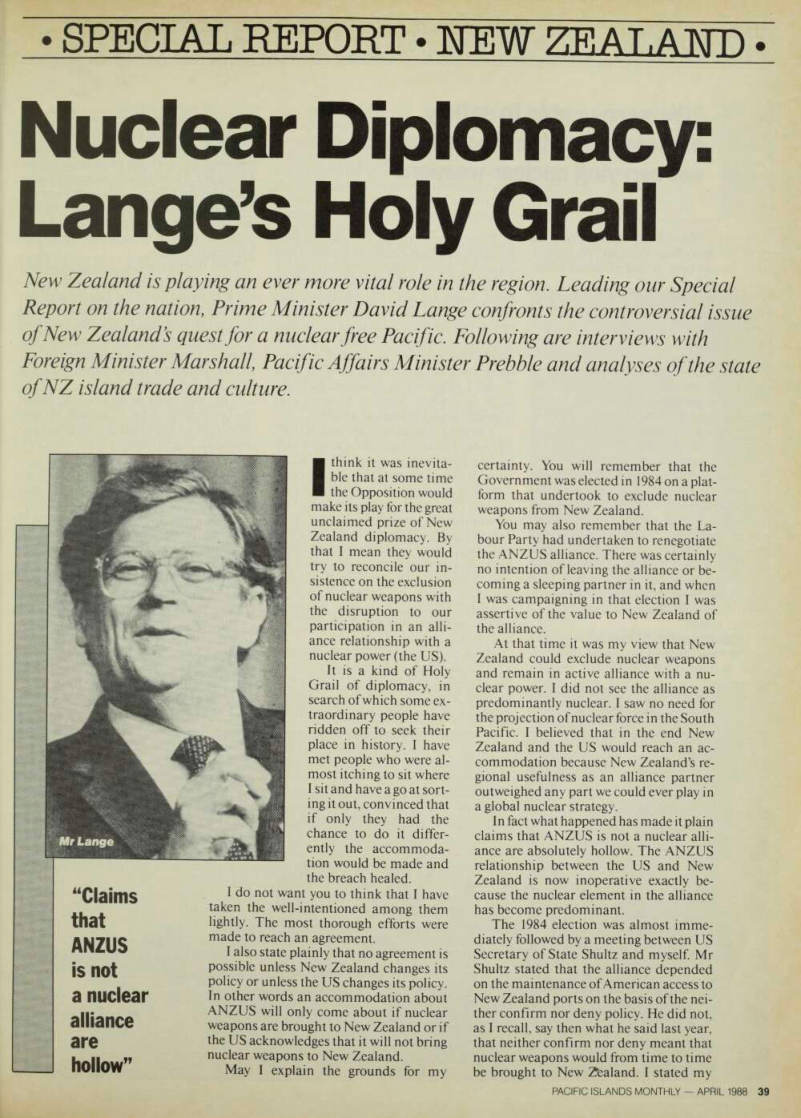
Mr Lange
“Claims that
Anzus
is not a nuclear alliance are hollow”
“We were unable to satisfy ourselves that the was not carrying nuclear weapons”
party’s view that nuclear weapons must be excluded from New Zealand. We agreed there should be a period of consultation and negotiation.
In the next few months the US made no request for any naval vessel to visit a New Zealand port and consultation and negotialion duly took place.
I must say that throughout the negotiations the American position did not alter; they would neither confirm nor deny the presence of nuclear weapons. They stated the consequences if New Zealand did not allow American vessels unimpeded access on that basis. They did not threaten, but they did not move.
American insistence on obscuring the presence or absence of nuclear weapons has a blunt logic to it. It preserves the ambiguity that maintains the credibility of the nuclear deterrent. Some vessels are nuclear-armed. Some are not. The pack is shuffled. As the Secretary of Stale put it to me, accepting neither confirm nor deny means accepting that from time to time American ships will be not might be — nuclear armed.
Hindsight now tells me that we might as well have stopped the negotiations almost as soon as we started, but you will understand why there was great reluctance to do that. The negotiations, however, assumed a remarkable character.
What happened was that various pro posals to alter New Zealand’s position were discussed. Some of those proposals proved acceptable to the New Zealand Govern ment, some did not. The proposals that were acceptable did not impair the integ rity of our insistence on keeping nuclear weapons out of New Zealand. The pro posals that were not acceptable were no more than devices through which New Zealand might try to proclaim itself nu clear free while actually allowing un impeded access to nuclear weapons...
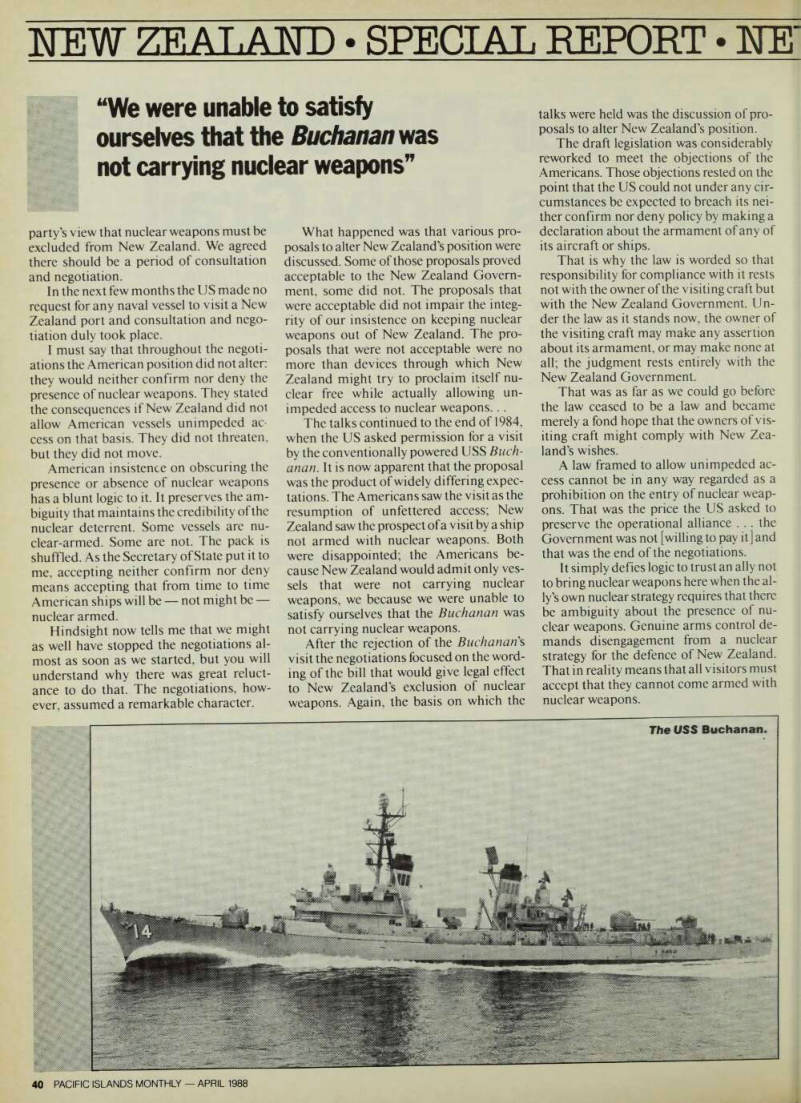
The talks continued to the end of 1984, when the US asked permission for a visit by the conventionally powered USS Buck anan. It is now apparent that the proposal was the product of widely differing expec tations. The Americans saw the visit as the resumption of unfettered access; New Zealand saw the prospect ofa visit by a ship not armed with nuclear weapons. Both were disappointed; the Americans be cause New Zealand would admit only ves sels that were not carrying nuclear weapons, we because we were unable to satisfy ourselves that the Buchanan was not carrying nuclear weapons.
After the rejection of the Buchanan's visit the negotiations focused on the word ing of the bill that would give legal effect to New Zealand’s exclusion of nuclear weapons. Again, the basis on which the
talks were held was the discussion of pro posals to alter New Zealand’s position.
The draft legislation was considerably reworked to meet the objections of the Americans. Those objections rested on the point that the US could not under any cir cumstances be expected to breach its nei ther confirm nor deny policy by making a declaration about the armament of any of its aircraft or ships.
That is why the law is worded so that responsibility for compliance with it rests not with the owner of the visiting craft but with the New Zealand Government. Un der the law as it stands now, the owner of the visiting craft may make any assertion about its armament, or may make none at all; the judgment rests entirely with the New Zealand Government.
That was as far as we could go before the law ceased to be a law and became merely a fond hope that the owners of vis iting craft might comply with New Zea land’s wishes.
A law framed to allow unimpeded ac cess cannot be in any way regarded as a prohibition on the entry of nuclear weap ons. That was the price the US asked to preserve the operational alliance ... the Government was not [willing to pay it] and that was the end of the negotiations.
It simply defies logic to trust an ally not to bring nuclear weapons here when the al ly’s own nuclear strategy requires that there be ambiguity about the presence of nu clear weapons. Genuine arms control de mands disengagement from a nuclear strategy for the defence of New Zealand.
That in reality means that all visitors must accept that they cannot come armed with nuclear weapons.
The USS Buchanan.
I should deal here with the point that arises from the difference between the law relating to the entry of ships and the law relating to the entry of aircraft. The latter allows for what is called a blanket clear ance to be given to some types of aircraft.
Such a clearance has been given to aircraft supporting the Deep Freeze operation and to non-combat military aircraft bringing cargo and VIPs to New Zealand. All other aircraft must be cleared individually in the same way as ships.
The reason for the distinction is sim ple. Some ships carry nuclear weapons.
The aircraft that have the blanket clear ance do not. That is why the clearance has been given, but the law has the same ef fect. A visit by an aircraft carrying nuclear weapons would result in as much of a breach in the law as a visit by a ship car rying nuclear weapons, and the law would be similarly invoked. The law requires the same judgments to be made whether visits are on an individual basis or a class basis.
Visits by aircraft in compliance with the law are welcome, as much as are visits by ships in compliance with the law.
I want it to be absolutely plain that New Zealand cannot return to an active alli ance relationship with the US unless New Zealand changes its policy and allows nu clear weapons here, or unless the US changes its policy and accepts that it can not bring nuclear weapons here.
I have some sympathy with those who argue seriously for the return of consensus in New Zealand foreign policy but I shall not allow it to be consensus based on de ceit about nuclear weapons. There is much that is insincere in international relations and much that we do not like that we have to put up with, but this country at least can be plain about nuclear weapons.
This Government is committed to their exclusion from New Zealand as a serious measure of arms control. Words are not enough. We have acted, we have borne the consequences of our actions and we are not going backwards.
All of this brings me naturally to two further questions: whether we are better or worse off, and where we go from here.
In terms of threats to our independent existence we are in exactly the same po sition in 1987 as we were in 1984. There is no threat and none can be conjured. Those who refuse to take comfort in the Govern ment’s assurances on this point can per haps take comfort in the assertions of its most ardent critics: not even the fiercest of them has been able to identify an enemy massing on the horizon. Instead they tend to see the Government’s dereliction as the little tear we have made in the seamless fabric of nuclear deterrence.
In the wider meaning of security we are
certainly not worse off. Those who talk about the withdrawal of the American se curity guarantee as if they are talking about a fact are doing, in fact, a disservice. The existence of the so-called guarantee was at the very least a matter of dispute. It was certainly never part of my calculations during the short period when the alliance with the US was operative.
That of course is very far from saying that I did not value conventional defence co-operation with the US. I did, and I would value it again, but I have simply never seen the alliance in terms of a small country in peril and its inevitable rescuer.
That is not the reality of it.
Defence co-operation should consist of the pursuit of common interests. That is the nature of New Zealand’s defence re lationship with Australia. We have com mon interests that are well established and each can be helpful to the other in the pur suit of them. Those who suggest that the New Zealand Government would like Australia to be a kind of guardian for the US are misinformed if not malicious. As we did not see the US as a certain protec tor, we are hardly likely to think of Aus tralia as a guarantor of our security.
While the ending of the operational al liance relationship with the US had some short-term disadvantages, in the long run we are better off. A false sense of security is not sufficient reward for taking part in a strategy that has no relevance to the def ence of New Zealand. The ANZUS alli ance has been unequivocally revealed in the past three years to be a nuclear alli ance, a defence arrangement underpinned by a global strategy of nuclear deterrence.
As long as it retains that character it is no use to New Zealand and New Zealand had better make arrangements that are rele vant to our own circumstances.
I am not suggesting that we shall be en gaging in the internal politics of other countries. I will defend New Zealand’s po sition anywhere in the world, but New Zealand interference in the domestic pol itics of other countries would be as intol erable as outside interference in New Zealand politics. We shall concentrate our efforts on forums where a case for nuclear disarmament may freely be put and the in terest of governments properly engaged.
In defence and in international rela tions generally, 1 think that the next few years will largely be a period of consoli dation. There has been in some quarters a hope that the policy of the past three years is an aberration, but it is not and we shall have to get used to the new reality.
That means we must continue our reappraisal of our defence spending to match it better to our interests in the Pa cific. We must reconsider the pattern of our
overseas representation. There is little doubt that the greatest challenge to New Zealand diplomacy in the next few years lies in the South Pacific, but we are cer tainly not short of challenges, in trade and marketing as well as international relations. n
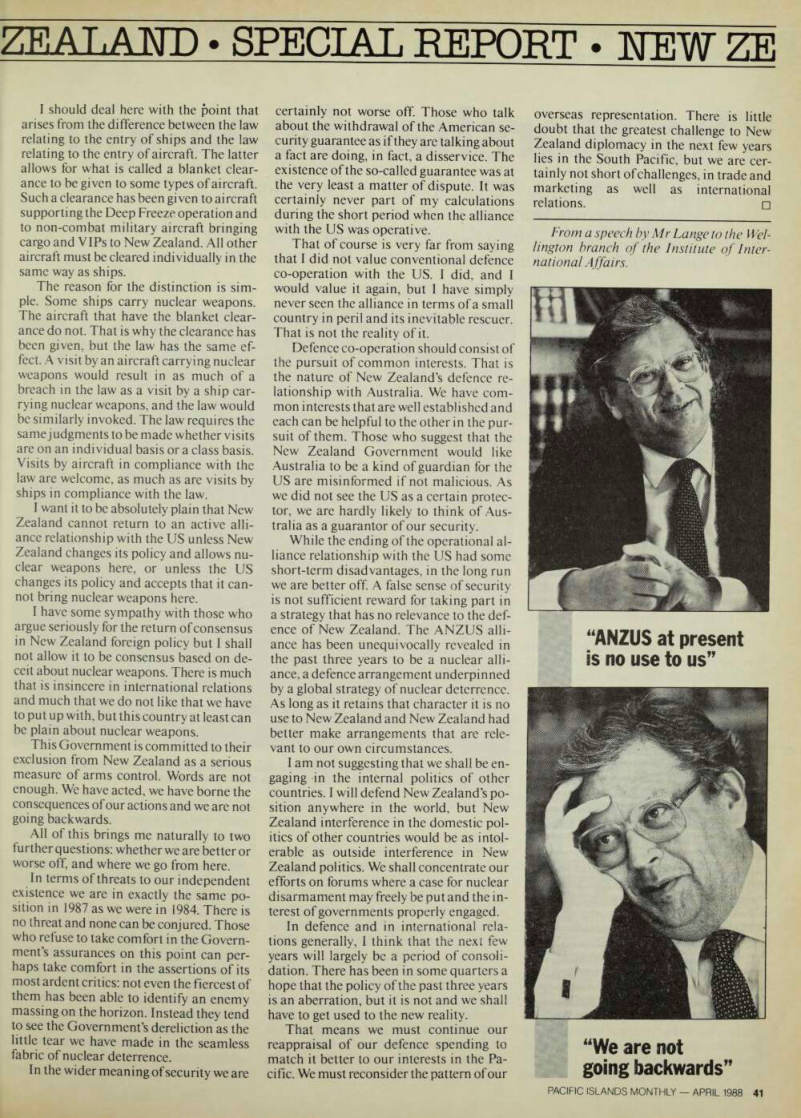
From a speech by Mr Lange to the Wel lington branch of the Institute of Inter national Affairs.
“ANZUS at present is no use to us”
“We are not going backwards”