Professionals On The Run
p. 12 · Read in the full issue
Fiji
Fiji’s brain drain hampers economic recovery.
ONE OF Fiji’s most pressing problems to day, along with how to revive its economy, attract more tourists and woo for eign investment, is how to fill key professional positions, particularly those where spe cial skills are required.
The Republic, which is now struggling to get back on the rails after last year’s coups, is faced with the problem of a massive and unprecedented brain drain. Indians who make up 51 per cent of the population and who domi nated most professions in the past teachers, doctors, law yers, computer operators, nurses and administrators are now leaving the country for such places as Australia, Canada, New Zealand and the United States.
Historically, Indian par ents who themselves had lit tle education and had served as labourers on sugar cane plantations placed great em phasis on educating their children, with the result that these children found them selves to be academically qualified for positions in most professions.
However, the scene is now changing rapidly. Indians in senior positions within the civil service say they have been forced to retire or to leave prematurely. Several who were permanent secretaries have been retired; heads of other departments, such as the commissioner for inland revenue, the comptroller of customs, senior health ad ministrators and labour offi cers, have resigned and
doctors and nurses have left the service.
It is not only the public sector that has been affected.
Banks and organisations such as the Fiji Electricity Author ity, the Fiji Sugar Corpora tion and the media (in particular the national radio station, Radio Fiji, and the two newspapers, the Fiji Times and the Fiji Sun) have lost most of their senior In dian staff.
Sir Vijay Singh, chief ex ecutive of the Fiji Sugar Cane Growers’ Council; Justice Ki shore Govind, a judge of the Supreme Court, and the for mer police commissioner, Mr Raman, are now living in Australia.
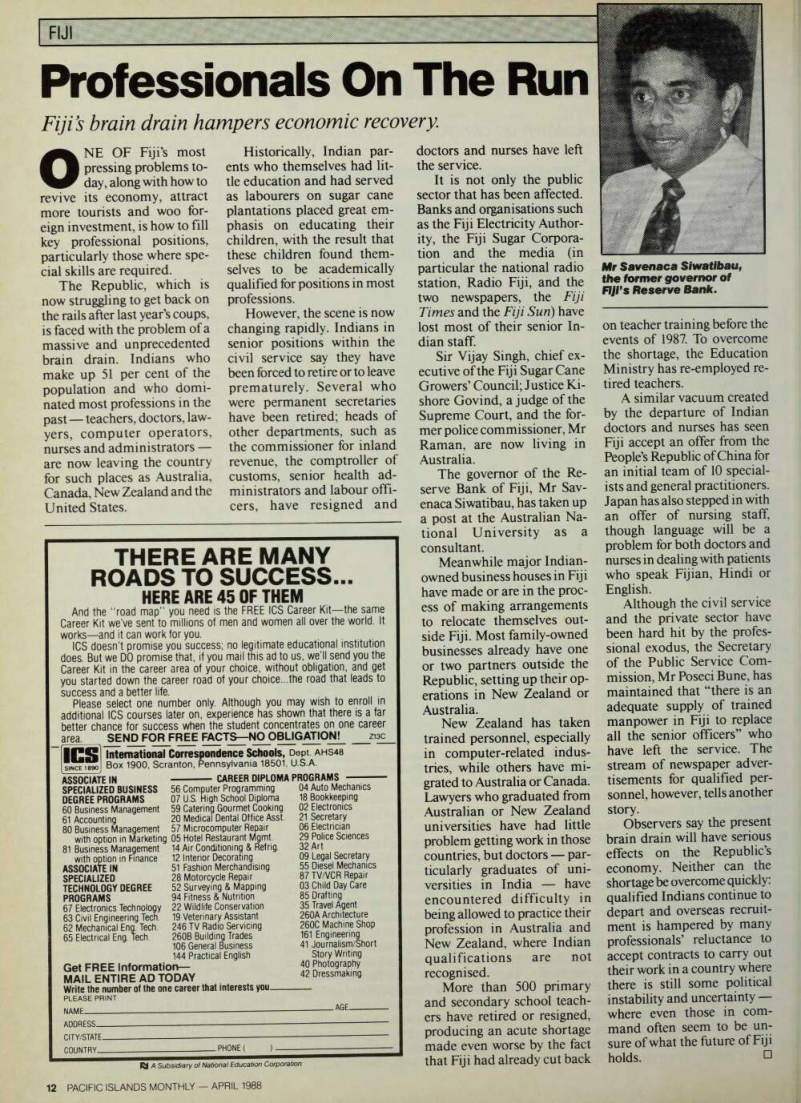
The governor of the Re serve Bank of Fiji, Mr Sav enaca Siwatibau, has taken up a post at the Australian Na tional University as a consultant.
Meanwhile major Indian owned business houses in Fiji have made or are in the proc ess of making arrangements to relocate themselves out side Fiji. Most family-owned businesses already have one or two partners outside the Republic, setting up their op erations in New Zealand or Australia.
New Zealand has taken trained personnel, especially in computer-related indus tries, while others have mi grated to Australia or Canada.
Lawyers who graduated from Australian or New Zealand universities have had little problem getting work in those countries, but doctors par ticularly graduates of uni versities in India have encountered difficulty in being allowed to practice their profession in Australia and New Zealand, where Indian qualifications are not recognised.
More than 500 primary and secondary school teach ers have retired or resigned, producing an acute shortage made even worse by the fact that Fiji had already cut back
on teacher training before the events of 1987. To overcome the shortage, the Education Ministry has re-employed re tired teachers.
A similar vacuum created by the departure of Indian doctors and nurses has seen Fiji accept an offer from the People’s Republic of China for an initial team of 10 special ists and general practitioners.
Japan has also stepped in with an offer of nursing staff, though language will be a problem for both doctors and nurses in dealing with patients who speak Fijian, Hindi or English.
Although the civil service and the private sector have been hard hit by the profes sional exodus, the Secretary of the Public Service Com mission, Mr Poseci Bune, has maintained that “there is an adequate supply of trained manpower in Fiji to replace all the senior officers” who have left the service. The stream of newspaper adver tisements for qualified per sonnel, however, tells another story.
Observers say the present brain drain will have serious effects on the Republic’s economy. Neither can the shortage be overcome quickly: qualified Indians continue to depart and overseas recruit ment is hampered by many professionals’ reluctance to accept contracts to carry out their work in a country where there is still some political instability and uncertainty where even those in com mand often seem to be un sure of what the future of Fiji holds. a
Mr Savenaca Siwatibau, the former governor of Fiji’s Reserve Bank.