Paris Split On Pacific Role
pp. 14-15 · Read in the full issue
New Caledonia
The metropolitan French view of New Caledonia is much more complex than many
Pacific observers think.
By Dr Robert Aldrich
NEW CALEDONIA may not have occupied a great deal of space on the front pages of daily newspa pers recently, but the territory’s situation is far from resolved. Violent confronta tions in the town of Poindimie, on the northeastern coast of Grande Terre, pitted Kanak nationalists against French gen darmes in February. In January, the French National Assembly approved the new plan for the territory put forward by the Government of Jacques Chirac and elections have been called for April 24 to select leaders for the re-drawn regions and the Congress of New Caledonia elec tions the FLNKS has said it will boycott.
Not coincidentally, the voting will be held the same day as the first round of voting for the French Presidency.
New Caledonia is not the central issue in the contest to choose a new President, but all parties see a chance to win votes through their positions on New Cale donia. In fact Maurice Satineau, in his re cently published book Le Miroir de Noumea {The Mirror of Noumea), argues that each party’s position on New Cale donia is determined largely by the possi bility of scoring electoral points in France.
Yet metropolitan France’s attitudes to New Caledonia are more diverse and more subtle than they may appear at first glance.
No real consensus on the future of the is lands exists, and the program designed by Chirac’s Minister for Overseas Depart ments and Territories (“Dom-Tom” to the French), Mr Bernard Pons, is far from winning unanimous approval. Efforts are now being made to discuss different points of view on New Caledonia. One major at tempt was a seminar held in January at the National Assembly in Paris.
The meeting was organised by the new Assocation pour I’Evolution Pacifique de la Nouvelle-Caledonie (Association for the Pacific Evolution of New Caledonia), headed by Socialist politician and former Secretary of State for Overseas Depart ments and Territories George Lemoine.
The aims of Lemoine’s organisation are to “aid in the Pacific evolution of the terri tory” and, significantly, to “ensure the presence of France in the South Pacific”.
In opening the seminar, Lemoine said that the situation in New Caledonia is now “stalemated” by the lead-up to the presi dential election and by the wait for the im plementation of the Pons program.
However, the time is now ripe for discus sions that could lead to a peaceful solution of the New Caledonia problem.
The first speaker at the Paris meeting, Alain Rollat (who covers the South Pacific for France’s most respected newspaper, Le Monde), characterised the situation since the September 1987 referendum as an “impasse”. The referendum which was boycotted by the FLNKS and in which the remaining 50 per cent of the electorate voted almost unanimously for New Caledonia to remain an integral part of France has produced only unhelpful results.
Rollat argued that it is necessary for “the state to eliminate inequalities and create reconciliation”, but such has manifestly not been the case with the present Government. The State should be an “arbiter” between the different interests, though current policy is simply to dismiss the activities of the FLNKS as the work of agitators; and French authorities in the territory avoid meeting those who do not support their views ... an approach that hardly facilitates dialogue. The FLNKS, Rollat believes, does not want a complete break with France, but the intransigence of the Chirac Government provides ammunition for more radical elements in the pro-independence coalition.
Jean-Louis Seunn, professor of political science at the University of Bordeaux, emphasised legal questions and warned against underestimating the results of the referendum, since it was carried out in conformity with the French constitution and is legally binding Seurin agrees with Rollat that Paris
must act as an arbiter and must work out a consensus but argues that Melanesians must be reminded it is legally impossible to have a referendum reserved for them alone; likewise, the Socialists must be re minded that “the State has to do more than console Jean-Marie Tjibaou”.
Jean-Pierre Doumenge, a geographer from Bordeaux and author of several au thoritative studies of Melanesian society in New Caledonia, also pointed to long term structural problems in New Cale donia particularly the disparities be tween different regions and economic sectors. Greater development would re duce ethnic and regional inequality and make the territory less dependent on oul side investment and expertise. But it is important, said Doumenge, to work out an “intercommunal pact” for the evolution ot the territory.
The final speaker was Jean Chesneaux, a former professor at the Sorbonne whose most recent book is Transpacijiques {re viewed in Pacific Islands Monthly in Jan uary). Chesneaux posed a senes o questions about the future ol New Caje donia and France’s role in the South Pa cific: does a French presence in the South Pacific, for example, necessarily demand sovereignly’Other co “ n ‘;' e “^J;| 1 n S^p ; l ] ’‘ many and Japan are able to ™ amta cific presence without such sovereig y.
Chesneaux also questions thc dcg ec of identification between New Caledonia and metropolitan France, arguing that poll
Reuters
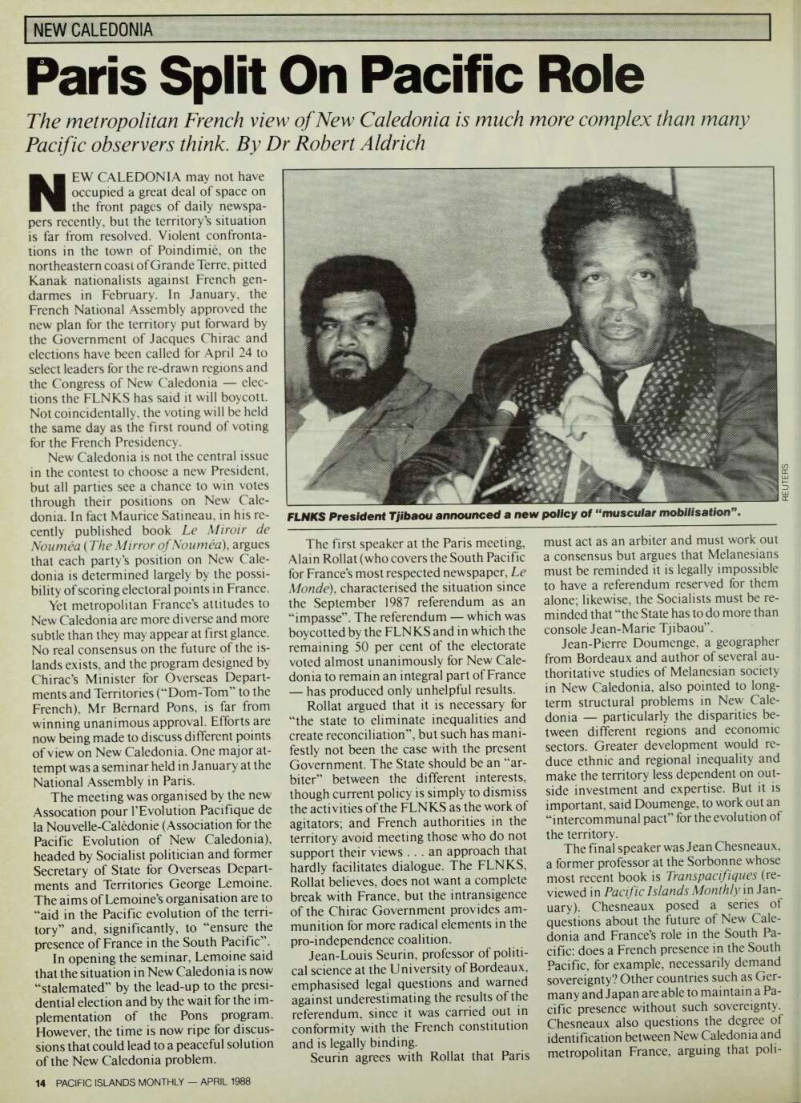
FLNKS President Tjibaou announced a new policy of “muscular mobilisation".
cymakers must reflect on the strategic value Noumea does or does not of fer. (For his part, Chesneaux agreed with Admiral Alexandre Sanguinetti, who was in the audience, that New Caledonia’s strategic value alone is minimal.) These discussions left many questions unanswered, including how a new govern ment whether Socialist or conservative would act. In any case, as Alain Rollat suggested, action of any kind would be dif ficult. Unresolved, too, was the method by which regional and ethnic inequalities could be attacked and how a consenus could be reached. But the talks at least in dicate to an often simplistic Australian media the diversity of opinions that exist in metropolitan France.
In the parliamentary debates on the Pons law in December, the Socialist Party strongly criticised the proposals presented by the conservative Government. The French Communist Party has condemned French “colonialism” in New Caledonia, as has the small Parti Socialiste Unifie and groups on the far left. But even members of the coalition in power particularly several in the UDF, the more moderate partners of Jacques Chirac’s RPR have questioned the Government’s approach.
Demonstrations of support for Kanaks have attracted thousands of participants in Paris and have been endorsed by trade unions, a variety of political parties and by influential individuals.
The different Kanak support groups are generally sympathetic to the FLNKS and independence for New Caledonia, but a second current of opinion, widespread in the Socialist Party and in some parts of the UDF, sees the need for a solution to the New Caledonian question that does not necessarily involve total independence.
The FLNKS is accepted as a legitimate mouthpiece for the Melanesians, though it does not represent the opinions of all Kan aks. Only a redesigned relationship be tween France and the territory, says this “pragmatic” group, can allow a redressing of Melanesian grievances, safeguards for Caldoches and’other groups and a pres ervation of France’s wider interests in the Pacific region.
The starting point for Bernard Pons’ argument, of course, is that New Cale donia is legally part of the French Repub lic and that the referendum of September confirms the desire of the majority of the territory’s population to retain that status.
At the extreme, the French view can become exaggerated and polemical. A new work by French Senator Pierre Lacour, ti tled De I’Oceanic au Pacifique: Histoire et Enjeux {From Oceania to the Pacific: History and Stakes) insists on the “incon testable right of France to be present in the Pacific and to remain there, in spite of the perfidious campaigns of denigration” to which France is subjected. Following the fashionable argument that “the centre of the world is inexorably moving toward the Pacific basin, which is now destined for a
formidable economic development and will soon become the favoured terrain for Big Power struggles”, Lacour demands that France take a strong role in the region. He charges that “Anglo-Saxon” hostility to the French has historical roots and that Aus tralians in particular have tried to thwart France’s ambitions. “We saw this only too well when France and Great Britain re cognised the ‘independence’ of Vanuatu in fact, an Australian protectorate by proxy, which furthermore does not exclude shore rights for Soviet ships. Whence also comes the impudence with which Australia con demns France’s nuclear tests (after having organised them itself) and the incorrect ness or the guilty complicity of New Zea land in welcoming the subversive missionaries of Greenpeace.”
Such is the diversity of French atti tudes. The Pacific and Australasian me
dia have often caricatured the French viewpoint, seeing it as unanimous and hardline. They have ridiculed legitimate French concerns, using the shorthand of “colonialism” as sufficient interpretation.
They have mistakenly reported aspects of French policy and have exhibited a lack of understanding (and lack of interest in) the French political system.
In reality, politicians and scholars in France have a rather more complex and much less unanimous view of the Pa cific and the role that France can and should play in the region. □
Dr Robert Aldrich is Senior Lecturer in Economic History at the University of Sydney and a specialist in French history.
His forthcoming book, The French in the South Pacific 1842-1945, is to be pub lished by MacMillan.