Monsieur Giraud Says “Non!”
p. 11 · Read in the full issue
The Region
France refuses to back down on controversial Pacific policies.
By Larry Writer
Despite the handshakes, the smiles, the ceremony and the gifts, the abiding message from French Defence Minister Andre Giraud at the conelusion of his recent visit to Australia was that his Government and the Australian administration would continue to disagree over France’s Pacific policy.
Mr Giraud and Australian Prime Minister Bob Hawke spent two hours discussing bilateral and regional issues, including French nuclear testing at Mururoa Atoll and French policy in New Caledonia. At the meeting, said Australian officials, the pair had agreed to “bury the hatchet”, so ending officially a year-long freeze in relations imposed by French Prime Minister Chirac after bitter Australian
condemnation of France’s Pacific activities.
Mr Giraud and Mr Hawke each guar anteed that his country was prepared to discuss “any issue at any time”. However, said officials, the pair recognised “that there will continue to be differences of opinion on Pacific issues”. While in Can berra Mr Giraud, the first French Minis ter to visit Australia since 1985, also had talks with his Australian counterpart, Defence Minister Kim Beazley, and act ing Minister for Foreign Affairs and Trade, Senator Evans.
Later, at a sumptuous gathering on board the French navy ship Jeanne d’Arc on Sydney Harbour, Mr Giraud said: “My talks with Mr Hawke were cordial and
successful. We share many common opin ions. There is largely more to unite our countries than to disagree about.” He added that France and Australia “had a vital interest in the Pacific, and so we have the same interests in developing peace and stability in the region.”
However, never during his Australian visit did the French Foreign Minister in dicate that France would make any concession to critics of its Pacific policy.
He explained that France had stepped up its profile in the region to put an end to any “misconceptions” that it was not a legiti mate part of the Pacific. Mr Giraud said France had every right to continue nuclear testing on Mururoa, as the atoll was French territory. He especially discounted criti cism from the South Pacific Forum, which has continually made it clear to France that countries in the Pacific region are against the tests.
Mr Giraud nas a reputation of being the member of the Chirac Government most favourably disposed toward Australia. But in a television interview he bluntly told Australian nuclear opponents to stop in terfering in matters that did not concern them. “France is not thinking of stopping nuclear testing at Mururoa,” Mr Girand said. “It’s not your country; mind your own business.”
When asked whether New Caledonia would always remain part of France, the Minister countered: “Will Tasmania be come an independent country because it is an island?”
While in Australia, Mr Giraud awarded Australian war heroine Nancy Wake the French Legion of Honour medal and in Sydney opened the La Perouse Museum, France’s bicentennial gift to Australia.
There, an anti-nuclear artist thrust a painting into his hands. It was titled: Ura nium You Can’t Have Your Yellowcake And Eat It Too.
There were also demonstrations against the visit of the Jeanne d’Arc. The helicop ter carrier was the target of the Sydney Peace Squadron, Australians For Kanak Independence and the Pacific Peace Fleet.
The Fleet’s spokesperson, Elizabeth Mor ley, said: “We object to the arrogance of French policies in the Pacific. We are also concerned that France is planning a huge increase in its nuclear arsenal just when the US and USSR are reducing theirs.”
At the end of his Australian visit Mr Giraud flew to New Caledonia, where a regional election will be contested on April 24, coinciding with the first round of French Presidential elections. □
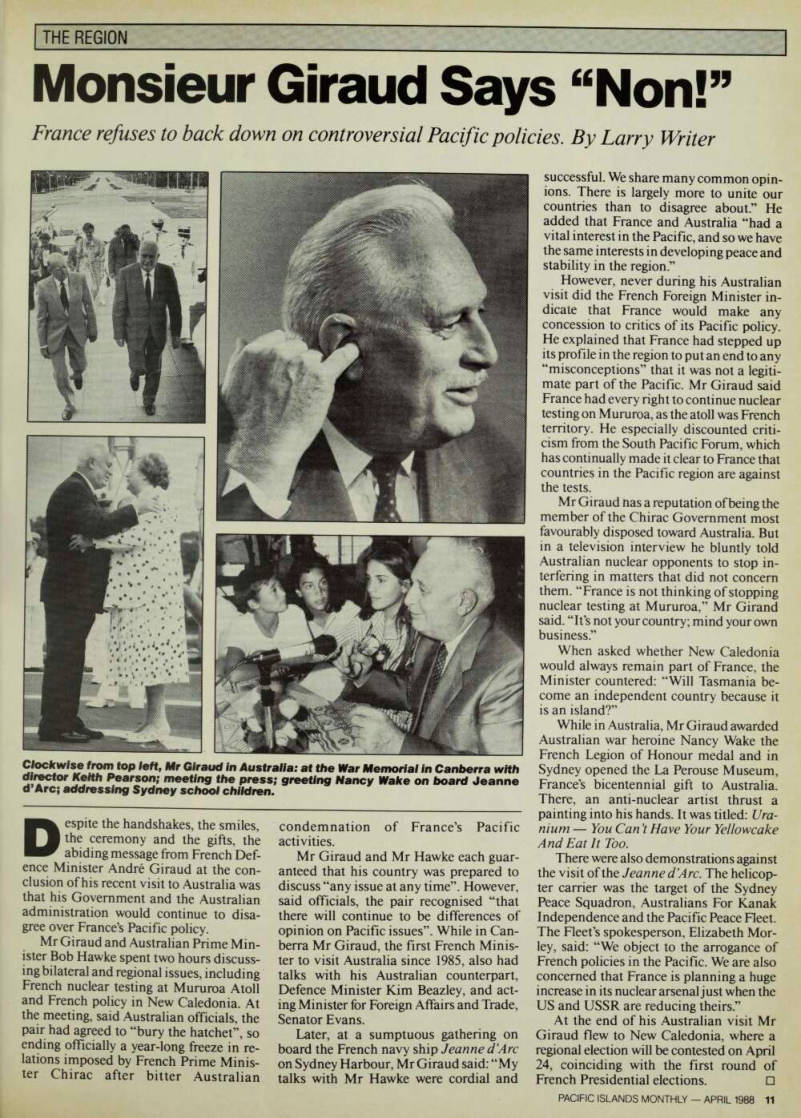
Clockwise front top left, Mr Giraud in Australia: at the War Memorial in Canberra with director Keith Pearson; meeting the press; greeting Nancy Wake on board Jeanne
d’Arc; addressing Sydney school children.