No Confidence: Uses And Abuses
r ER THE election in July last Mjk year, many PNG politicians pro " * posed that certain sections of the Constitution be amended or deleted alto gether. Among these was the provision for votes of no confidence. f u n omi ?’ one the authors o the PNG constitution, said the provi si°n had outlived its usefulness, while the man who had used it most often and who had benefited from it most, Sir Julius C han, says it is a useful tool in the hands ot the people to change bad governments and also to keep those who are in power on their toes. ...
Pnme Minister Mr Wingti will sup port any moves to do away with the pro vision. He told Pacific Islands Monthly, e are waiting for Father Momis to in tr° w? 11 h U P-’’
What, then, is this motion of no con idence and how has it been used over the years since Independence?
Section 145 of the Constitution stipu ates that a motion of no confidence can be moved in the Prime Minister or a min ister provided there is one week’s notice and that it is supported by a number of members not less than one tenth of the to tal number of seats in parliament.
No confidence votes have bedevilled PNG since 1975.
Here is a history of the power play.
A motion cannot be moved 12 months before elections or six months after the for mation of a new government following elections.
The provision was first exercised in August 1978, by the late Sir (then Mr) lam bakey Okuk when he was the Opposition leader. Sir lambakey moved the motion when Mr Somare tried to introduce the controversial leadership code. The vote was never taken. Sir lambakey withdrew it on grounds that he did not have the numbers.
Later that year, however, another party leader, Roy Evans, introduced the motion again. Mr Somare defeated it by 68 votes to 35. In November 1978, Sir Julius Chan’s People’s Progress Party withdrew from Mr Somare’s Government and sponsored Op position leader Sir lambakey Okuk as the alternative Prime Minister. The vote was beaten 63 to 45 by Mr Somare’s Pangu Pati and the United Party, which had defected from the Opposition to join the Government.
In September 1979, Papua Party leader Galeva Kwarara, who was in the Oppo sition, moved another vote of no confi dence in Mr Somare. It was again defeated, this time 63-64.
Finally, in March 1980, the Opposition put up Sir Julius Chan as alternative Prime Minister and parliament for the first time ousted Michael Somare in a vote of no confidence. Mr Somare was beaten 57 to 49 in the vote, taken on March 11.
Mr Somare, then in Opposition, moved his only vote of no confidence in a min ister against Police Minister Warren Dutton in 1981, but was defeated.
The next year the people returned Mi
chad Somare to power in the second na tional elections.
Sir lambakey Okuk moved a vote of no confidence in November 1984 but with drew it as he had done in 1978, and for the same reasons.
In March 1985, Pangu Pati deputy leader Paias Wingti crossed the floor with 15 others, splitting the biggest political party in PNG in half. He was enticed across by Sir Julius Chan, who promptly named him alternative Prime Minister.
Mr Somare defeated the motion with the help of Sir lambakey’s National Party 68 votes to 19.
The Opposition was undeterred. On November 21 1985, Mr Somare fell to a Sir Julius sponsored vote that put Mr Wingti in power. Wingti scored 58 votes to So mare’s 51.
It was a well-planned move. Mr Wingti had 18 months to rule. A vote could not be taken in the first six months. Neither could it be taken in the next 12 months, because they were the 12 months leading to the elections in 1987. It was 18 months of un disturbed political sailing and Mr Wingti used the opportunity to make sure he was returned to power.
During all these protected periods he has proposed drastic changes to the public service and changed the Government’s policy emphasis from the social sector to the economic sector.
His period of freedom from a motion of no confidence expired in January 1988, when the six months’ grace specified by the Constitution lapsed.
April is the first opportunity in 24 months for a motion to be made. The Op position is losing no time. □
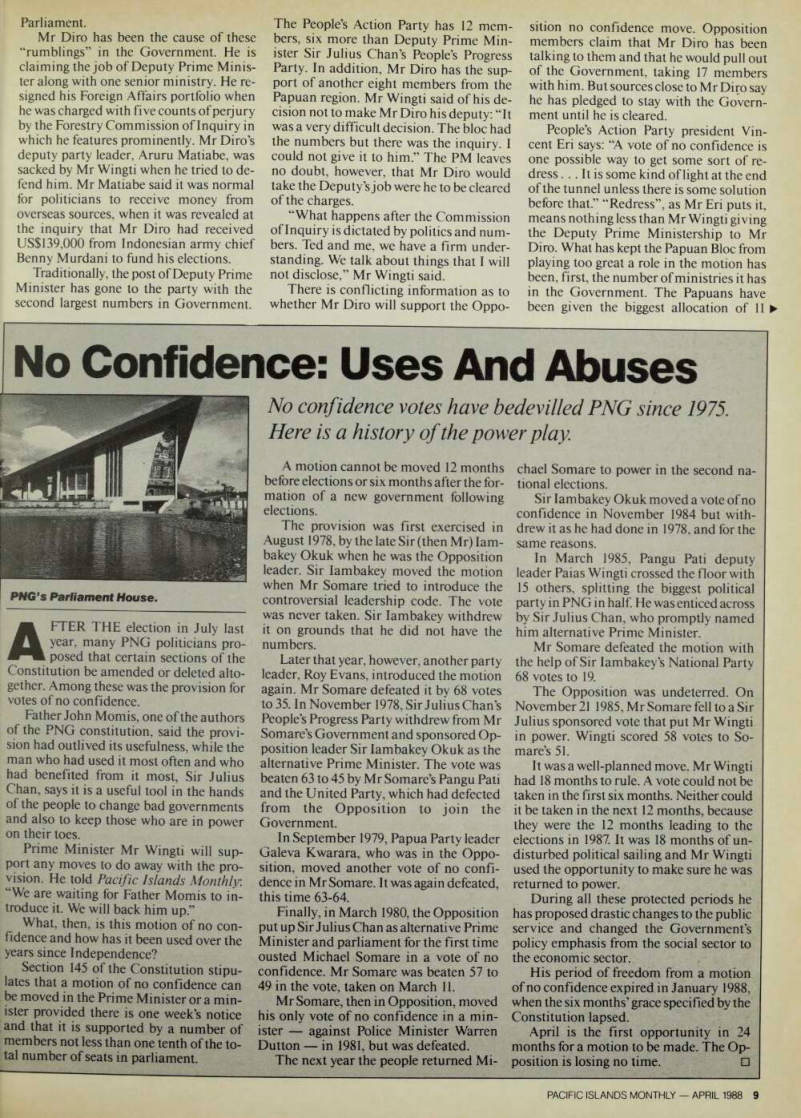
PNG’s Parliament House.