Bid To Sack Wingti
pp. 8-10 · Read in the full issue
Papua New Guinea
Frank Senge examines the PNG Opposition’s bid to oust PMPaias Wingti, and finds a cynical exploitation of the Constitution for personal power.
AMOTION of no confidence in the Government is one of the most fre quently exercised sections of the Papua New Guinea Constitution. It is a mini-election in Parliament, where poli ticians can veto the people’s choice and elect their own government often switching party affiliations with abandon and with no thought for personal integrity or credibility.
The two post-independence govern ments of Michael Somare had eight votes of no confidence moved against it in seven years, from 1978 to 1985. Two succeeded in ousting Mr Somare from office, once in 1980 and again in November, 1985.
Now Mr Somare, for the first time on the opposition benches after an election, is poised to move his own no confidence motion against the nine-month-old Government of Prime Minister Paias Wingti in this month’s sitting of Parlia ment. The Opposition has been planning the motion since last August, when Mr Wingti took government by a three-vote majority. That narrow victory and an other very close vote for the speakership in November 1987, when 14 Government
members voted for the Opposition can didate, has encouraged the Opposition to forge ahead with its plans, despite Mr Wingti’s obvious numerical strength at the moment. The Government coalition has 68 members to the Opposition’s 40.
An Opposition task force called the Policy and Strategy Committee was formed for the purpose of preparing for the no confidence motion. The committee is headed by Mr Somare’s Pangu Pati deputy leader, Rabbie Namaliu, and comprises
parliamentarians from the three Opposition coalition par ties Pangu, National and Melanesian Alliance.
The Opposition has yet to spell out clearly the sins of the Wingti Government that it wants to remedy by removing it from power. But in press statements released in the past the Opposition has accused the Government of making a “bil lion Kina bungle” when it brought down the country’s biggest budget since Independ ence, in November last year. It has charged the Government with not living up to its prom ise to provide free education and diverting K 46 million from the European Economic Com munity targeted specifically for agriculture, toward general items in the budget.
The Opposition has also spoken out against the Govern
ment’s proposed mass media bill, its housing policy, its proposal to place members on sta tutory boards and city councils, and drastic cuts to education and health allocations.
It once announced that if successful it would introduce a mini-budget aimed at shifting the present Government’s empha sis on economic devel opment back to the social sector. However no more has been heard of this particular plan.
It is not at present
certain whether the Opposition will move the no confidence vote in this sitting or at a later meeting.
An Opposition spokesman said: “It will be an eleventh-hour decision. Much of it depends on the rumblings in government.”
The uncertainty arises from the un clear position of the key figure in the Op position’s plans: controversial former Defence Force commander Ted Diro, leader of the People’s Action Party. Mr Diro also heads the Papuan Bloc in
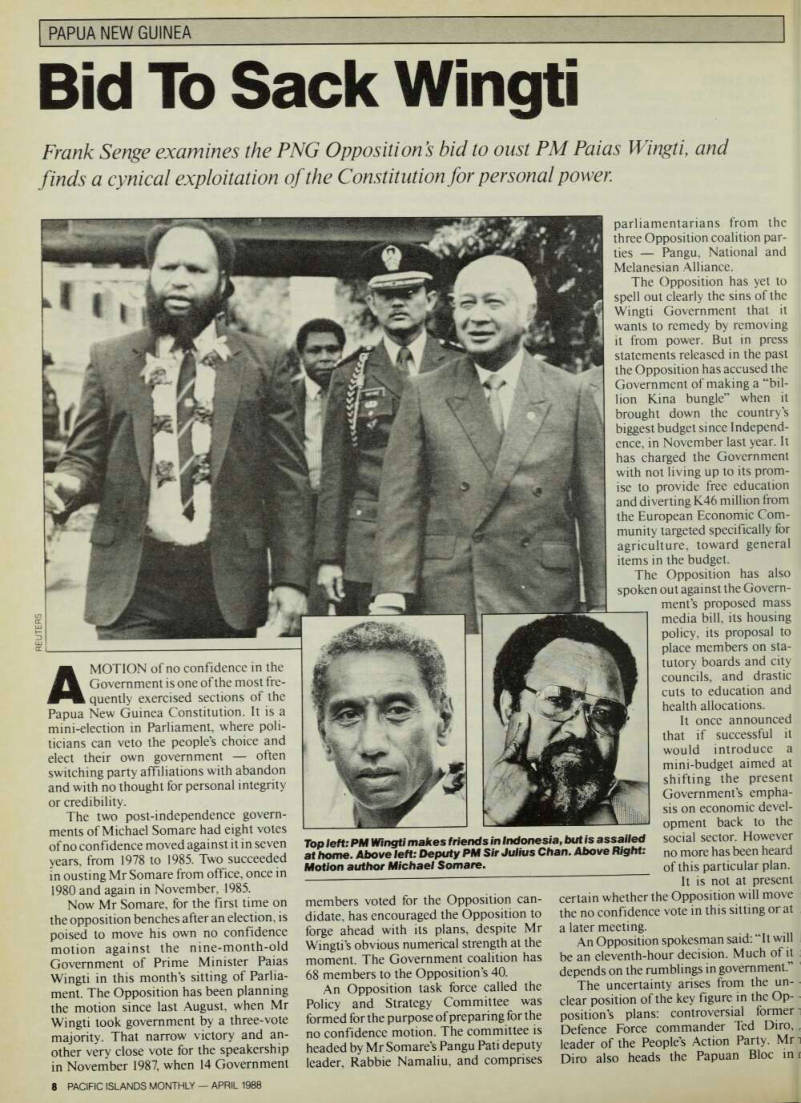
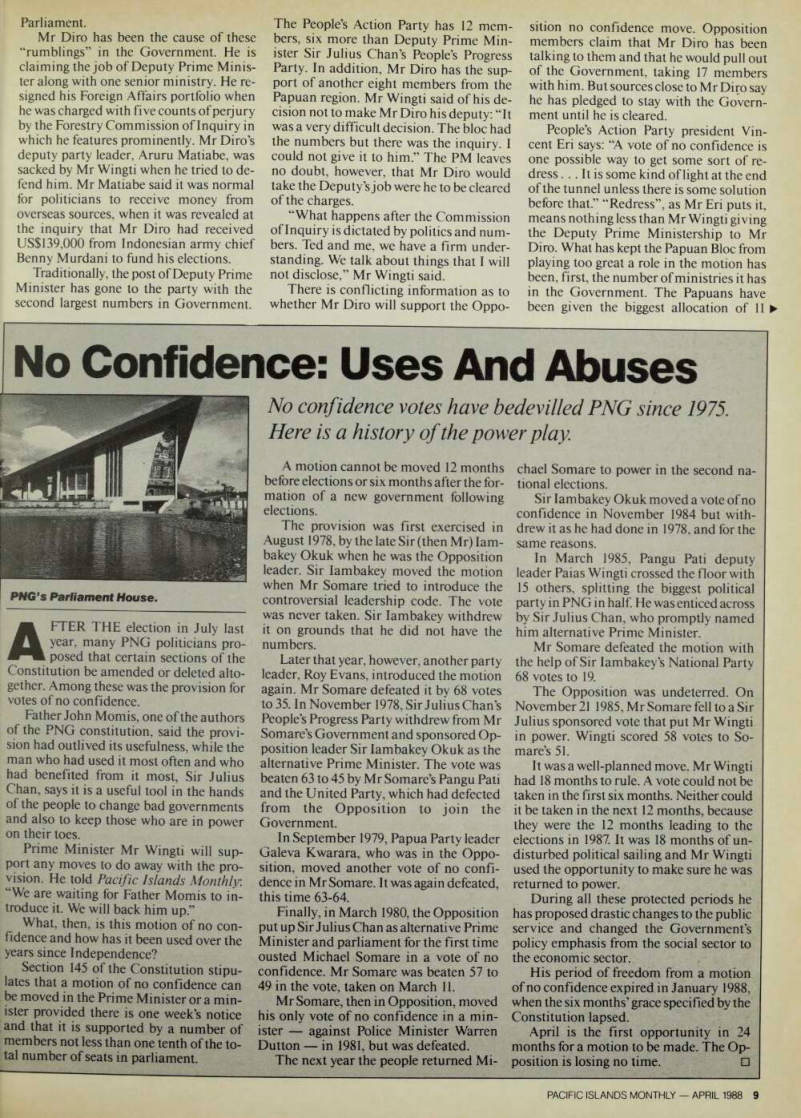
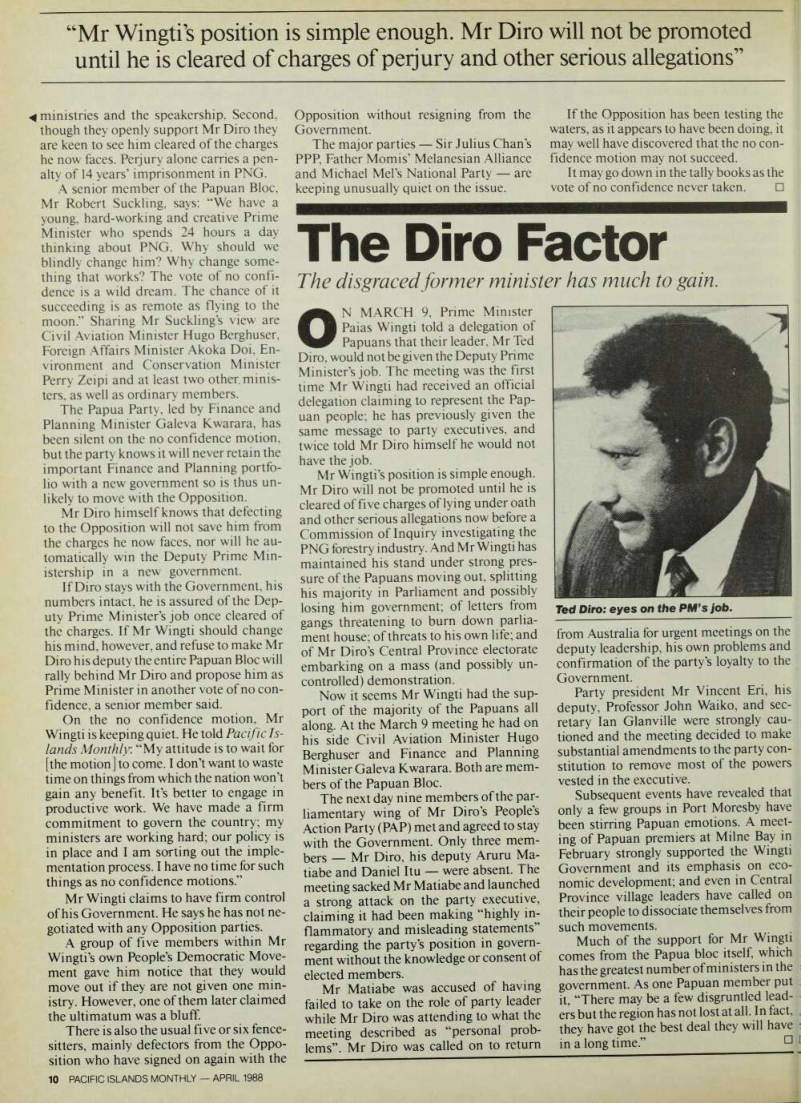
Top left: PM Wingti makes friends in Indonesia, but is assailed at home. Above left: Deputy PM Sir Julius Chan. Above Right: Motion author Michael Somare.
Reuters
Parliament.
Mr Diro has been the cause of these “rumblings” in the Government. He is claiming the job of Deputy Prime Mimster along with one senior ministry. He resigned his Foreign Affairs portfolio when he was charged with five counts of perjury by the Forestry Commission of Inquiry in which he features prominently. Mr Diro’s deputy party leader, Aruru Matiabe, was sacked by Mr Wingti when he tried to defend him. Mr Matiabe said it was normal for politicians to receive money from overseas sources, when it was revealed at the inquiry that Mr Diro had received U 55139,000 from Indonesian army chief Benny Murdani to fund his elections.
Traditionally, the post of Deputy Prime Minister has gone to the party with the second largest numbers in Government,
The Peoples Action Party has 12 members, six more than Deputy Prime Minister Sir Julius Chan’s People’s Progress Party. In addition, Mr Diro has the support of another eight members from the Papuan region. Mr Wingti said of his decision not to make Mr Diro his deputy: “It was a very difficult decision. The bloc had the numbers but there was the inquiry. I could not give it to him.” The PM leaves no doubt, however, that Mr Diro would take the Deputy’s job were he to be cleared of the charges.
“What happens after the Commission of Inquiry is dictated by politics and numbers. Ted and me, we have a firm understanding. We talk about things that I will not disclose,” Mr Wingti said.
There is conflicting information as to whether Mr Diro will support the Oppo-
ssion no confidence move. Opposition members claim that Mr Diro has been talking to them and that he would pull out of the Government, taking 17 members with him. But sources close to Mr Diro say he has pledged to stay with the Govern ment until he is cleared.
People’s Action Party president Vin cent Eri says: “A vote of no confidence is one possible way to get some sort of re dress ... It is some kind of light at the end of the tunnel unless there is some solution before that.” “Redress”, as Mr Eri puts it, means nothing less than Mr Wingti giving the Deputy Prime Ministership to Mr Diro. What has kept the Papuan Bloc from playing too great a role in the motion has been, first, the number of ministries it has in the Government. The Papuans have been given the biggest allocation of II ►
“Mr Wingti’s position is simple enough. Mr Diro will not be promoted until he is cleared of charges of perjury and other serious allegations”
<4 ministries and the speakership. Second, though they openly support Mr Diro they are keen to see him cleared of the charges he now faces. Perjury alone carries a pen alty of 14 years’ imprisonment in PNG.
A senior member of the Papuan Bloc, Mr Robert Suckling, says: “We have a young, hard-working and creative Prime Minister who spends 24 hours a day thinking about PNG. Why should we blindly change him? Why change some thing that works? The vote of no confi dence is a wild dream. The chance of it succeeding is as remote as flying to the moon.” Sharing Mr Suckling’s view are Civil Aviation Minister Hugo Berghuser, Foreign Affairs Minister Akoka Doi, En vironment and Conservation Minister Perry Zeipi and at least two other, minis ters, as well as ordinary members.
The Papua Party, led by Finance and Planning Minister Galeva Kwarara, has been silent on the no confidence motion, but the party knows it will never retain the important Finance and Planning portfo lio with a new government so is thus un likely to move with the Opposition.
Mr Diro himself knows that defecting to the Opposition will not save him from the charges he now faces, nor will he au tomatically win the Deputy Prime Min istership in a new government.
If Diro stays with the Government, his numbers intact, he is assured of the Dep uty Prime Minister’s job once cleared of the charges. If Mr Wingti should change his mind, however, and refuse to make Mr Diro his deputy the entire Papuan Bloc will rally behind Mr Diro and propose him as Prime Minister in another vote of no con fidence, a senior member said.
On the no confidence motion, Mr Wingti is keeping quiet. He told Pacific Is lands Monthly : “My attitude is to wait for [the motion] to come. I don’t want to waste time on things from which the nation won’t gain any benefit. It’s better to engage in productive work. We have made a firm commitment to govern the country; my ministers are working hard; our policy is in place and I am sorting out the imple mentation process. I have no time for such things as no confidence motions.”
Mr Wingti claims to have firm control of his Government. He says he has not ne gotiated with any Opposition parties.
A group of five members within Mr Wingti’s own People’s Democratic Move ment gave him notice that they would move out if they are not given one min istry. However, one of them later claimed the ultimatum was a bluff.
There is also the usual five or six fence sitters, mainly defectors from the Oppo sition who have signed on again with the
Opposition without resigning from the Government.
The major parties Sir Julius Chan’s PPP, Father Momis’ Melanesian Alliance and Michael Mel’s National Party are keeping unusually quiet on the issue.
If the Opposition has been testing the waters, as it appears to have been doing, it may well have discovered that the no con fidence motion may not succeed.
It may go down in the tally books as the vote of no confidence never taken. □