Hawaii
pp. 38-40 · Read in the full issue
THE PAST YEAR has seen a major expansion of aviation in the South Pacific, but nothing has quite matched the explosion in the operation of Hawaiian Airlines, which now offers serv ices to seven destinations out of Honolulu.
At the beginning of 1987 the carrier be gan the first Apia-Honolulu direct serv ice; in March it announced its application to fly into Papeete, Auckland and Raro tonga; in September it gained fifth free dom rights between Rarotonga and Tahiti and, in January 1988, inaugurated its Syd ney-Honolulu service via Pago Pago.
The new services have plugged many of the gaps that have hampered inter-is land travel in the past. The year also saw, among other innovations, Continental open a Guam-Port Moresby service, Air Nuigini a twice-weekly service to Singa pore, Tonga upgrading its airport with the aim of handling 747 s and Thai beginning a Bangkok-Auckland run with New Zea land rights to fly on to two other points in
the Pacific (though Thai has now gone cold on Nadi as one of them). -in the long term we see ourselves as the South Pacific specialist airline,” Hawaiian’s Australian sales director, Gillian Harman, says. The carrier flies to Honolulu from five US west coast cities and from Alaska, a traffic it hopes will provide plenty of business for its South Pacific services.
The extent to which regional air services have proliferated in recent years is exemplified by Apia, an airport serving a population of 161,000, which now has four international airlines using it Air New Zealand, Air Pacific, Polynesian, as well as Hawaiian While Hawaiian is planning 1988 as a year of consolidation after such extraordinary route growth, it does have tentative plans for further expansion: taking up its right to a second weekly flight out of Sydney, negotiating with the Japanese for a Tokyo-Honolulu flight, and, further in the future, services into Nadi.
The airline uses LlOOl Tristars for its Honolulu-US runs, but sticks with refurbished DCS aircraft for the Pacific. These have 16 first class and 194 economy seats, with in-flight entertainment. Hawaiian’s route explosion is partly at the expense of the hapless South Pacific Island Airways (SPIA), though Harman says the company has had Australia and New Zealand in its sights for a long time (Australian rights were granted within 60 days of the application). SPIA, which operated Boeing 707 s from Honolulu to Rarotonga, Pago Pago, Papeete, Nukualofa and Auckland, ran foul of US civil aviation authorities on safety and financial grounds. The emergency rights granted to Hawaiian to fill the vacuum left by SPIA gave it the base it needed to secure air rights for Sydney and Auckland.
Not that Hawaiian has not had its hie-
cups. Hawaiian property developer Chris Hemmeter (who made his fortune build ing resorts such as the Hyatt Regency in Honolulu and the outer islands) thought he had clinched a deal to buy the airline when the sharemarket all but collapsed in October 1987. He had offered SUSSO for each Hawaiian share, quoted on the ex change before the crash for $3O, making the deal worth about $lOO million. But he was then unable to get the backing he needed to meet the January deadline, The company remains in the hands of Hawaiian’s chairman, John H Magoon, who holds 56 per cent of the stock, and President Paul J Finazzo, another sigmf icant stock holder. Magoon, now 72, had made it clear he was interested in selling only to a buyer who was based in the is land group. .
Hawaiian started in 1929 flying eight seater Sikorsky amphibians between Honolulu and the outer islands. It gradu ated to DC3s in 1941 and played a major role in inter-island transport during t e war. It was not until 1984 that Hawaiian Airlines began international services with three DCBs running to Pago Pago and Nukualofa. For the past few years the air line has clearly been anxious to break out of Pago Pago in American Samoa as its southern destination in the Pacitic: while the US territory provided passengers trom American Samoa to the mainland, and transported those who worked the fishing boats out of Pago Pago, the temtory was hardly a tourist paradise.
Pan Am, Continental and American Airlines all tried routing via Pago Pago (and there have been reports that Conti nental is planning to try again). While the place has great natural beauty, there was not a great deal for the tourist to do. The town itself was down-at-heel, the accom modation limited (only one hotel is re garded as up to international standards) ►
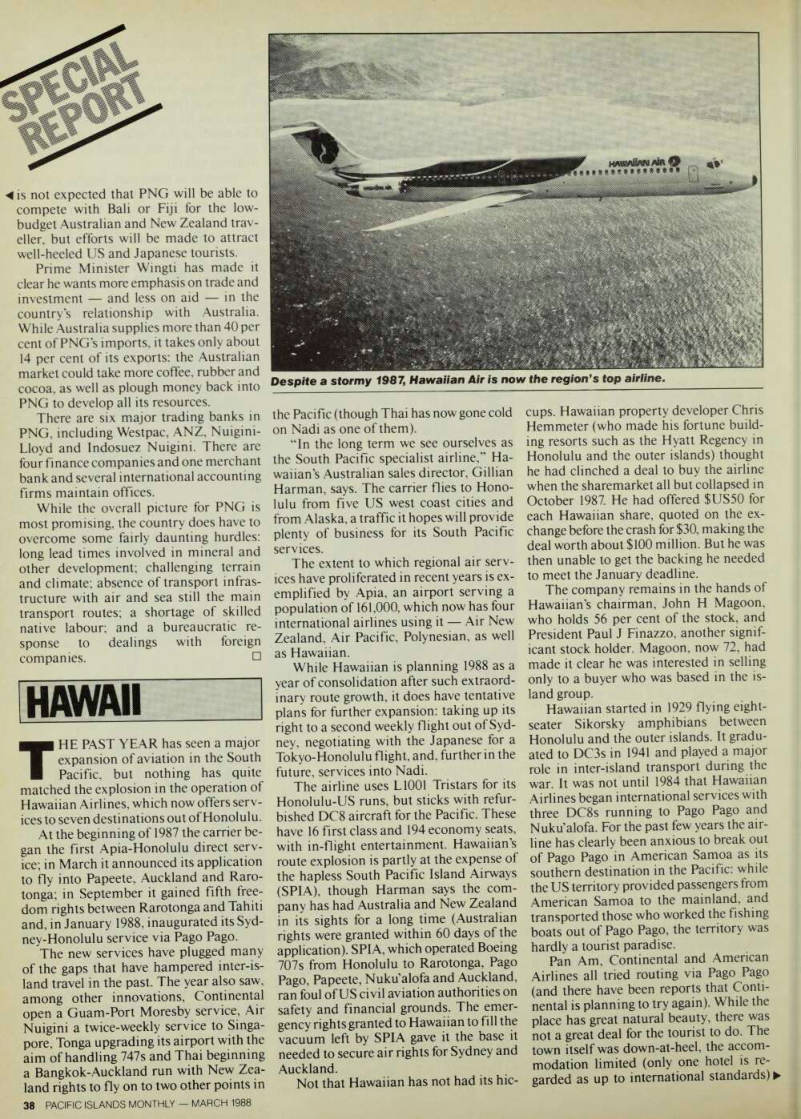
Despite a stormy 1987, Hawaiian Air is now the region’s top airline.
M and those airlines flew on only to Auck land or Sydney.
That is where Hawaiian is different.
From Pago Pago, the American tourist can now fly to Apia, Nukualofa, Papeete and Rarotonga. Pago Pago has a way to go yet before it rivals Nadi as the airline hub of the Pacific, but it is clearly back on the air line map.
Hawaiian now has the ability to offer flights to Australia and New Zealand as well as side trips to the islands (reserva tions for the Cook Islands have risen 70 per cent). Meanwhile, Australians and New Zealanders have been quick to take up the introductory cheap fares $A699 out of Sydney to Honolulu return. The use of older, narrow-bodied jets does not seem to have met any consumer resistance, says Gillian Harman; even first class bookings are good.
As more of the states of the South Pa cific compete for the tourist dollar es pecially the US dollar Hawaiian Airlines is clearly a force to be reckoned with in the region.