Fiji
p. 40 · Read in the full issue
DURING the period of economic restraint following the second mil itary coup, Fiji’s appeal as an ex port market has been severely diminished.
Although figures are not yet available, purchases of foodstuffs and household furniture which account for a large part of Australian and New Zealand exports to Fiji have dropped markedly as the pop ulation husbands its resources in antici pation of lower living standards.
The call-up of reserves to the army during the constitutional crisis mopped up some part of the workforce, but unem ployment is certain to remain high until the economy recovers and the tourists re turn. The Fijian Government’s economic policy will continue to promote the build ing of manufacturing plants for both ex port and import substitution. Late last year, tax-free zones were announced: any enterprise exporting 95 per cent of its pro duction will be designated a tax-free fac tory (as will companies that re-export or supply exporting plants to the extent of 95 per cent of their production) and will pay no excise or customs on equipment, no corporate taxes for 13 years, no taxes on dividends and royalties paid abroad, a preferential eleclicity tariff and other concessions.
It is the garment industry that has been
Fiji’s fastest-growing manufacturing sector, and until the first quarter of 1987 (the latest figures available) it was doubling its exports every six months, accounting for about a third of manufactured exports, Most of the joint ventures in the garment industry involve Australian companies, and the Australian Stafford Group recently announced it would acquire Narotarn Garments of Suva. The garment industry is based on the towns of Suva, Nadi and Lautoka and has taken advantage of duty-free entry to Australia under the Sparteca agreement.
Fiji offers clothing manufacturers the advantage of low wage levels from $F 1.13 to $2 per hour depending on skill) and high quality seamstress work. For the foreign investor Fiji has the additional advantage thal a high proportion of its 715,000 people speak English. Apart from temporary union bans in Australia after the coups, industry and exporters were largely unaffected by the political turmoil.
Other exports expected to grow are fresh fruit and vegetables, timber and sugar while the barely developed seafood industry has huge potential. Several Aus-
tralian companies are now investigating exploitation of Fiji’s fishing resources, For all the talk of greater links with ASEAN nations, Fijis trade in the im mediate future will remain with its tradi tional trading partners. Australia leads the import total in Fiji ($F 166.5 million in 1986), with New Zealand and Japan as the other major suppliers: because of its sugar purchases, Britain was in 1986 Fiji’s big gest customer, buying more than twice the value of exports than the next on the list, Australia. Then followed Malaysia, New Zealand and the United States.
The key to winning in the Fijian mar ket, however, is being in on the ground floor. There is a clear trend to government discouragement of imports and a building of Fiji’s economic base, so major conces sions are already being offered to enter prises prepared to establish themselves m the islands. Foreign companies are now exploring for minerals including gold, copper and manganese.
Fiji is a hub of international air routes, has regular shipping services and the Bank of New Zealand, ANZ, Westpac and Hong Kong & Shanghai maintain branches.
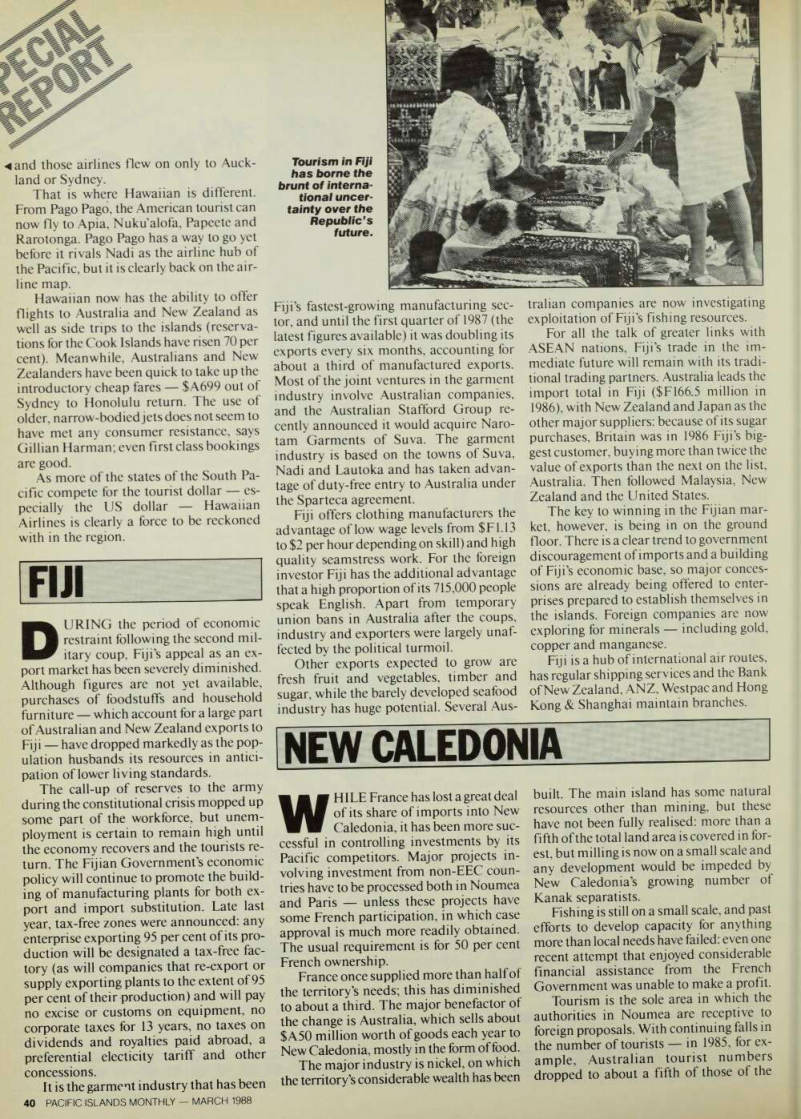
Tourism in Fiji has borne the brunt of interna tional uncer tainty over the Republic’s future.