Papua New Guinea
pp. 37-38 · Read in the full issue
IF ALL the promises held for Papua New Guinea come true, the nation will undergo an economic transformation in the next decade: one trading bank has predicted a 5.9 per cent real growth in GDP in 1989 alone.
Significant business opportunities ex ist: in mining, forestry, tourism, fishing and manufacturing. But 85 per cent of the population is still engaged in subsistence farming and it is only when agriculture moves into the cash cropping area that there will be an explosion in consumer de mand. The Bank of PNG recently re ported that a good coffee harvest and high bounty payments in the Highlands led to a burst of consumer spending that contin ued well into 1987.
The Government is placing heavy em phasis on rural development both to raise living standards in the country to stop the drift to the cities, and to cushion the economy from falls in mineral prices.
There has been much less emphasis on manufacturing, though there is great scope for import substitution. The main prob lem in encouraging secondary industry remains the shortage of skilled labour.
PNG’s economic future will, however, revolve around its mining. Gold contrib uted 46.3 per cent to total exports in 1987, with copper expected to make an increas ing contribution to exports over the next few years.
There is talk of PNG producing more gold than Australia by the year 2000. There are several new projects that will help lift gold production the Midima mine, which is already ready to come on-stream; the Lihir mine, which could begin pro duction in 1991 if feasibility studies prove positive; and studies of the Porgera gold mine are almost complete.
Oil prospecting is the next great hope for PNG, but many other minerals may exist in economic quantities, among them chromium, nickel, lead, silver, mercury and manganese.
Manufacturing has been relatively ne glected (in 1985 manufactures accounted for just 10.8 per cent of exports) while the dream of a mineral bonanza and rural re construction has been high on the Government agenda. A white paper on manufacturing was issued in 1984 and there are plant installation incentives for foreign investors.
A few companies have initiated local manufacture in recent years a paint fac tory and foundry are examples and there has been talk of setting up an industrial zone. Skilled workers, who are in short supply, are paid about SAIOO a week and unskilled workers about SA7O; competi tive even with wages in the major East Asian economies. But most skills still have to be imported in the form of expatriate workers.
Nevertheless, with a population of more than 3.5 million, PNG is a sizeable market for consumer products: opportunities are good for those serving a localised market with a strong continuing demand, such as food and beverage manufacture.
The Pactra and Sparteca agreements provide for largely free access of PNG products into Australia and New Zealand and if PNG pulls off its attempt to gain full membership of Asean, the whole picture will change.
As Asian timber producers reduce exports after massive depletion of their re-
sources, PNG is poised for a rapid increase in production. About 40 million hectares are forested and about eight million hec tares (estimated to contain more than 400 million cubic metres of commercial tim ber species) available for immediate de velopment. Exports of forest products exceeded K9l million in 1985 Japan took logs and woodchips and Australia and Canada veneers, with Australia and New Zealand being the largest market for lumber.
It has been estimated that PNG’s fish ery resources could yield up to half a mil lion tonnes each year, though fish exports in 1986 amounted to just over 2000 tonnes.
Japan had a fishing agreement with PNG, but this was not renewed after a disagree ment over the price to be fixed and apart from US tuna fishing, fishing remains at a low level of activity. There is a huge lobs ter resource in the Gulf of Papua, and it has been estimated by the Government that 180,000 tonnes of skipjack tuna can be harvested each year without depleting the stock. Prawns and barramundi are also
present in commercial quantities.
The PNG Government will provide in centives to companies setting up process ing plants on the coasts, and wants to see a domestic fleet established. It is an ob vious area for foreign investment and, un like much of the timber and minerals of the country, is not located in regions of difficult terrain.
Tourism is untapped, largely because of the high cost of flying to and within the country. But international air services are improving: Qantas and Air Nuigini run frequent flights from Australia and Air Nuigini also flies to Singapore and Ma nila. Continental has established a service to Port Moresby from Honolulu via Guam.
Because of high air fares and the cost of servicing tourists (all food and drink, for example, must be flown to the resorts), it ►
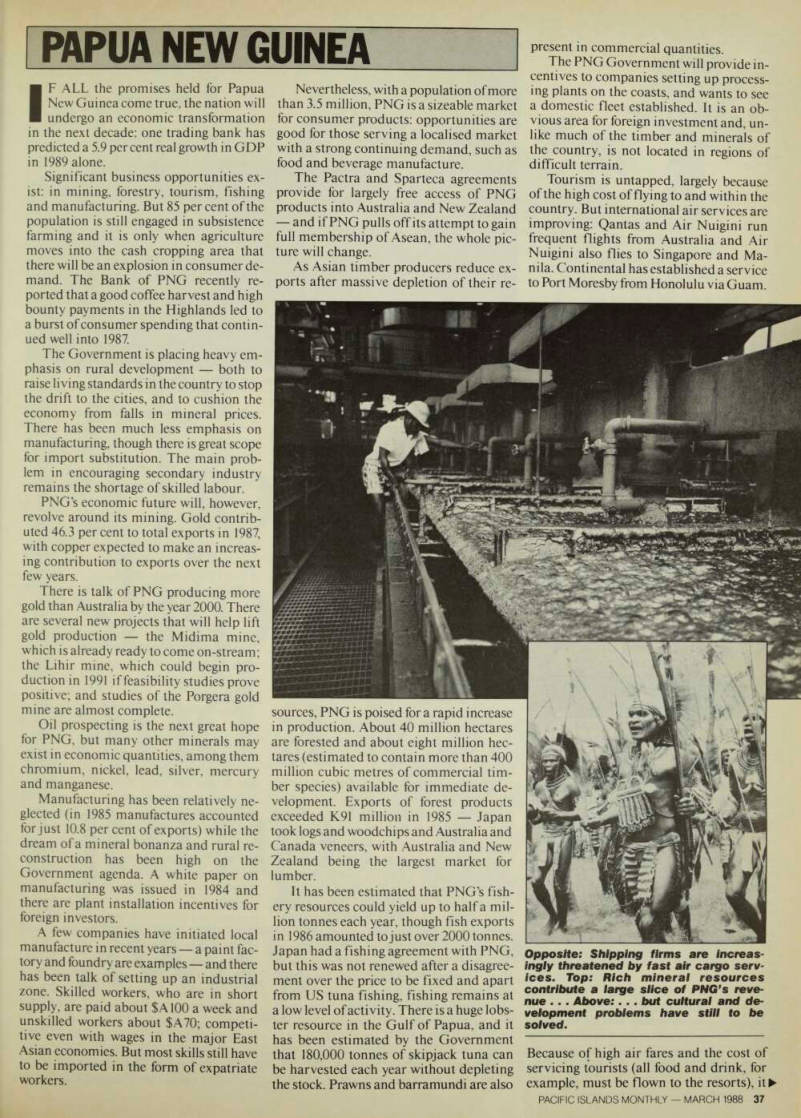
Opposite: Shipping firms are increas ingly threatened by fast air cargo serv ices. Top: Rich mineral resources contribute a large slice of PNG’s reve nue ... Above:... but cultural and de velopment problems have still to be solved.
◄ is not expected that PNG will be able to compete with Bali or Fiji for the low budget Australian and New Zealand trav eller, but efforts will be made to attract well-heeled US and Japanese tourists.
Prime Minister Wingti has made it clear he wants more emphasis on trade and investment and less on aid in the country’s relationship with Australia.
While Australia supplies more than 40 per cent of PNG’s imports, it takes only about 14 per cent of its exports: the Australian market could take more coffee, rubber and cocoa, as well as plough money back into PNG to develop all its resources.
There are six major trading banks in PNG, including Westpac, ANZ, Nuigini- Lloyd and Indosuez Nuigini. There are four finance companies and one merchant bank and several international accounting firms maintain offices.
While the overall picture for PNG is most promising, the country does have to overcome some fairly daunting hurdles: long lead times involved in mineral and other development; challenging terrain and climate; absence of transport infras tructure with air and sea still the main transport routes; a shortage of skilled native labour; and a bureaucratic re sponse to dealings with foreign companies. □