Maori Land Fight
pp. 12-13 · Read in the full issue
Maoris call for reinforcements as battle hots up.
By Jack Kelleher
EVER since Maori chiefs and Euro pean settlers signed a sovereignly and protection agreement at Wai langi in the Bay of Islands in 1840, Maoris have been concerned about the Europe ans’ understanding of Maori land and shoreline (fishing) rights: wars have been fought between them over land. Now one tribe, the Ngati Te Ata from south of Auckland, has gone international by bringing a United Nations specialist to New Zealand and by its decision to attend a UN meeting in Geneva when the rep resentative reports on her visit.
The Ngati Te Ata brought Professor Er ica-Irene Daes, chairperson of the United Nations working group on indigenous populations, from Australia where she was studying the status of Aborigines. Ngati Te Ata asked her to observe continued pol lution of Manukau Harbour, south of Auckland, and iron-sand mining by the NZ Steel Mining Co at the site of tnbal burial grounds. Other tribes joined in the briefing on the five-day tour of contested Maori land.
After a meeting with Associate Foreign
Minister Fran Wilde, Professor Daes re- ported “great understanding” with the ; minister on many issues. She said the t government of New Zealand was prepared t to consider further support and protection r of human rights of the Maori people, and t indicated certain procedures she thought t would be helpful. The minister said theyy had discussed the history of Maori landfc claims back to the signing of the Treaty ofh Waitangi, as well as efforts to preserves Maori language and culture.
On the mining issue, Ms Wilde saidb present legislation was not strong enoughrl to protect sites that should be protected. AA review of historic places would be com-r pleted this year.
The tribe subsequently resolved to sencbi a member, Mrs Nganeko Minhinnick, toj Geneva to observe a meeting of the UM Commission on Human Rights and lot monitor the Daes report on New Zealandb The professor had recommended that thor Maori people state their case to the Uniteoe Nations and said it was possible she migh rl return Ngali Te Ata also decided to havtv a member affiliated to the Americans
Indian Treaty Council (recognised by the UN) and to seek representation of other tribes to provide a national platform.
Meanwhile, old land issues have resurfaced in the Tauranga district, a forestry trade outlet and retirement stretch on the Bay of Plenty northeast of Rotorua. Forced sale of a block of land raised questions in Maori minds about its status at a time when even a town hall had been occupied as a signal of Maori determination to
revive historic land claims. The owners of the block and a chief of the hapu or sub tribe involved, Ngati Tamawhariua, agreed to remain off the land pending consider ation of the case in Wellington in Febru ary. The block was part of 47,385 hectares of land confiscated in 1865: much of the land is now Tauranga City.
Many land disputes concern the legal ity or fairness of old confiscations, and of sales some Maoris argue could not have
involved contemporary signatories in per petuity, where land was tribal, and which could not have involved fishing rights that were specifically protected by the treaty.
Settlers seeking land had found some chiefs eager to barter anything for guns they could use for protection against (or for settling old scores with) other tribes; the settlers had little insight into tribal tradi tions and the rights of anyone in a tribe to sell access to food.
Some Maori land negotiators in the south of the North Island were more as tute than historians have acknowledged.
These chiefs sold blocks on condition that one tenth was to be held in trust for the fu ture benefit of the chiefs and their heirs.
This agreement, dated from a deed of 1839 between the New Zealand Land Company and 16 chiefs, is still being enforced in claims in Wellington, Taranaki, Mana walu and Nelson provinces.
One of the tenths involves Athletic Park, New Zealand Rugby Union head quarters, operated on peppercorn rental.
It highlights the claimants’ assurance that some of the land could hardly be returned, and that the ancestors would accept land elsewhere in New Zealand or cash com pensation. Such a claim, lodged in Wel lington early in January, is the largest to go before the Waitangi Tribunal that is cre ating precedents for new thinking and de cision-making on Maori rights. □
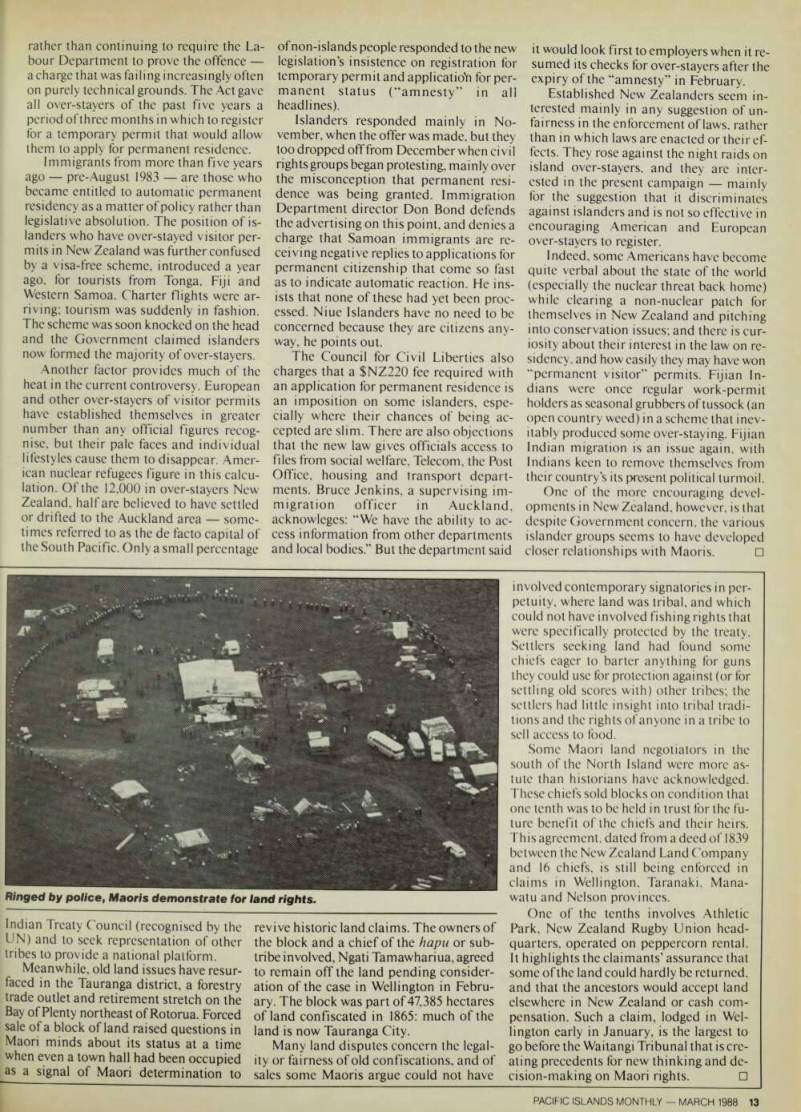
Ringed by police, Maoris demonstrate for land rights.