Target: Illegal Immigrants
pp. 12-13 · Read in the full issue
New Zealand
A Government crackdown on over-stayers.
By Jack Kelleher
MANY thousands of Pacific is landers, most from Tonga and Western Samoa, face deporta tion from New Zealand for over-slaying visitor permits. Many have been in the country for years and have settled into communities and jobs. They have been smoked out by an apparent amnesty that offered a type of permit in return for ille gal settlers registering.
The permit was attractive in that it gave the immigrant immediate legality. But it was temporary a “gift of lime”, as one immigration officer puts it, to apply for permanent residence. If years on the run had caused them to be overawed by the novelty of becoming legal, even for a few months, it did seem to be understood by some that an interim legitimacy was in volved and that it would need to be con firmed later.
What has blurred the issue for many of the islanders is that the New Zealand me dia referred to the whole offer as an "am nesty” as if permanent residence were available from initial registration, though the Government publicity was never so sweeping. And islanders who read on and who understood the temporary permit was intended to give them only lime and op portunity to apply for permanent resi dence, didn’t seem to realise they would have no head start with such an applica tion; that they would have to meet routine requirements which could involve a specific skill as listed from lime to lime, qualification under "family reunion” reg ulations or sponsorship by other family members.
Islanders are more likely to qualify un der family and race assimilation provi sions than they are by skill: many have won employment but not in those skilled oc cupations that cause the NZ Government to seek immigrants worldwide.
The Government inliative has seen nothing like the uproar of night raids by immigration officers accompanied by po lice of a decade ago, when suspected ille gal immigrants were confronted in their homes before dawn, mostly in the semi-in dustrial suburbs of cities where ghettos were forming. The Labour parliamentary opposition of the day joined in a clamour that persuaded authorities to be more civilised.
Labour in government is more effec tive. Last year it passed a new Immigra tion Act that owed something to an earlier National bill heavily criticised in both the community and Parliament. The bill re quired over-stayers to prove innocence
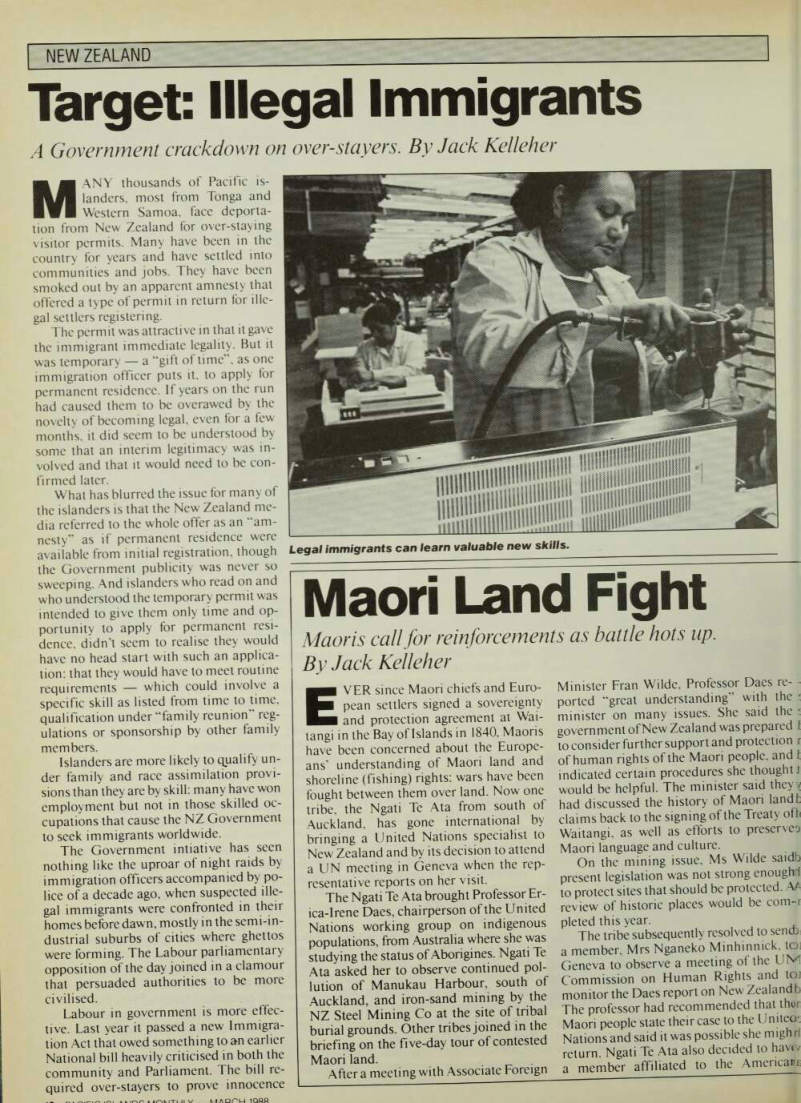
Legal immigrants can learn valuable new skills.
rather than continuing to require the Lahour Department to prove the offence a charge that was failing increasingly often on purely technical grounds. The Act gave all over-stayers of the past five years a pcnodoflhree months in which to register for a temporary permit that would allow them to apply for permanent residence.
Immigrants from more than five years ns 0 pre-August 1983 are those who became entitled to automatic permanent residency as a matter of policy rather than legislative absolution. The position of islanders who have over-stayed visitor permils in New Zealand was further confused by a visa-free scheme, introduced a year ago, for tourists from Tonga, Fiji and Western Samoa. Charter flights were arriving; tourism was suddenly in fashion, The scheme was soon knocked on the head and the Government claimed islanders now formed the majority of over-stayers.
Another factor provides much of the heat in the current controversy. European and other over-stayers of visitor permits have established themselves in greater number than any official figures recogmse, but their pale faces and individual lifestyles cause them to disappear. American nuclear refugees figure in this ealeulation. Of the 12,000 in over-slayers New Zealand, half are believed to have settled or drifted to the Auckland area sometimes referred to as the de facto capital of the South Pacific. Only a small percentage
of non-islands people responded to the new legislation’s insistence on registration for temporary permit and application for per manent status (“amnesty” in all headlines).
Islanders responded mainly in No vember, when the offer was made, but they too dropped off from December when civil rights groups began protesting, mainly over the misconception that permanent resi dence was being granted. Immigration Department director Don Bond defends the advertising on this point, and denies a charge that Samoan immigrants are re ceiving negative replies to applications for permanent citizenship that come so fast as to indicate automatic reaction. He ins ists that none of these had yet been proc essed. Niue Islanders have no need to be concerned because they are citizens any way, he points out.
The Council for Civil Liberties also charges that a SNZ22O fee required with an application for permanent residence is an imposition on some islanders, espe dally where their chances of being ac cepted are slim. There are also objections that the new law gives officials access to files from social welfare, Telecom, the Post Office, housing and transport depart ments. Bruce Jenkins, a supervising im migration officer in Auckland, acknowleges; “We have the ability to ac cess information from other departments and local bodies.” But the department said
it would look first to employers when it re sumed its checks for over-stayers after the expiry of the “amnesty” in February.
Established New Zealanders seem in terested mainly in any suggestion of un fairness in the enforcement of laws, rather than in which laws are enacted or their ef fects. They rose against the night raids on island over-stayers, and they are inter ested in the present campaign mainly for the suggestion that it discriminates against islanders and is not so effective in encouraging American and European over-stayers to register.
Indeed, some Americans have become quite verbal about the stale of the world (especially the nuclear threat back home) while clearing a non-nuclear patch for themselves in New Zealand and pitching into conservation issues; and there is cur iosity about their interest in the law on re sidency, and how easily they may have won “permanent visitor” permits. Fijian In dians were once regular work-permit holders as seasonal grubbers of tussock (an open country weed) in a scheme that inev itably produced some over-slaying. Fijian Indian migration is an issue again, with Indians keen to remove themselves from their country’s its present political turmoil.
One of the more encouraging devel opments in New Zealand, however, is that despite Government concern, the various islander groups seems to have developed closer relationships with Maoris. □