Torres Strait
pp. 10-11 · Read in the full issue
Islands
Torres Strait On The Brink
Australian PM Bob Hawke refused the islanders’ bid for independence.
Now the scene seems set for a secession showdown between the islands and their “mother” country.
By Larry Writer
IT WAS ONE birthday present Aus tralia could have done without. As the nation was letting its hair down in preparation for the Bicentenary celebra tions on January 26, its leaders were rocked by a bid by Torres Strait Islanders to secede.
A group of 400 elders representing communities on 15 islands notified the Australian Government of its non-nego tiable bid for independence. The drastic move, they said, was necessary to main tain the identity of the islanders. Saying they were ignored and neglected and that their islands were being destroyed by out side economic interests, the group also de manded multi-billion dollar compensation from Australia.
The islands, annexed by Australia m 1879, stretch from Cape York to Papua New Guinea and have a population of about 25,000, mostly of Melanesian ori gin. Australia is well aware of the Torres Strait Islands’ considerable strategic and economic potential. They lie above gas and oil basins, as well as the Indian Ocean-Pa cific Ocean exchange current with its tre mendous power generation potential.
The chairman of the Torres Strait Is lands Co-Operative Council, Mr George Mye, said secession was the only alterna tive after “50 years of neglect by Aus tralian governments and being ignored by the present Prime Minister, Mr Hawke.
Mr Hawke in turn accused the island
ers of taking blatant advantage of Aus tralia’s bicentennial celebrations to launch their bid for independence, and added that the bid had no chance of success. He then sent the Minister for Aboriginal Affairs, Mr Gerry Hand, to the islands to hear the islanders’ grievances.
The islanders interpreted this as a per sonal slight and professed “anger and dis appointment” that the PM would not visit the islands himself. Said acting chairman of the Torres Strait Islanders’ Council, Mr Getanto Lui Jnr, “We feel it is a very ir responsible attitude by the Prime Minis ter because he did not come up with an alternative [to our demands]. By rejecting our demands outright, we feel he is reject ing the islanders as part of Australia, anyway. It is time Mr Hawke sat up and took notice of what we are about.”
The executive chairman of the Torres Strait Independence Working Party, Mr Jim Akee, called Mr Hawke’s attitude “mental and moral thuggery” and blamed the Australian Prime Minister for a heart attack suffered by Mr Mye.
When Mr Hand arrived in the Torres Strait Islands, the secessionist leaders pre sented him with their grievances. They complained that since annexation their lands had been despoiled and desecrated by foreign economic interests; that it was difficult for islanders to find jobs as most positions were filled by Asians and Euro peans; and that outside interests had made no attempt to understand or respect tra ditional Torres Strait Islands culture, grouping islanders and Australian Aborig ines together for bureaucratic convenience.
The islanders told Mr Hand that they
Aboriginal Affairs Minister Gerry Hand was rushed north to reason with the islanders
had been neglected and oppressed in re turn for turning over their lands and re sources to outsiders. They said they had no control over their welfare, particularly in regard to the granting of mining leases and commercial fishing operations, and that electricity, sewerage and housing were inadequate. Finally, the irate islanders upped their compensation demand from the original SA3 billion to SAS billion and stressed to Mr Hand that they would not retreat from their independence call.
Said the Torres Strait Independence Working Party’s Mr Jim Akee: “Mr Hand came here convinced we were all bluff.
Now he knows we are not open to offers.
We want to talk to Mr Hawke, we want im mediate autonomy and identification as an independent nation.”
Mr Hand met with Mr Hawke on his return to Australia. Mr Hawke’s response was flatly to reject the islanders’ inde pendence claim, calling it “unrealistic”.
However, he said he would establish an in ter-departmental committee to conduct an urgent investigation into the islanders’ so cial and economic concerns.
He conceded that the islanders had many “obviously legitimate” grievances, including lack of basic services, exploita
tion of fisheries resources and growing numbers of PNG immigrants. The issue of greater autonomy for the islands would also be examined. Mr Hawke said he would visit the islands when the committee’s work was completed, possibly in a few months’ time.
Should the Torres Strait Islanders suc ceed in their secession bid, they would stand to lose Australia’s SA2O million per year investment in the islands, as well as unemployment and child welfare pay ments. But it is understood pro-secession ists would hope to enjoy financial patronage of the sort Australia has granted to PNG since that nation’s independence.
This, they believe, would open the way for a re-emergence of traditional culture and the replacement of Asian and European administrators by native islanders.
Significantly and ominously for secessionists who had hoped for support from the South Pacific Forum Melane sian Spearhead leader, PNG Prime Min ister Paias Wingti, is unsympathetic to the islanders’ plight. Mr Wingti has said he considers the issue an internal matter for the Australian Government to resolve. He said his Government would not hold talks with the secessionist leaders. □
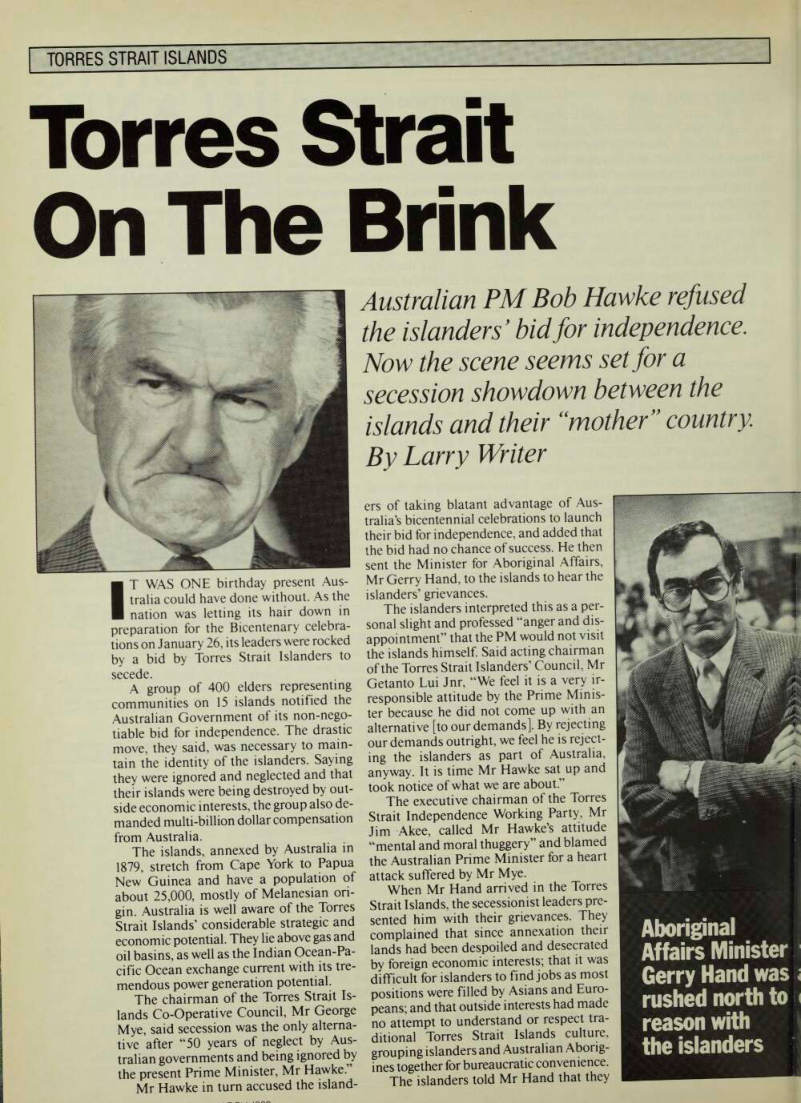
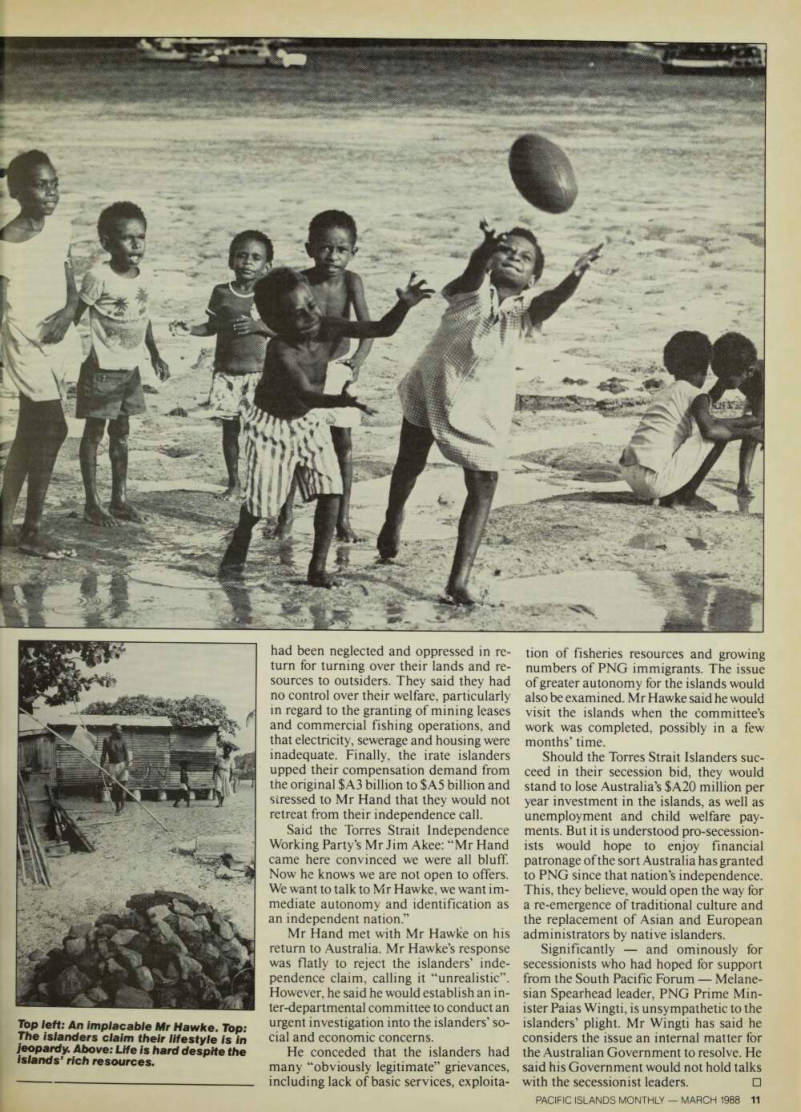
Top left: An implacable Mr Hawke. Top: The islanders claim their lifestyle is in jeopardy. Above: Life is hard despite the islands’ rich resources.