The Rush To Recognition
pp. 14-15 · Read in the full issue
Fiji
Australian and US aid plans balance erosion of media freedom and civil rights.
EVENTS IN the Republic of Fiji over past weeks reflect a continuing de cline in human rights, balanced by recent announcements of aid to flow to those Fijians who need it most.
The political and economic situation is serious; overall economic indicators have improved and sugar production has in creased, but markets have contracted and Fiji’s dependence on one major primary industry has made it a natural target for nations and ideologies seeking a stronger presence in the Pacific. Official state ments provide little comfort to those in vulnerable positions, and unemployment in a nation that has no unemployment re lief has forced many into realising the emptiness of a call to return to traditional ways and economies. Tourism is in de cline, with numbers reduced and those who do come from Australia and New Zealand spending far less than their pred ecessors; as well, major investors have withdrawn from planned developments and replacements are proving hard to find.
Public discussion even public awareness will suffer with the Govern ment’s announcement of laws to control the country’s media through a system of lic ences designed to prevent “irresponsible reporting” that might incite “racial feel ings and social tension”, according to the Fiji Post.
The announcement came soon after seven Government decrees that, as well as regulating internal matters such as ex penditure and the structure of the police force, judiciary and civil service, gave no tice of major changes in the conduct ot public affairs. Members of the then Royal Fiji Military Forces have been munity from prosecution in any civill or criminal matters arising from the 1V»/ coups. Fijian citizens will no longer be able to seek redress for assault, wrongful arrest or destruction of property during the coups and their aftermath, Full executive power is to be vested in the President, Ratu Sir Penaia Gamlau, who will have all the powers formerly ex ercised by the Governor General, The legal system is to be extensively al tered, with the current Supreme Court dis banded and replaced by a nine-member High Court whose makeup is yet to be an nounced. The Court of Appeal is to be maintained, but a new Supreme Court will take the place of the Privy Council m Lon don as Fiji’s final court of appeal, The net effect of the decrees, say F.ji ans who have left the country, will be to concentrate ethnic Fijian control of the nation’s affairs, further removing minor ities from power or licence to seek com pensation and entrenching the role of the Great Council of Chiefs. The Ministry of
Information in Suva has stated that the decrees are only temporary, and that they are “essential to create confidence and stability” while the country’s new consti tution is prepared. They “reflect the Government’s awareness of the people’s determination to return to normal life,” says the Ministry, and that with increased international financial confidence, “the tourists, investors, aid donors, trade and international moneylenders [are] ex pected to follow ”
Former Supreme Court judge Mr Jus tice Kishore Govind, however, has criti cised the decrees and the Ministry of Information’s assertion that they are de signed to promote confidence in human rights in Fiji. He said in Sydney where he had flown with his family after they had received anonymous threats in Suva that he would consider returning to Fiji and to the bench only after the military had been demobilised and full democracy had been restored.
A few days after Justice Govind’s call for a return to democracy, three members (one aged 72) of the Taukei movement made a farcical attempt to take over Radio Fiji, armed with a traditional war club they had stolen from the Fiji Museum. Threat ening bloodshed if they were not given air time to announce their intention of taking over the country, the three were soon over powered and removed by police. One, 30year-old lawyer Kitione Vuetaki, told a Suva court at a committal hearing that the authorities had no right to prosecute him because “the real authority rests with the Great Council of Chiefs”.
In further developments, the Govern ment released 162 prisoners jailed for “political offences” during the period be tween the election of the Bavadra Govern ment and the October 7 declaration of Independence, but did not define^ what constituted a “political offence . A spokesman for the Coalition Government said 21 of the 23 former ministers were out of work and that no-one would employ them for fear that they would be seen to be sympathetic to non-Melanesian Fijians.
Many of those who would like to leave Fiji have been prevented by a blacklist at first denied, then admitted by the Government that seeks to control the overseas movement of potentially critical Fijians, whether Melanesian, Indian or European. Among them was Robert Keith- Reid, publisher of Islands Business mag azine, who was at first prevented from leaving Fiji on a business trip but was fi nally allowed to board his aircraft after a heated discussion with officials. Many
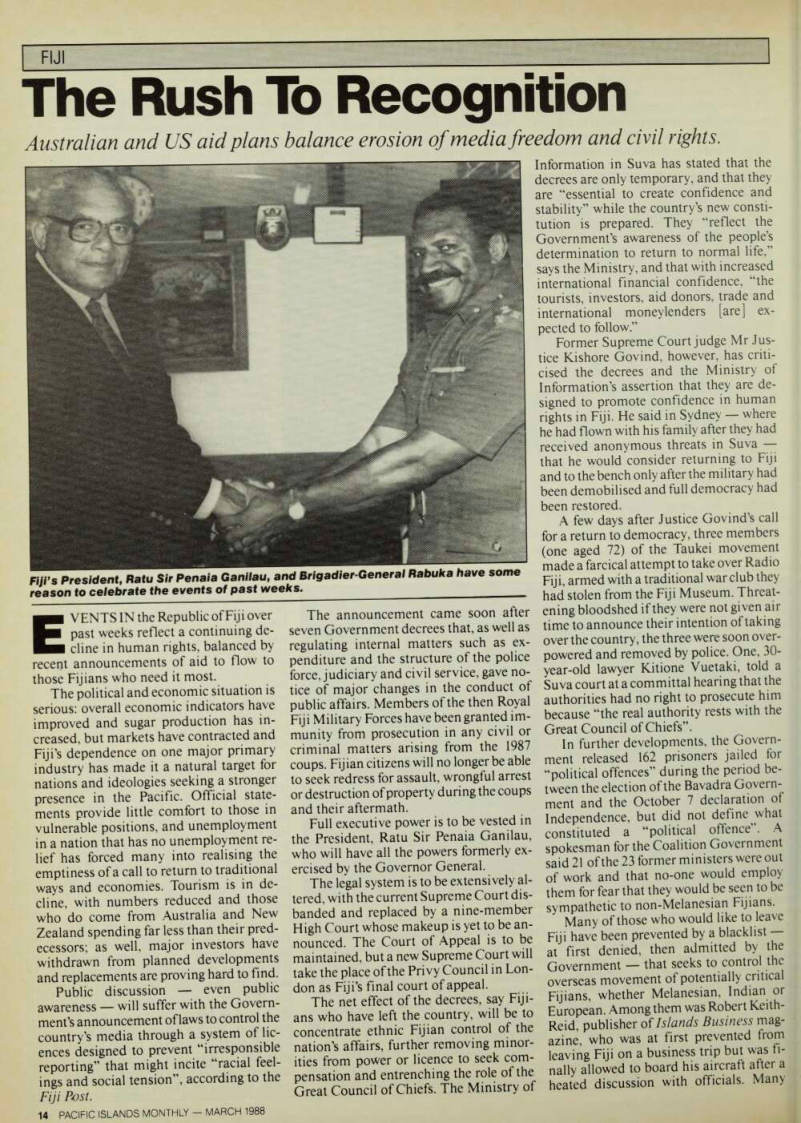
Fiji’s President, Ratu Sir Penaia-Gnilau, and Brigadier-General Rabuka have some reason to celebrate the events of past weeks.
have left without interference, and Fiji’s professional and entrepreneurial ranks have thinned as doctors, dentists, lawyers, accountants, civil servants and business people (Indian and European) have taken their experience and skills to Australia, New Zealand, England and Canada. The Government has advertised for replace ments, mainly from Asia, as it allows Fi jian citizens to leave.
Success, however, has greeted Fiji’s ov ertures to re-establish relations with a number of governments. Fear of interfer ence from France or Indonesia has led the Australian Government not only to change its criteria for diplomatic recognition, from one of recognising legitimate govern ments to one of recognising states, but also to resume aid with an SA7 million pack age for 1988. Australian Foreign Affairs Minister Bill Hayden says that Australian aid will go only to projects and destina tions deemed in greatest need and of so cial value, but this move has drawn immediate criticism from his New Zea land counterpart, Mr Russell Marshall. In a press statement in early February, Mr Marshall said that New Zealand would wait until Fiji’s new Constitution was pro mulgated before it decided whether to reactivate its diplomatic presence there, though it will resume aid soon.
Mr Marshall’s remarks came only a week before the Reagan Administration announced that the United States would recognise the Republic of Fiji, though aid grants will have to be approved by the US Congress.
Although Papua New Guinea Prime Minister Mr Paias Wingti has welcomed Australia’s recognition of Fiji, saying the Republic should not be “isolated” from other South Pacific nations, New Zea land’s attitude is both more cautious and far less accepting. Its Government, said Mr Marshall, did not approve of the actions of then Colonel Rabuka or of the coups, and would continue to press for the return of full democracy and a balanced represen
tation in government of Fijians from all backgrounds.
And there are signs that, despite acts as provocative as the acquittal of Taukei leader Apisai Tora on sedition charges (a result of a speech he made in Fiji soon after the election that ousted the Alliance
Government), a broader democratic base is gaining strength. Suva firemen went on strike in protest over cuts both in their pay and in the service they provide, and Fiji Trades Union Congress (FTUC) presi dent Mr Jale Toki has called for “unity in the face of worsening hardship”.
That he could make such a statement is a measure of the Government’s back down on control of union freedom and a retreat from its previous position of re strictions on union activities and deten tion of “unco-operative” union leaders.
The election of Mr Mahendra Chau dhry as General Secretary of the TUC has been interpreted as a distinctly political manoeuvre. Mr Chaudhry is secretary of the Fiji Public Servants’ Association, Fi ji’s largest union, and led the firemen’s strike in late January. He was Finance Minister of the Bavadra coalition Govern ment and has pledged to “take stock of the issues facing the union movement and the country as a whole”.
National affairs were coming under further scrutiny as Pacific Islands Monthly went to press, with reports of a radical re structuring of the 150-member Great Council of Chiefs. □