Fiji
p. 43 · Read in the full issue
PROMOTING a country after one military coup challenges the inge nuity; after the second, the novelty understandably begins to pall. Bill Whit ing, manager of the Fiji Visitors’ Bureau in Sydney, says 1987 will be remembered as a year of economic disasters in Fijian tourism. On May 13, with tourism up 10 per cent on the previous year, the country was set for a successful year. On May 14, the overthrow of the newly elected Ba vadra Government followed by the at tempted hijack of an Air New Zealand plane at Nadi Airport caused the total collapse of Fiji’s second largest industry.
Japanese visitors halved during June, and dropped further during July and August; Australian, American and New Zealand tourists dropped by 71 per cent.
Devaluation of the Fijian dollar on June 30, coupled with special bargain packages of $A299 aimed at the Australian and New Zealand markets, succeeded in in creasing tourism from these areas by 9.6 per cent in August and by about 40 per cent in September. Then, on September 28, the second coup occurred and 30 per cent of those tourists cancelled their bookings.
“Those who did come were previous vis itors, but as far as first-time travellers were concerned, Fiji was off their shopping list,”
Bill Whiting says.
Before the May coup, tourism earned Fiji SF2OO million a year; SF4 million each week. In June 1987, with the arrival of 5000 tourists instead of the previous year’s 18,000, tourism grossed only SF7O million.
With Fiji’s gradual return to normalcy and civil Government, tourist officials and tour operators hope that a promotional campaign coupled with reduced fares from Australia will succeed in pushing occu pancy levels back up again. But even if the current drive succeeds, the industry knows that cut-price fares and discounted tariffs are merely short-term solutions. The in dustry will only recover when tourists pay normal prices: tourists, attracted by cheap deals, who spend $2O a day instead of $lOO cannot make the country solvent.
Although cuts to its air services coin cided with the coup, Continental Airlines’ decision to withdraw from Fiji was largely a result of a dispute with Qantas; and there is anxiety that long-haul carriers mas sive 747 s carrying 650 passengers will increasingly overfly Fiji. Since Air Pacific
is basically a regional carrier and only car ries 28 per cent of the tourist traffic into Fiji, Fijian businessmen are pushing for a charter service between Fiji and the United States. “At the moment, the avia tion business does not support Fiji’s hotel infrastructure,” says Paddy Doyle, the group’s spokesman, who owns the Crow’s Nest Hotel. “With a 42 per cent increase in Americans during 1986, this is ob viously our ideal target,” explains Doyle, who is also chairman of the Civil Aviation Authority. “We are looking at the cost of leasing a Boeing 747 2008, which can fly 550 passengers. We’re also holding discus sions with our ministry and with PATA in our search for agents and consolidators who might be interested. We plan to fly di rectly from the United States to Nadi, by passing Honolulu.”
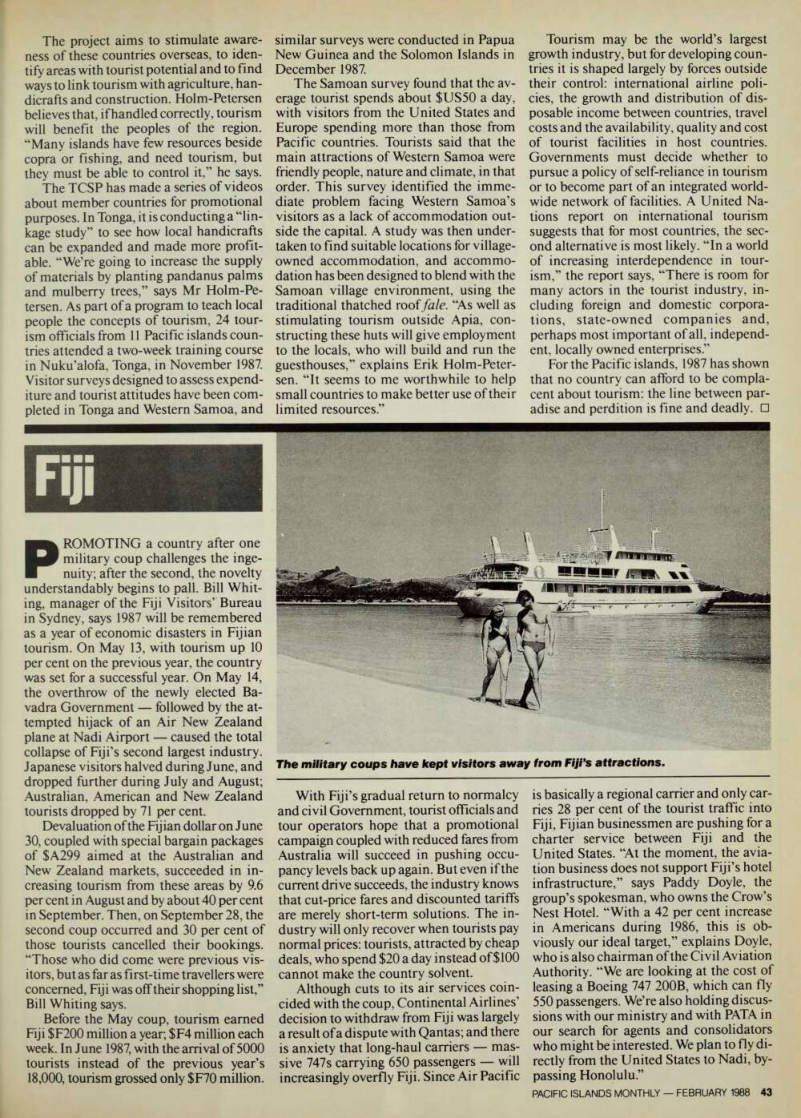
The military coups have kept visitors away from Fiji’s attractions.