French Polynesia
pp. 44-46 · Read in the full issue
END FOR the tourists,” said Jacques Teura, then President of the Government of French Polynesia, on the third anniversary of in ternal autonomy in June 1987.
Sending for the tourists became a top priority for French Polynesia. The year be gan badly with the withdrawal of the American cruise ship Liberte, which brought 33,000 American tourists to the islands in the previous year. That loss has cost Tahiti around SUSI 9 million. By Au gust 1987, American arrivals were down by 29.8 per cent on the previous year. Accord ing to Jean-Paul Schittenhelm, general manager of the Tahiti Tourist Promotion Board for Australasia, Asia and Europe, the withdrawal was caused by transfer of
the ship to the Caribbean but the high cost of living in Tahiti upset many of the cruise passengers in the three days they spent in hotels.
High prices in French Polynesia have upset many tourists. The strength of the Pacific franc, high salaries, no direct tax ation and a high consumer tax on im ported goods especially alcohol have all contributed to making Tahiti an expen sive destination, but the fall of the Amer ican dollar has aggravated the situation.
Australian tourists fell by 13.2 per cent in 1987 compared with 1986 figures: the number of tourists from France, however, rose by 47.2 per cent.
Tourism is Tahiti’s main industry, bringing in a fifth of the territory’s rcvc-
nue; far ahead of black pearls, which are next highest source of income at 4 per cent, In a report on tourism published in April 1987, Alexandre Leontieflf, at the time Tahiti’s Minister of Economy, Tourism and the Sea, wrote that tourism could reduce the Territory’s economic dependence as well as creating jobs. According to his report, the Government of French Polynesia aims to increase income from tourism to 35 per cent of the GNP by 1990. To achieve
that, he estimates it will have to increase hotel capacity to 4000 rooms (from the current 3000), while the number of tour ists will have to reach 200,000. In 1986, when the total number was 160,000, al most a quarter came on the Liberte.
With tourism down by 14 per cent in 1987, this is an ambitious, if not daunting, goal but one the Government is not pur suing energetically. It must convince investors it means business, explains Mr Schittenhelm. In August 1987, the Government adopted a twelve point plan to reduce prices and in an unprecedented move officials held talks with private ho teliers and restaurateurs and with a mix ture of pressure and persuasion convinced them to co-operate on a reduction in the price of rooms, food and drinks. In a rare “detaxation” initiative, the Government reduced the tax on alcohol by 80 per cent and the tax on local beers has been dropped. Hotels and restaurants have been encouraged to adhere to the new price controls in return for assistance from the Tourist Board. Restaurants have also been asked to provide a “touristic menu” fea turing an a la carte meal at reasonable rates.
Director-General of the Tahiti Tourist Promotion Board in Papeete, Christian Vernaudon, is delighted with the results, which have slashed beverage prices by up to 60 per cent in some cases. “A bottle of
wine that once cost $A57.50 now costs around 5A21.25; beer costs SA3 instead of SA4, coffee has dropped to $ A 1.25, and even Coca-Cola, which used to cost SA4, is now SA2. Most hotels now offer a three course evening meal for around $A22.50,” he says. Even the top hotels such as the Beachcomber, Maeva Beach and Tahara, in Papeete, have reduced their tariffs by 30- 40 per cent. Inter-island travel has been re duced by up to 30 per cent by the intro duction of Air Polynesie’s Air Pass.
The price reductions were ac companied by cheap holiday packages from Australia; in October 1987, Aus tralian in-bound traffic (which was down by 7.75 per cent the previous month) rose by 65.1 per cent.
But in October, just as the tourist sit uation was beginning to improve, Tahiti’s High Commissioner proclaimed a state of emergency in the wake of clashes between gendarmes and striking dock workers. A curfew was imposed in Papeete and neighbouring towns, 10 people were in jured, shop windows were smashed and cars were gutted. The crisis passed quickly, but it was hardly calculated to improve Polynesia’s tourism statistics.
Since then, several positive steps to im prove Tahiti’s tourism potential in 1988 have been set in train. Qantas has put greater capacity into French Polynesia, and has launched programs promoting not only ►
Austral International
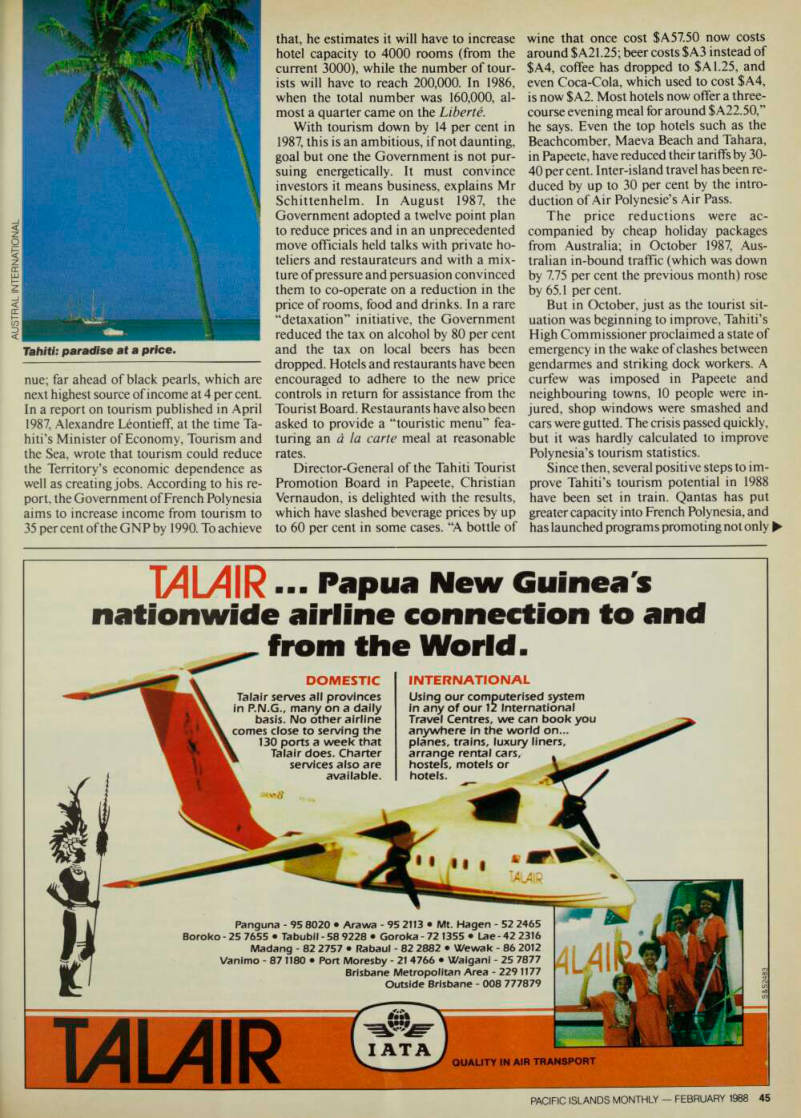
Tahiti: paradise at a price.
Tahiti but the islands as well. UTA and Air France have begun direct flights from Paris to Papeete, and a charter company, Nou velle Frontiere, flies to Tahiti every two weeks via the United States.
The newly opened Bora Bora Moana Beach Hotel will add an exclusive Polyne sian-style resort of 40 bungalows at Point Matira, which will feature in the Qantas Jetabout Tahiti program for 1988. In July 1987, the cruiser Windsong , which accom modates 150 people, began cruising in In 1989, World Expeditions plans to intro duce a new range of adventure holidays in Tahiti, including trekking and excursions on the tiny islands. Another encouraging sign is the introduction of charters from Japan, due to begin this year. “French Po lynesia will never be a bargain destination for mass tourism,” says Jean-Paul Schit tenhelm, “but in the past, American and Australian tourists have only visited Ta hiti once because we were too expen
sive. Now, with normal prices, they should return.” One question remains, however: when the packages expire and the airlines raise their prices, will the hotels and res taurants keep to their agreements and will the tourists keep coming?
Carriers: UTA, Air New Zealand, Conti nental, Cook Islands International, Lan- Chile, Qantas.
Accommodation: 2750 classified rooms, 85 per cent of which are in international hotels.
Contribution of tourism: 23 per cent of GNP in 1986.
Projected growth: Increase in number of tourists to 200,000. By 1990, increase in tourist revenue to cover 35 per cent of im ports, and increase in hotel rooms to 4000.
Main attractions: French Polynesia con sists of 130 islands covering an area the size of Europe. The capital, Papeete, is a colourful port with a Mediterranean fla vour. Other islands include Moorea, Bora Bora, Huahine and Rangiroa, a remote atoll. Activities include game fishing, div ing, boating and Polynesian feasts.
ian Government Tourist Office in Sydney.
“We aren’t cheap, so we must attract people who will enjoy a little sophistication in the Pacific.”
There is not enough, however, to at tract the upmarket traveller: in many at tractive places, hotels requisitioned by gendarmes create an atmosphere not con ducive to relaxation. The military occu pation also means that only Noumea, the Isle of Pines and the Loyalty Islands are available for tourists.
Despite the difficulties, visitors to New Caledonia increased by 19.8 per cent dur ing the first seven months of 1987. The NCGTO aims to increase the number of Australian tourists to 20,000 this year and the number of Japanese.
Tourist facilities are improving: in Noumea, the Novotel Le Surf has added 100 rooms and is building a convention centre; six million francs have been in vested in refurbishing Club Med; a Japa nese company has invested 15 million francs in the Escapade Resort; and the He de France holiday apartments now pro vides 48 fully equipped serviced flats.
Carriers: UTA, Qantas, Air New Zea land, Polynesian Airlines, Air Caledonie International, Air Nauru.
Accommodation: 1690 rooms the ma jority in hotels in Noumea, including Club Med. Tribal lodges (giles) available on the Isle of Pines and Loyalty Islands.
Contribution of tourism: 10 per cent of GNP in 1984.
Projected tourist growth: Return to 1984 figures (90,000 tourists from Australia, New Zealand and Japan by 1989, com pared with 58,700 in 1986.) Increase in number of hotel rooms to 2060 by the end of l9BB.
Major attractions: Beaches, scenery, Me lanesian culture, French ambience in Noumea and unspoilt islands.