Tourism ’88
pp. 41-44 · Read in the full issue
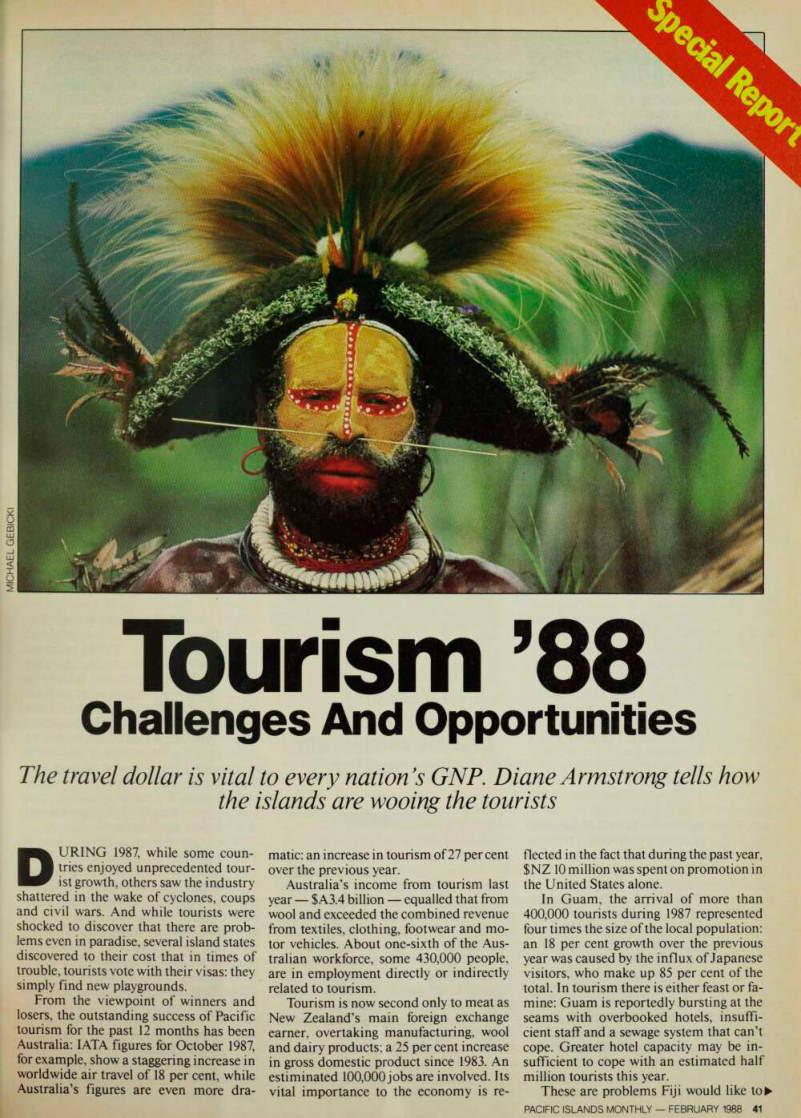
Challenges And Opportunities
The travel dollar is vital to every nation’s GNP. Diane Armstrong tells how the islands are wooing the tourists
DURING 1987, while some countries enjoyed unprecedented tourist growth, others saw the industry shattered in the wake of cyclones, coups and civil wars. And while tourists were shocked to discover that there are problems even in paradise, several island states discovered to their cost that in times of trouble, tourists vote with their visas: they simply find new playgrounds.
From the viewpoint of winners and losers, the outstanding success of Pacific tourism for the past 12 months has been Australia: IATA figures for October 1987, fer example, show a staggering increase in worldwide air travel of 18 per cent, while Australia’s figures are even more dra-
matic: an increase in tourism of 27 per cent over the previous year.
Australia’s income from tourism last year $A3.4 billion equalled that from wool and exceeded the combined revenue from textiles, clothing, footwear and motor vehicles. About one-sixth of the Australian workforce, some 430,000 people, are in employment directly or indirectly related to tourism.
Tourism is now second only to meat as New Zealand’s main foreign exchange earner, overtaking manufacturing, wool and dairy products; a 25 percent increase in gross domestic product since 1983. An estiminated 100,000 jobs are involved. Its vital importance to the economy is re-
fleeted in the fact that during the past year, SNZ 10 million was spent on promotion in the United States alone, In Guam, the arrival of more than 400,000 tourists during 1987 represented four times the size of the local population: an 18 per cent growth over the previous year was caused by the influx of Japanese visitors, who make up 85 per cent of the total. In tourism there is either feast or fa mine: Guam is reportedly bursting at the seams with overbooked hotels, insuffi dent staff and a sewage system that can’t cope. Greater hotel capacity may be in sufficient to cope with an estimated half million tourists this year.
These are problems Fiji would like to^
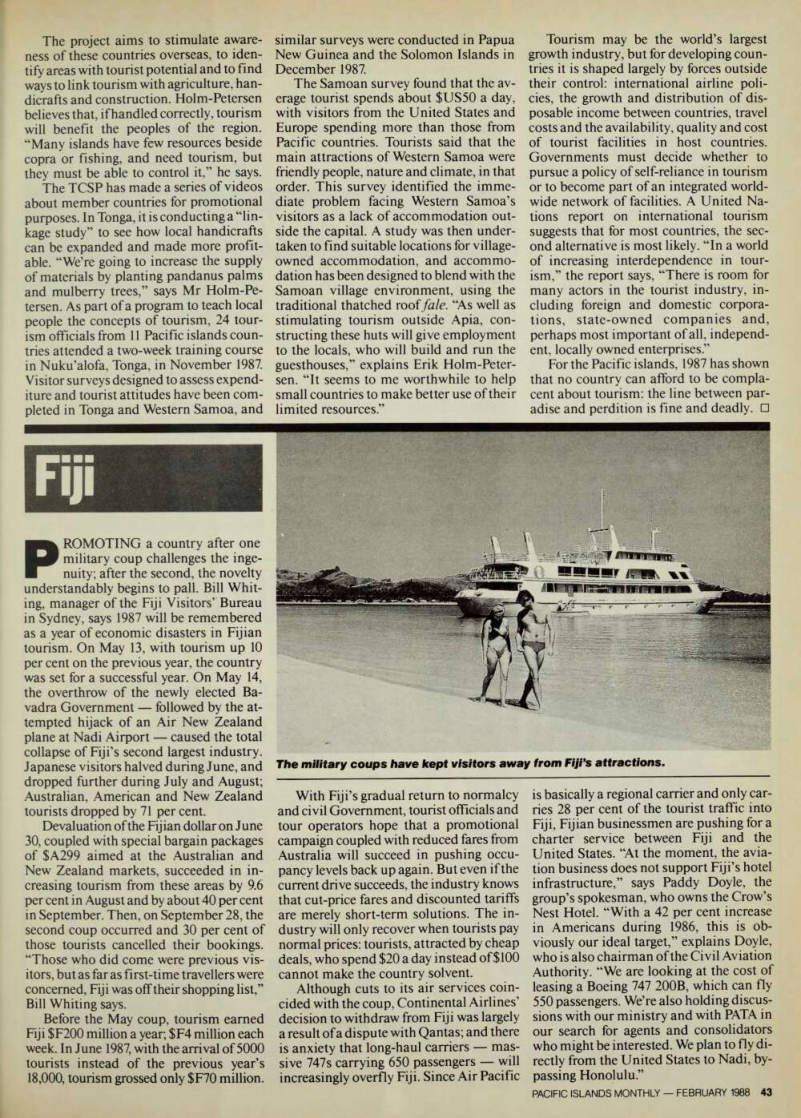
have, after a year filled with political chaos and near economic disaster. Fiji’s tourism industry, its second largest income earner, is in tatters as a result of airline withdraw als and empty hotels.
The events of 1987 gave several Pacific island states cause to ponder not only on fate, but also on the nature of tourists.
Cheap fares from Australia to Fiji resulted in a dramatic response: a 44 per cent rise over the previous year. Clearly, for many tourists, danger increased in direct pro portion with cost. Cheap packages also helped to stimulate tourism to New Ca ledonia, which in 1985 had lost more than 70 per cent of its tourists. The following years saw Australian tourism increase by 80 per cent. “Maybe there was civil war, but it was going cheap!” was the sanguine comment of Henri Maniquant, director of the New Caledonian Government Tourist office in Sydney.
Cyclones are catastrophes but, as Van uatu and the Cook Islands found, it’s really an ill wind that blows nobody any good.
“The publicity we got as a result of the cy clone increased awareness of the Cooks as a tourist destination,” said a spokesper son for the Cook Islands Tourist Author ity. The Cook Islands spent more than SNZ2OO,OOO on advertising campaigns in the past year but visitor arrivals in the Cook Islands in 1987 totalled 33,000, an increase of 17.7 per cent over the previous year. Most visitors came from New Zea land, followed by Australia; numbers from Europe tripled.
Sandra Bourjois, manager of the Van uatu Tourist Board in Australia, says Feb ruary’s cyclone Uma resulted in massive, much-needed refurbishing of hotels and resorts, which has raised the standard of facilities. In 1985, Vanuatu suffered be cause of New Caledonia’s troubles; many travellers, it seemed, could not differen tiate between them. Rumours of pro- Libyan sympathies did little to restore confidence. The problems were com pounded by controversy over Air Vanu atu, whose service has been in limbo since the airline’s contract with Ansett Airlines expired. In 1983, Vanuatu had 26,000 tourists; by 1986, that figure was halved and the first six months of 1987 saw a fur ther 30 per cent decline. In December, however, Air Vanuatu began weekly flights between Sydney and Vila, and there are plans to expand the service to Melbourne and Brisbane. Apart from resumption of the national carrier, positive indications for 1988 include improved hotels, the up grading of Vila airport, and the granting of $A250,000 aid by the Australian Govern ment. Those engaged in promoting tour ism to Vanuatu are upset by decisions such as that requiring French nationals to ob tain visas: a move certain to lose tourists.
“There are too many chiefs, too many fac
tions, and not enough commitment to tourism,” admits one official.
Looking at recent gains and losses in the Pacific, a domino effect emerges as events in one state affect several others. Vanuatu benefited from Fiji’s loss, by receiving funds normally allocated to Fiji. An in crease in tourism to the Cook Islands was due partly to the situation in Fiji; but Tonga and Samoa suffered because Fiji is the hub for many travellers to these islands.
Hawaii revealed its own hopes of at-
tracting tourists who would have visited Fiji. Tourism, Hawaii’s largest industry, employs 500,000 people. “It’s been a good year for us, with a five to eight per cent growth,” says Rob Dell, regional manager of the Hawaii Tourist Board. Hawaii’s main market is the US mainland, fol lowed by Japan, which accounted for one million tourists. The recent expansion of Hawaiian Airlines to the South Pacific should stimulate more tourism.
Between the winners and losers are the strugglers, island states that want more tourists but lack the funds, the infrastruc ture or the airline access to get them. Iron ically, those that need tourism most because they lack other resources are
the ones that can least afford the massive investment needed to provide transport, communications, airport facilities and in ternational hotels. Some claim they want tourism but do little to promote it. Others want revenue, but fear the effect of mass tourism on their culture.
Tonga and Western Samoa illustrate this dilemma. They want “tourism on our terms” in the shape of selective, affluent tourists but lack the sophisticated facili ties these travellers seek. Tonga had 16,000 visitors for the year ending June 1987, which represents a 9.4 per cent increase over the previous year. Tourism accounts for 30 per cent of the kingdom’s income and is its most important industry but its small population, limited funds, lack of a national carrier and inadequate infras tructure make dramatic growth unlikely. lan Bums-Wood, managing director of the Tonga Visitors’ Bureau, says that, “It’s the old cat and mouse game. The airlines won’t invest unless they see lots of big hotels, while investors won’t risk building hotels unless airlines become committed first.”
The high price of some Pacific curren cies militates against tourism. While high costs in Europe and the United States are acceptable, a pricy paradise is not. Con cerned about losing tourists as a result of its high prices, the Government of French Polynesia has taken the extraordinary step of slashing the price of alcohol, meals and accommodation. A few years ago such an initiative in Tahiti would have been un thinkable, but over the past year tourism industry setbacks have made many coun tries re-evaluate their importance.
Island-hopping around the Pacific has been made even more difficult by incom patible airline fare structures and time tables. Now, to make travel around the Pacific easier, the Association of South Pacific Airlines (ASPA), which consists of Air Pacific, Air Caledonie International, Polynesian Airlines and Cook Islands In ternational, has established an add-on fare that can be used on any of these airlines.
This flexible and relatively inexpensive system will enable travellers to create their own itinerary simply by adding on the rel evant fare for each sector.
The most interesting development in Pacific tourism in the past year is the Tourist Council of the South Pacific, based in Suva. In August 1986 this organisation received a grant of three million “Euro pean Currency Units” from the EEC un der the Pacific Regional Tourism Development Program, to develop and promote tourism in the area. Speaking in Suva, project director Erik Holm-Peter sen explained that participating countries Fiji, Papua New Guinea, Vanuatu, Tonga, Western Samoa, Tuvalu, Solomon Islands and Kiribati, “cannot afford to promote themselves internationally; but if they pool resources they can promote the entire re gion while at the same time stressing the unique aspects of each destination.”
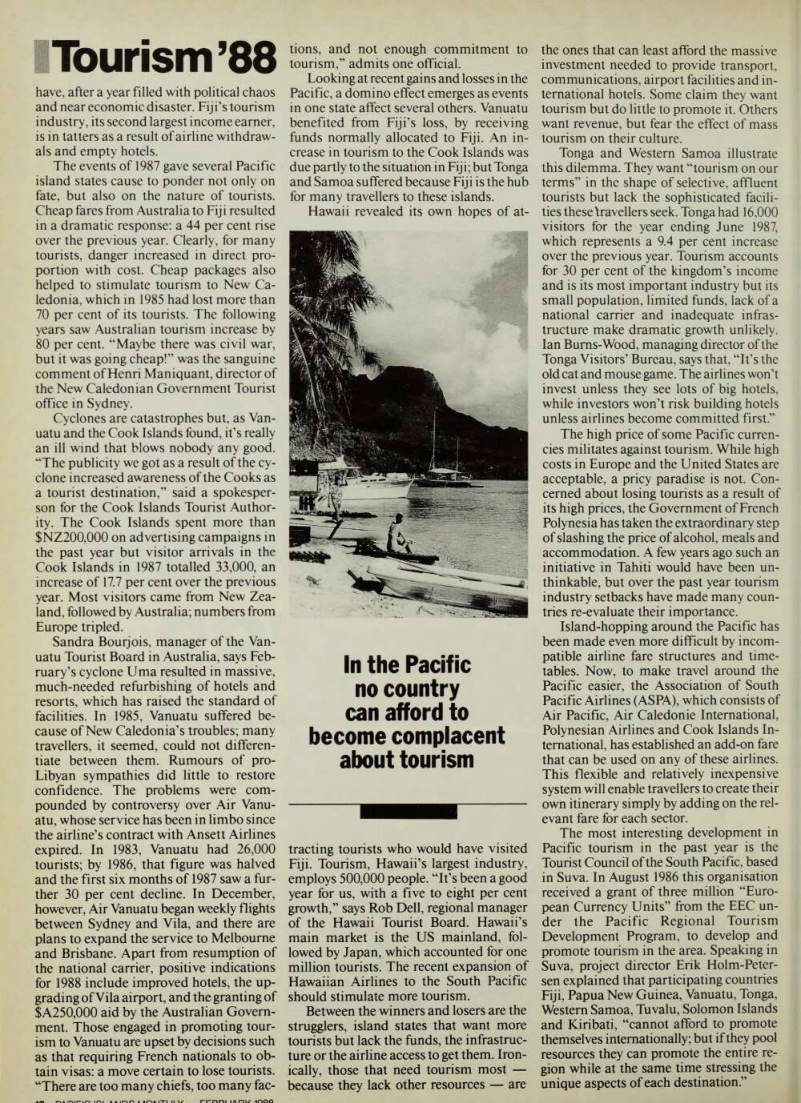
In the Pacific no country can afford to become complacent about tourism
The project aims to stimulate awareness of these countries overseas, to idem tify areas with tourist potential and to find ways to link tourism with agriculture, handicrafts and construction. Holm-Petersen believes that, if handled correctly, tourism will benefit the peoples of the region.
“Many islands have few resources beside copra or fishing, and need tourism, but they must be able to control it,” he says, The TCSP has made a series of videos about member countries for promotional purposes. In Tonga, it is conducting a “linkage study” to see how local handicrafts can be expanded and made more profitable. “We’re going to increase the supply of materials by planting pandanus palms and mulberry trees,” says Mr Holm-Petersen. As part of a program to teach local people the concepts of tourism, 24 tourism officials from 11 Pacific islands countries attended a two-week training course in Nuku’alofa, Tonga, in November 1987.
Visitor surveys designed to assess expenditure and tourist attitudes have been completed in Tonga and Western Samoa, and
similar surveys were conducted in Papua New Guinea and the Solomon Islands in December 1987.
The Samoan survey found that the average tourist spends about SUSSO a day, with visitors from the United States and Europe spending more than those from Pacific countries. Tourists said that the main attractions of Western Samoa were friendly people, nature and climate, in that order. This survey identified the immediate problem facing Western Samoa’s visitors as a lack of accommodation outside the capital. A study was then undertaken to find suitable locations for villageowned accommodation, and accommodation has been designed to blend with the Samoan village environment, using the traditional thatched roof fale. “As well as stimulating tourism outside Apia, constructing these huts will give employment to the locals, who will build and run the guesthouses,” explains Erik Holm-Petersen. “It seems to me worthwhile to help small countries to make better use of their limited resources.”
Tourism may be the world’s largest growth industry, but for developing coun tries it is shaped largely by forces outside their control: international airline poli cies, the growth and distribution of dis posable income between countries, travel costs and the availability, quality and cost of tourist facilities in host countries, Governments must decide whether to pursue a policy of self-reliance in tourism or to become part of an integrated world wide network of facilities. A United Na tions report on international tourism suggests that for most countries, the sec ond alternative is most likely. “In a world of increasing interdependence in tour ism,” the report says, “There is room for many actors in the tourist industry, in eluding foreign and domestic corpora tions, state-owned companies and, perhaps most important of all, independ ent, locally owned enterprises.”
For the Pacific islands, 1987 has shown that no country can afford to be compla cent about tourism: the line between par adise and perdition is fine and deadly. □
He hopes to begin the first service in April, and to continue for six months a year. He believes the Japanese honey moon market could be stimulated to come to Fiji in larger numbers if hotels catered for their needs. With the expansion of Air Pacific to Tokyo next May, that may be come a reality.
There are already some signs of a re turn of confidence: the opening of the $55 million Sheraton Fiji Resort at Denarau Beach, near Nadi, is the first major hotel development in Fiji for 10 years, and marks Sheraton’s debut in the South Pacific. An other luxury project that aims to provide competition for the exclusive Turtle Is land is a $2.5 million resort on Liku Beach in the Yasaw group. Developed by Aus tralian investor Norman Bolitho, it will have its own airstrip and will be serviced by Sunflower Airlines.
In normal years, Paddy Doyle’s hotel has a 45 per cent occupancy. Not long after the coup, he described its occupants rue fully as “my dog, my cat and me”. Never theless, he is optimistic about the future of tourism in Fiji. “We’ve got a great prod uct: all we need is people. It amazes me that tourists still travel to violent places while our coup scared them away. An
American asked me how safe he’d be com ing to Fiji: I told him the most dangerous part of his trip would be the Los Angeles freeway.” □
Carriers: Qantas, Air Pacific, Air New Zealand, Polynesian Airlines and Cana dian Airlines International.
Accommodation: 4300 rooms.
Contribution to revenue: SFIBS million in
1986:1987figures not available.
Attractions: Fiji consists of 300 is lands that offer large, luxurious resorts and small hideaways, such as Namale on Vanua Levu, with seven bures and Qamea Beach Club, with 10 bures. Clear waters, superb lagoons and unspoilt scenery make Fiji ideal for diving, snorkelling, swim ming, horseriding, game fishing and sailing.