Spender Slams Pacific Neglect
pp. 14-15 · Read in the full issue
Australia
Australia’s shadow Foreign Minister speaks out.
By Larry Writer
AN AUSTRALIAN Government policy of “leisurely neglect” in the South Pacific has resulted in slip page of influence and widespread confu sion about the country’s objectives in the region. This was an abiding impression gained by Australia’s Opposition spokes man on Foreign Affairs, Mr John Spender, while on a fact-finding mission to island nations.
Australia’s foreign policy, says Mr Spender, must be to protect and promote its national interests and security with vi gour by ensuring stability, regional de mocracy and democratic institutions. He believes the Government’s reduction or abolition of aid to needy countries “Fiji and PNG come to mind” has opened the way for other powers to gain a toehold in many island states strategically vital to Australia.
Mr Spender also slams the Australian Government’s “strident” reaction to the coups in Fiji, to Libyan mischief-making in Vanuatu and New Caledonia, and to French policy in New Caledonia, saying it has done nothing constructive for the people of those nations.
He recalls an American general’s com ment to him in Hawaii that, “We may not have great gains to make in the region, but we can suffer great losses.” That dictum, Mr Spender says, applies equally to Australia.
He is also critical of the quality of some Australian diplomats in island states. “We should be putting the South Pacific at the top of our list of diplomatic priorities. Our best representation should be in the Pa cific, the area of immediate and strategic national interest: a posting in the region shouldn’t be a stepping-stone to Paris or Washington or a reward for long service.”
Australia should be sending its brightest and best people to the region. That way Australia could develop real and formi dable expertise in the complicated affairs of the island nations.
“We should be, without doubt, the leader of the region in terms of knowl edge,” he says. “It is dangerous and un wise to think that just because you are dealing with small countries, their politick are simple.”
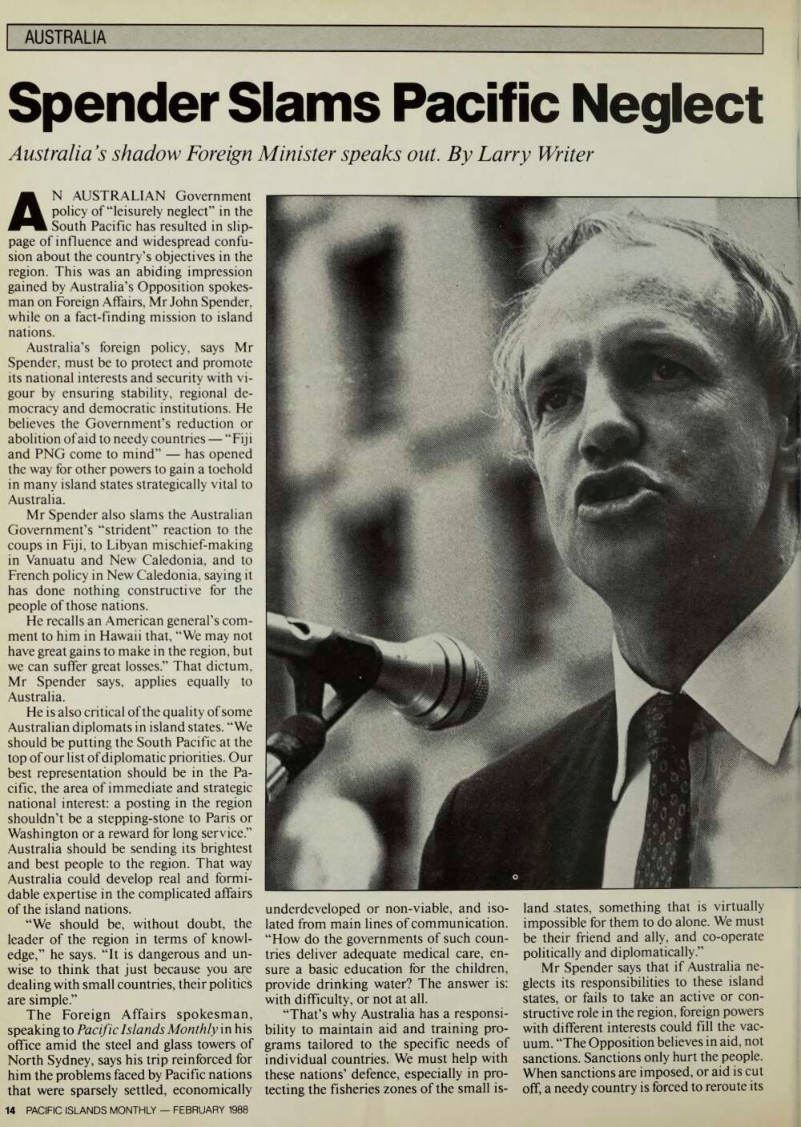
The Foreign Affairs spokesman, speaking to Pacific Islands Monthly in his office amid the steel and glass towers of North Sydney, says his trip reinforced for him the problems faced by Pacific nations that were sparsely settled, economically
underdeveloped or non-viable, and iso lated from main lines of communication.
“How do the governments of such coun tries deliver adequate medical care, en sure a basic education for the children, provide drinking water? The answer is: with difficulty, or not at all.
“That’s why Australia has a responsi bility to maintain aid and training pro grams tailored to the specific needs of individual countries. We must help with these nations’ defence, especially in pro tecting the fisheries zones of the small is
land .states, something that is virtually impossible for them to do alone. We must be their friend and ally, and co-operate politically and diplomatically.”
Mr Spender says that if Australia ne glects its responsibilities to these island states, or fails to take an active or con structive role in the region, foreign powers with different interests could fill the vac uum. “The Opposition believes in aid, not sanctions. Sanctions only hurt the people.
When sanctions are imposed, or aid is cut off, a needy country is forced to reroute its
energies. Necessity becomes the mother of invention and, to survive, the disaffected country looks elsewhere for assistance.”
The Opposition spokesman says a nu clear-free Pacific is “a nonsense”. “I op pose the concept of the South Pacific Nuclear Free Zone. Compliance with such a proposal would tie Australia’s hands were we ever required to offer, say, America base facilities of one kind or another.
“Does a nuclear-free zone mean we are
free from the threat of a nuclear war? No country on earth is free from that threat.
Does a nuclear-free zone mean your na tion is free from the passage of nuclear powered ships? There is no way any major maritime power would agree to that. Nu clear powered ships can be found in the navies of the United States, the USSR, Britain, France and China. More such ships will be built as nuclear energy be comes increasingly efficient. These are all realities and words can’t change them.”
Nevertheless, Mr Spender opposes
French nuclear testing on Mururoa but, ever the pragmatist, feels there is little that can be done to put a stop to them and sees little chance that the French will take their tests elsewhere.
The flamboyant politician welcomes Fiji’s return to civilian government but has misgivings about the yet to be promul gated constitution. He is concerned that it could entrench racial or ethnic back grounds as a basis for voting, and that it
may ensure that a group of a partic ular background enjoys a guaran teed majority.
A lawyer him self, Mr Spender also sees a need for the constitution to be enforced by an independent judi ciary. “No matter how brilliantly it is worded, the con stitution will only be as good as its capacity to protect the rights of the people. This takes a strong and inde pendent court.
The world is lit tered with consti tutions that are ignored by subser vient or terrified judges.”
Another clear conclusion he drew was that Aus tralia and the world would have to get used to deal ing with a very dif ferent Fiji from the one we have known. “There are bound to be tee thing problems for us and for the Fi jians themselves,” he says. “The re lationship be tween indigenous Fijians and Indi ans is something that will have to be
worked out by all Fijians. I hope they can do it without violence.” Many of the people of the islands he visited, he says, sympathised with Brigadier Rabuka’s ideals, but took issue with the methods he used to achieve them, A Western Samoan MP had told him that the events in Fiji had initiated a ripple effect that would spread throughout the entire region. “The coups were an exam pie of how the old ways and customs were under challenge and in danger of breaking down. If the chiefly system had held, the
coups could never have happened,” Mr Spender says.
The Australian Government could not be proud of its position on New Cale donia. Mr Spender says its “strident” ap proach to French policy there had not succeeded in helping the cause of Kanak independence; it had merely only alien ated the French. There are, he says, some indications that a number of FLNKS members are becoming impatient with the peaceful tactics of FLNKS leader Tji baou. These people are prime customers for Libyan arms dealers, says Mr Spender.
Libya would make trouble for France wherever it could as payment in kind for French support of the Government in Chad. “Some people in New Caledonia believe now that violence is the only op tion left. I hope that card is not played.
Something achieved through violence can be worse than what it has replaced.
“For the time being the FLNKS must realise that, as hard as it is for them, a small voice is better than no voice. They should contest the New Caledonia elections after the French Presidential elections. The French, for their part, must make an effort to listen to legitimate Kanak grievances such as those concerning land rights.
However, the French track record at lis tening is not heartening. The best hope for the country is for all parties to try to re solve differences without bloodshed. And that requires leadership.”
Mr Spender hits out at the Australian Government for cutting its aid to PNG by $AlOm in 1986. “This was an extraordi narily stupid move. We didn’t even tell them it was going to happen we just went ahead and did it.
“Papua New Guineans, understanda bly, regard this heavy-handedness as an arrogant way of doing business. It has un dermined their confidence in our inten tions. The cutting of a relatively small amount of aid money has undone a great deal of good and we have now to overcome that,” says Mr Spender.
“The aid reduction has caused PNG to believe that Australia is less reliable now than it has been in the past and that PNG should now court new friends and trade and defence arrangements. But I don’t think you’ll find PNG rushing out and signing defence agreements with the So viet Union!” Mr Spender adds that Aus tralia has to learn to live with PNG’s emerging assertions of independence.
He is “not paranoid” about incursions into the region by such powers as the USSR, Indonesia and Libya. “At the end of the day,” he says, “we are here and they are not. We have geography on our side.
Players will come and go. The Soviets do not live here; we do.
“Our strategic interests are obvious. We must use our economic and military strength to benefit the countries in the re gion, to benefit ourselves, because we are going to be here forever.” □
“Cutting aid to PNG was an extraordinarily stupid move.
We didn’t even tell them it was going to happen. We just went ahead and did it.” -John Spender