Counting The Cost
pp. 11-13 · Read in the full issue

Fiji
Fiji struggles to restore stability.
By John Dunn
FIJI WILL probably never be the same again, but it does seem the sit uation looks considerably more promising than in the dark days after May 14. Nevertheless, it is also clear that there are still very many problems to overcome.
Several developments, both internally and externally, in the early days of 1988 appear likely to play an important part in shaping the immediate outcome for Fiji.
At home the principal plus is that the nation remains not only violence-free but remarkably settled and stable. The new ci vilian Government headed by former Prime Minister Ratu Sir Kamisese Mara is settling in and adopting a low-key and commendably cautious approach to its
rule. Its most important initial task is the approval of the interim constitution, which will become the supreme law of the coun try until a new constitution is adopted.
The publication of its details and their acceptance, or otherwise, will largely hold the key to the future administration of the country.
In the meantime, an extremely tough budget is in place in an attempt to halt the nation’s deteriorating financial situation.
The uncertainty that followed the first coup caused a negative growth rate of 11 per cent last year but the budget is de signed not only to arrest that trend but to cut the negative growth rate by about half in 1988. Indirect taxes will be increased,
with excise rates being raised on ciga rettes, tobacco, beer, spirits and petrol.
As well, a two per cent duty has been placed on major exports including sugar, timber, gold and silver while the hotel turnover tax has been increased by three per cent to eight per cent.
These additional costs will make it even tougher for the majority of the population, already hard hit by prices that have risen about a third since the first coup. Traders have reported a general downturn of about 50 per cent in sales with some items, such as meat, falling by about 80 per cent.
Shoppers are relying on the staples such as potatoes and onions.
The cost of living is not the only aspect of Fiji’s daily life that has been affected. A severe brain drain is under way among professional people, ranging from doctors and lawyers to teachers and those with management expertise. Almost all are In dian and they have decided their future lies elsewhere, mainly in Australia, New Zea land or Canada.
The area worst hit is medicine, where hospital attention has been curtailed be cause of lack of skilled staff, causing the virtual elimination of elective surgery. The new civilian Government is well aware of this alarming situation and is searching actively for staff in several Asian countries.
However, while these problems are real and disturbing enough, there are some pluses on the home front, quite apart from the return of general community stability and orderliness.
The threat to peace posed by the mili tant Taukei movement seems to be under control even if it has not been completely extinguished.
An end-of-year demonstration by Tau kei extremists, who want the Government to take a harder and tougher pro-Fijian line or disband, and the Great Council of Chiefs to have a stronger and more direct voice in Government decisions, was turned aside with no violence and only a minor disruption to the newfound calm.
The movement has been virtually neu tralised by a split within its ranks, with a significant number of members happy to go along with the more moderate stance of the new civilian administration.
In fact, one of the Taukei leaders, Mr Taniela Veitata, has accepted a ministerial (Employment and Industrial Relations) and cabinet position that has taken con siderable steam out of the Taukei stand.
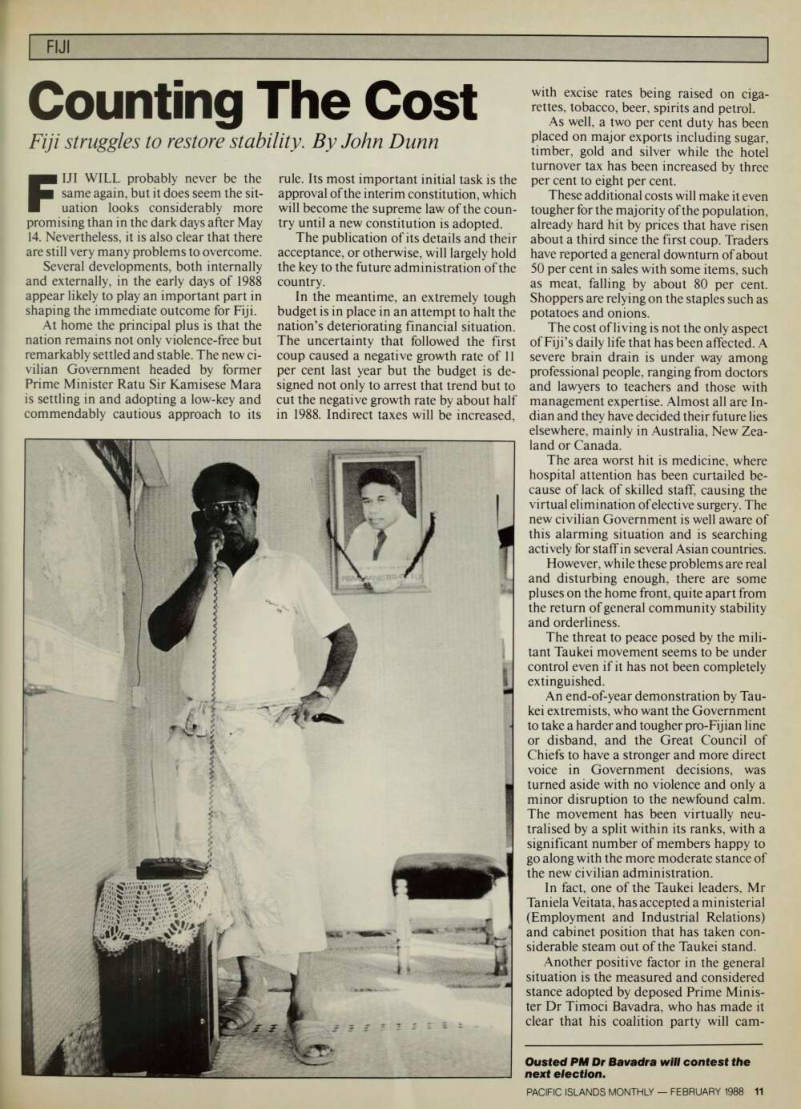
Another positive factor in the general situation is the measured and considered stance adopted by deposed Prime Minis ter Dr Timoci Bavadra, who has made it clear that his coalition party will cam-
Ousted PM Dr Bavadra will contest the next election.
paign for the next election but will do so in a “lawful and peaceful way”.
Dr Bavadra spends almost all his time now at his home village of Viseisei on the western side of tne main island of Viti Levu, but continues to monitor the politi cal developments in Suva. Fie has kept well clear of any controversial comments but did react to the suggestion that Australia may recognise the new civilian Govern ment. He called on Australia, and New Zealand, “to withhold any recognition until guarantees of democracy were given”.
In the same statement, his first for more than two months, Dr Bavadra made it plain that he expects to be consulted about the new constitution but there is, of course, no guarantee that this will happen.
The Australian move to recognise Fiji stems not from any desire to condone the political happenings of the past eight months but from a considerable concern that Australia could lose touch with, and influence in, not only Fiji but with the re gion as a whole.
The Australian Government fears the Soviet Union and Libya might attempt to step up their role in the South Pacific by taking advantage of the vacuum created by the stand-off that has developed.
Australia, too, is watching carefully the French attitude to the situation because it does not want Paris to replace it as Fiji’s major source of aid and vital trading part ner. Rumours persist that the French have been active indeed in Fiji, offering an aid package worth about SAI2 million, show ing a willingness to discuss help with cap ital works which, in turn, would provide badly needed employment, and to be dis cussing the possible sale of helicopters.
Miles Johnston, president of the Fijian Law Society, has expressed strong doubts about the French Government’s motives.
“It is early days yet but we are just seeing the tip of the iceberg with the French,” he says. “They will exert a great deal of politi cal influence and it will have two effects.
One will be to reduce the pressure in fa vour of the Kanak movement in New Ca ledonia; the other will be to diminish the
criticism of their bomb tests at Mururoa.”
Australia is expected to stop short of recognis ing the Fijian Govern ment officially, and would sidestep that problem by changing the basis on which it estab lishes diplomatic rela tions with other countries, from one of recognising govern
ments to that of recognising states.
If the Australian cabinet adopts this proposal it is likely Australian aid and defence pacts with Fiji (which were suspended following the coup) will be reinstated, allowing Australia to resume its
normal, substantial role with the country.
The Australian media has been watch ing this particular aspect with great inter est. The Melbourne Herald saw value in it.
Noting that “Australia’s interests in the South Pacific have been diminished by events in Fiji,” it observed: “It is apparent that outside powers are more than willing to take advantage of the situation.”
The Herald added: “Too much is at stake in the South Pacific and too much needs to be done for the well-being of its people for Australia to stand aside and let others take the running.”
Fiji cannot yet be written off as a po tential trouble spot, but it does seem that the worst in physical terms may be finished. Whether democracy is also fin ished remains to be seen. □
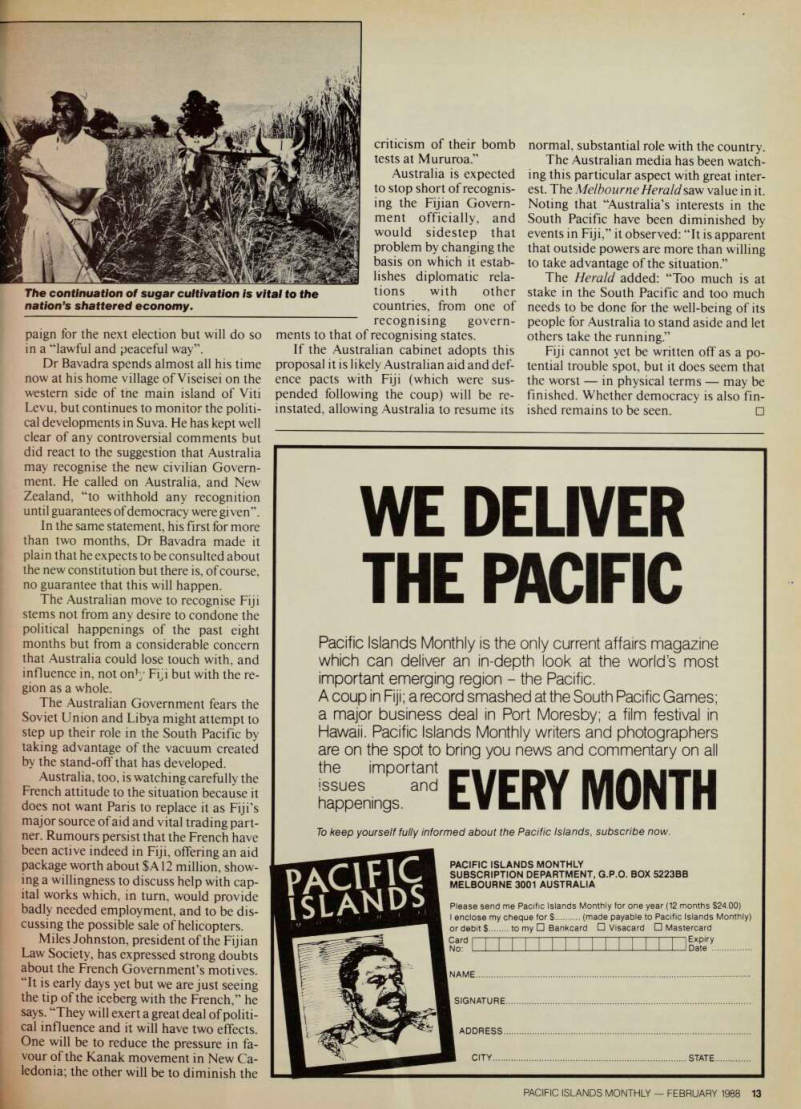
The continuation of sugar cultivation is vital to the nation’s shattered economy.