A New Order Takes Charge
pp. 8-10 · Read in the full issue
French Polynesia
Alexandre Leontieffs sudden rise to power may see an end to Tahiti’s bitter
confrontational politics.
By Nicolas Rothwell.
BEHIND THE sound and fury of changing government in Papeete at year’s end, a far more subtle and profound transformation was taking place in French Polynesia a territory where the calm grace of surface appearances is always deceptive, and revolutionary pas sions lurk unknown.
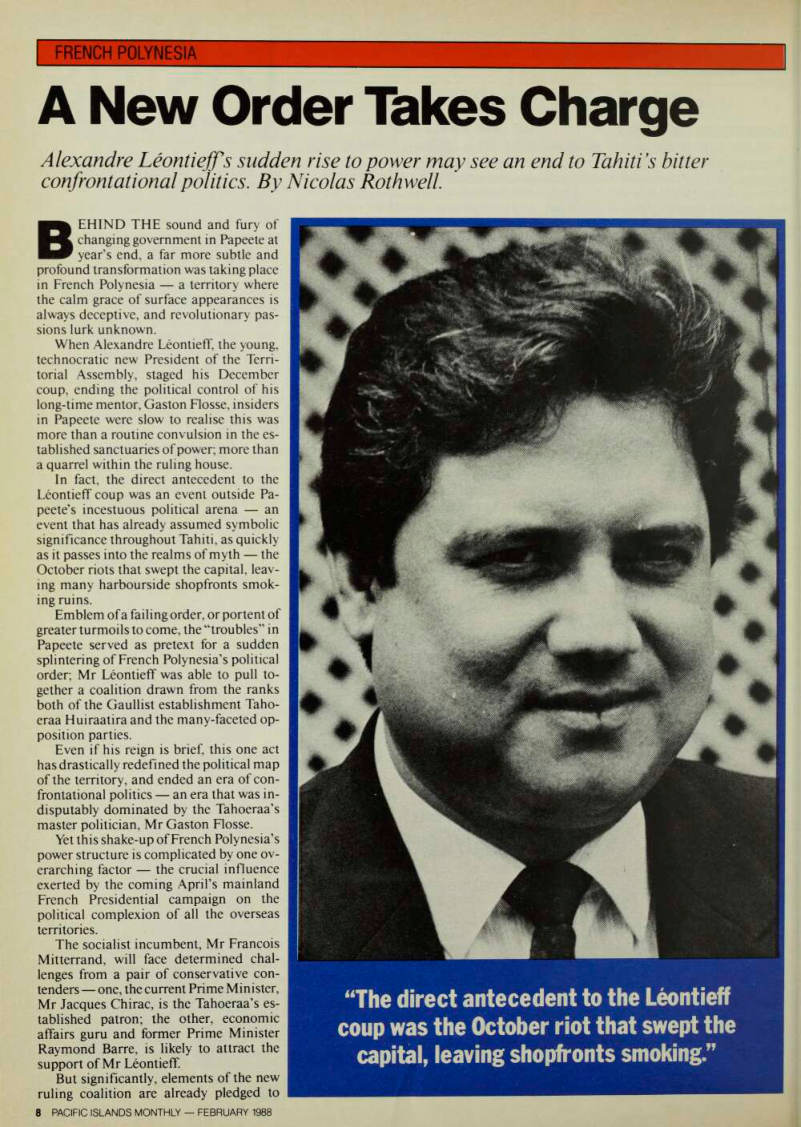
When Alexandre Leontieff, the young, technocratic new President of the Terri torial Assembly, staged his December coup, ending the political control of his long-time mentor, Gaston Flosse, insiders in Papeete were slow to realise this was more than a routine convulsion in the es tablished sanctuaries of power; more than a quarrel within the ruling house.
In fact, the direct antecedent to the Leontieff coup was an event outside Pa peete’s incestuous political arena an event that has already assumed symbolic significance throughout Tahiti, as quickly as it passes into the realms of myth the October riots that swept the capital, leav ing many harbourside shopfronts smok ing ruins.
Emblem of a failing order, or portent of greater turmoils to come, the “troubles” in Papeete served as pretext for a sudden splintering of French Polynesia’s political order; Mr Leontieff was able to pull to gether a coalition drawn from the ranks both of the Gaullist establishment Taho eraa Huiraatira and the many-faceted op position parties.
Even if his reign is brief, this one act has drastically redefined the political map of the territory, and ended an era of con frontational politics an era that was in disputably dominated by the Tahoeraa’s master politician, Mr Gaston Flosse.
Yet this shake-up of French Polynesia’s power structure is complicated by one ov erarching factor the crucial influence exerted by the coming April’s mainland French Presidential campaign on the political complexion of all the overseas territories.
The socialist incumbent, Mr Francois Mitterrand, will face determined chal lenges from a pair of conservative con tenders one, the current Prime Minister, Mr Jacques Chirac, is the Tahoeraa’s es tablished patron; the other, economic affairs guru and former Prime Minister Raymond Barre, is likely to attract the support of Mr Leontieff.
But significantly, elements of the new ruling coalition are already pledged to
"The direct antecedent to the léontieff coup was the October riot that swept the caoital, leaving shopfronts smoking."
supporting the Mitterrand candidacy, so an early and fundamental test of the “non ideological” Leontieff Government is in prospect.
Relations between the territory and the distant French mainland or“metropol” are also complicated by the tangled web of political alliances caused by the Leontieff coup. Prime Minister Chirac’s own Ras semblement Pour la Republique (RPR) is bound to support Mr Flosse, who is a member of the Chirac Cabinet in his ca pacity as minister with responsibility for Pacific affairs; yet, now out of govern ment, Mr Flosse’s Tahoeraa may be a less capable campaigning force.
For Mr Flosse himself, the ousting of the territorial Government led by his loyal lieutenant, Mr Jacky Teuira, was a body blow, since a part of his prestige and effectiveness in the South Pacific stemmed from his local power base.
Should Mr Mitterrand win the Presi dential poll, Mr Flosse would lose his portfolio, and France’s entire Pacific pol icy would almost certainly be revised.
An unlikely agent of that change emerged just before new year in Paris, when Mr Leontieff himself suggested to President Mitterrand that he give consid eration to reactivating a moribund instru ment of French influence in the Pacific —the South Pacific Council, presided over by a prominent radical intellectual, Mr Regis Debray.
Indeed, since he assumed control of the territorial Government, Mr Leontieff has been on an intriguing political journey. His conservative critics complain that he is under the malign influence of leftists in his governing coalition but the truth seems to be that he believes French Polynesia, a delicate society in a stage of transition, needs a politics of unity more than the confrontational techniques that main tained the Tahoeraa in power.
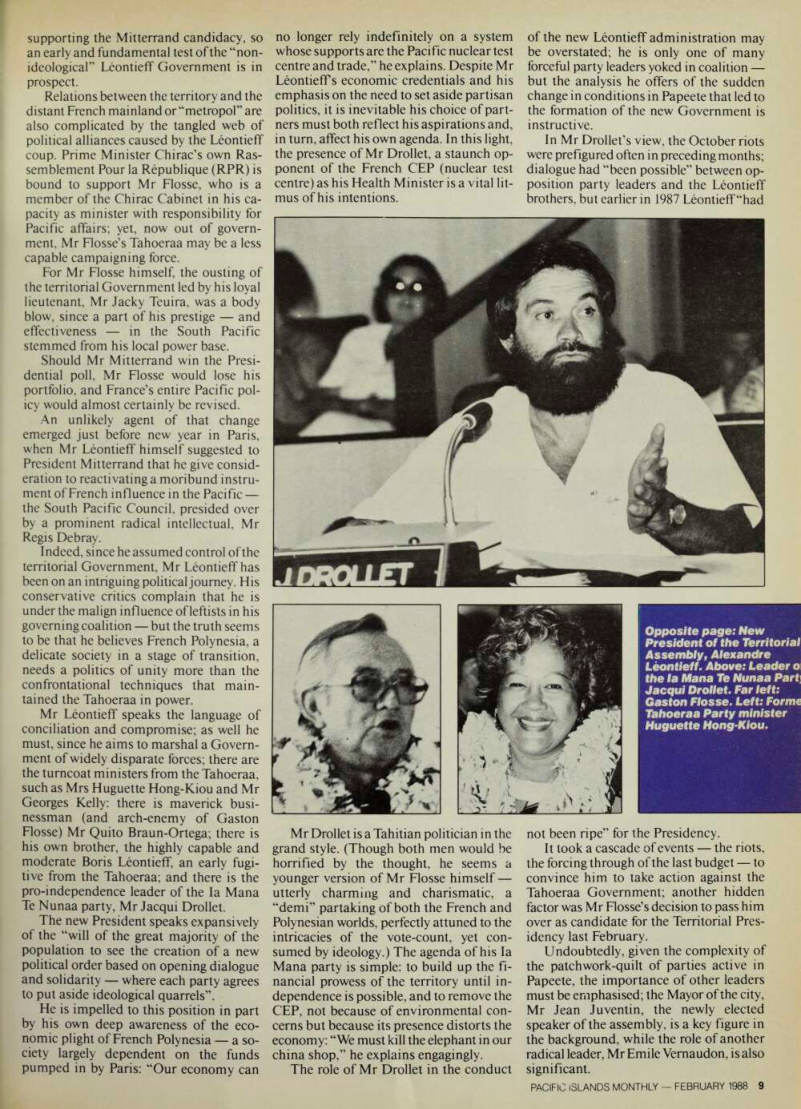
Mr Leontieff speaks the language of conciliation and compromise; as well he must, since he aims to marshal a Govern ment of widely disparate forces; there are the turncoat ministers from the Tahoeraa, such as Mrs Huguette Hong-Kiou and Mr Georges Kelly; there is maverick busi nessman (and arch-enemy of Gaston Flosse) Mr Quito Braun-Ortega; there is his own brother, the highly capable and moderate Boris Leontieff, an early fugi tive from the Tahoeraa; and there is the pro-independence leader of the la Mana Te Nunaa party, Mr Jacqui Drollet.
The new President speaks expansively of the “will of the great majority of the population to see the creation of a new political order based on opening dialogue and solidarity where each party agrees to put aside ideological quarrels”.
He is impelled to this position in part by his own deep awareness of the eco nomic plight of French Polynesia a so ciety largely dependent on the funds pumped in by Paris: “Our economy can
no longer rely indefinitely on a system whose supports are the Pacific nuclear test centre and trade,” he explains. Despite Mr Leontieffs economic credentials and his emphasis on the need to set aside partisan politics, it is inevitable his choice of part ners must both reflect his aspirations and, in turn, affect his own agenda. In this light, the presence of Mr Drollet, a staunch op ponent of the French CEP (nuclear test centre) as his Health Minister is a vital lit mus of his intentions.
of the new Leontieff administration may be overstated; he is only one of many forceful party leaders yoked in coalition but the analysis he offers of the sudden change in conditions in Papeete that led to the formation of the new Government is instructive.
In Mr Drollet’s view, the October riots were prefigured often in preceding months; dialogue had “been possible” between op position party leaders and the Leontieff brothers, but earlier in 1987 Leontieff “had
Mr Drollet is a Tahitian politician in the grand style. (Though both men would be horrified by the thought, he seems a younger version of Mr Flosse himself utterly charming and charismatic, a “demi” partaking of both the French and Polynesian worlds, perfectly attuned to the intricacies of the vote-count, yet consumed by ideology.) The agenda of his la Mana party is simple: to build up the financial prowess of the territory until independence is possible, and to remove the CEP, not because of environmental concerns but because its presence distorts the economy: “We must kill the elephant in our china shop,” he explains engagingly.
The role of Mr Drollet in the conduct
not been ripe” for the Presidency, It took a cascade of events the riots, the forcing through of the last budget to convince him to lake action against the Tahoeraa Government; another hidden factor was Mr Flosse’s decision to pass him over as candidate for the Territorial Pres idency last February, Undoubtedly, given the complexity of the patchwork-quilt of parties active in Papeete, the importance of other leaders must be emphasised; the Mayor of the city, Mr Jean Juventin, the newly elected speaker of the assembly, is a key figure in the background, while the role of another radical leader, Mr Emile Vemaudon, is also significant.
Opposite page: New President of the Territorial Assembly, Alexandre Léontieff. Above: Leader o[?] the la Mana Te Nunaa Part y Jacqui Drollet. Far left: Gaston Flosse. Left: Forme Tahoeraa Party minister Huguette Hong-Kiou.
“Times are changing... and this is what Gaston Flosse did not understand this need of the young to express themselves.”
M But analysts are now recognising the extent to which Mr Leontieffs decision to lead the defection from the Tahoeraa was a personal one a move that grew from the troubled ties between himself and Mr Flosse; and in that pattern can be traced other tokens of change now gusting through Tahiti.
One intimate of Mr Leontieff ventures that the riots were “only the tip of an ice berg of change, they were symptoms; for we have an economy that desperately needs a new source of funds, we have a fast growing population but no jobs this means the time is here for action, and the broader the consensus, the better it is”.
Leontieffs supporters tend to claim that their new administration will be more “Tahitian”, that it will avoid the confron tational styles supposedly characteristic of French mainland politics.
Another of the inner circle, this “court
of Czar Alexandre”, hints at the prevailing optic being employed by Polynesian ob servers to explain December’s palace coup: “This was as much about generations as about politics you can see it all over the territory the young displaces the old and assumes power.”
This pattern is traced in the realm of social change, where the once-undisputed writ of the family elders is now increas ingly challenged by members of the cos mopolitan younger generation. Many of Tahiti’s young have come to develop a bit ter resentment toward the consumerism obsessed, tourism-fuelled society that has failed to provide them with the jobs they need to enjoy the lifestyles that have been promised them.
Significantly, as these changes are tak ing place, the established political al legiances enjoyed by parties such as the Tahoeraa may begin to break down, not
only at the parliamentary level but also amongst the electorate, as younger family members proceed to break ranks with their elders.
“Times are changing it is May ’6B that has been happening here over the past few months, and this is what Gaston Flosse didn’t understand this need of the younger generation to express them selves,” one thoughtful political insider comments.
But a key Tahoeraa loyalist, one of Mr Flosse’s most trusted aides, sees things differently; he views Leontieff as a turn
coat who could never have won power at the polls, and so was forced to sieze it by parliamentary manoeuvre.
In this version of events, Flosse figures not as an old reactionary but as the friend of youth as the first Polynesian politi cian who gave opportunities to younger leaders, a rare meritocrat who rewarded brilliance and enterprise. And nothing is as certain, for those who entertain this view, as that Mr Flosse will sweep back to power again in the next election, van quishing the ungrateful prodigal.
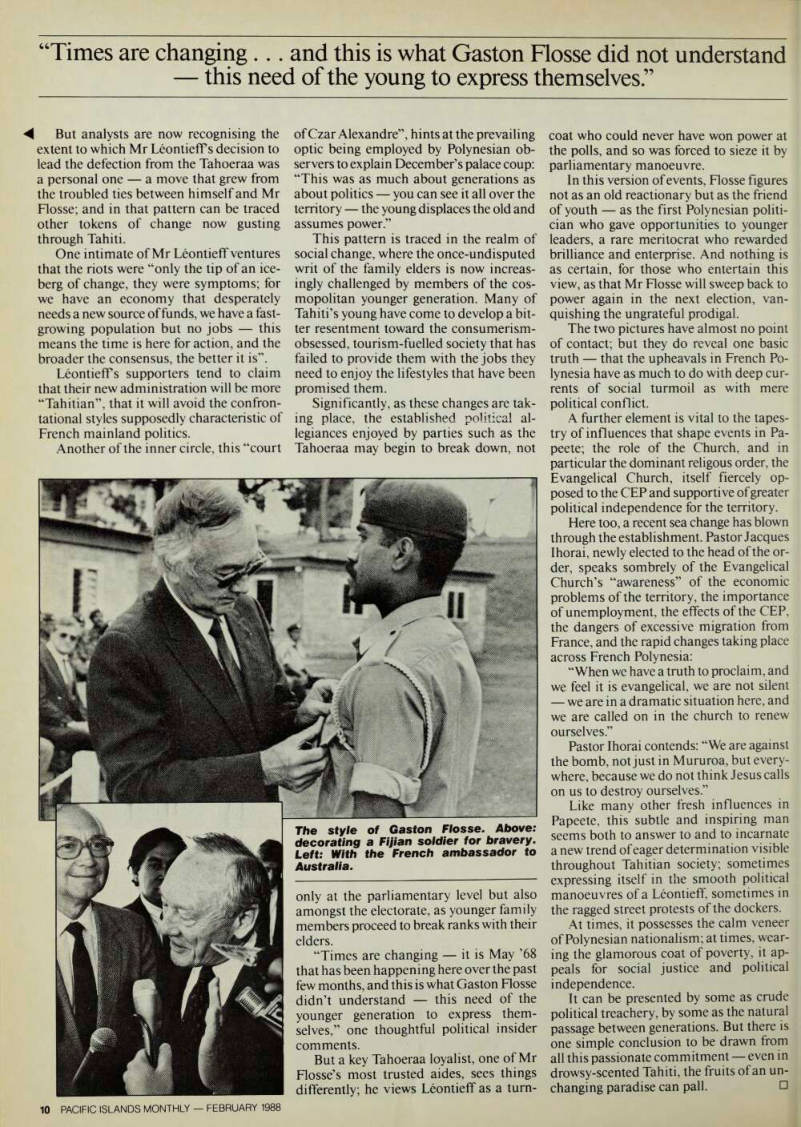
The two pictures have almost no point of contact; but they do reveal one basic truth that the upheavals in French Po lynesia have as much to do with deep cur rents of social turmoil as with mere political conflict.
A further element is vital to the tapes try of influences that shape events in Pa peete; the role of the Church, and in particular the dominant religous order, the Evangelical Church, itself fiercely op posed to the CEP and supportive of greater political independence for the territory.
Here too, a recent sea change has blown through the establishment. Pastor Jacques Ihorai, newly elected to the head of the or der, speaks sombrely of the Evangelical Church’s “awareness” of the economic problems of the territory, the importance of unemployment, the effects of the CEP, the dangers of excessive migration from France, and the rapid changes taking place across French Polynesia: “When we have a truth to proclaim, and we feel it is evangelical, we are not silent we are in a dramatic situation here, and we are called on in the church to renew ourselves.”
Pastor Ihorai contends: “We are against the bomb, not just in Mururoa, but every where, because we do not think Jesus calls on us to destroy ourselves.”
Like many other fresh influences in Papeete, this subtle and inspiring man seems both to answer to and to incarnate a new trend of eager determination visible throughout Tahitian society; sometimes expressing itself in the smooth political manoeuvres of a Leontieff, sometimes in the ragged street protests of the dockers.
At times, it possesses the calm veneer of Polynesian nationalism; at times, wear ing the glamorous coat of poverty, it ap peals for social justice and political independence.
It can be presented by some as crude political treachery, by some as the natural passage between generations. But there is one simple conclusion to be drawn from all this passionate commitment even in drowsy-scented Tahiti, the fruits of an un changing paradise can pall. □
T he style of Gaston Flosse. Above: decorating a Fijian soldier for bravery.
Left: With the French ambassador to Australia.