Kava: A Pacific Ritual
pp. 16-18 · Read in the full issue

The Region
Peace and contact with the spiritual word are granted by the roots of the
“intoxicatingpepper”.
By Nicolas Rothwell
AS THE SUN sets each evening across the islands of Vanuatu, men’s thoughts turn to Piper methysticum the wondrous kava root, emblem of tradition and custom, gateway to dreams and the spirit world.
Kava, long frowned on by colonial authorities in Vanuatu, has undergone a remarkable renaissance since independ ence came to this country in 1980. Though common across much of the Pacific in dif ferent forms, the drinking of kava reaches a peculiar intensity here: for ni-Vanuatu it has become an intriguing amalgam of es tablished ritual practice and new social enthusiasm, and though the pattern is echoed in other island societies, it has come to form a central thread of Vanuatu’s new political and cultural fabric.
The kava plant, related to the domestic pepper bush and found through much of the Pacific islands, has been carried across the ocean by man; only male kava plants have ever been found, indicating that it has spread solely by human division of the
roots and does not repro duce sexually. The drink prepared from the plant is a mild soporific its effects often live up to its Latin name, which some translate as “intoxicat ing pepper”.
Kava-drinking forms part of the cultures of countries in Polynesia, Melanesia and Micro nesia, and the custom is encountered from as far east as Hawaii to as far west as certain parts of Papua New Guinea where some experts be lieve the shrub may have originated.
While Vanuatu’s kava is reputed to be the most potent in the region, sev eral other island states have made it a central part of their culture; Fiji, where the drink is known as yaqona, Samoa and Tonga, and the Microne sian state of Ponape, which even includes the kava-drinking shell on its national flag.
Vanuatu kava-drink ing was by tradition an exclusively male ritual, and remains in modern
society a largely male preserve. A substi tute for alcohol consumption, which has fallen in the fast-growing capital of Port Vila in the post-independence years, the drink is almost always consumed as eve ning falls. Men gather at a nakamal, or kava-drinking hut, where a fresh brew is readily available. Here they find a quiet at mosphere of almost awe-inspiring shared respect, as other drinkers consume the bit ter-tasting drink in half-coconut shell cups, and “listen” reflectively to its effect on mind and body.
This phenomenon is an adaptation of the more ceremonial kava-drinking com mon on many of the islands of Vanuatu, where a range of customs surround the preparation of the drink. The nakamal in some areas is a sacred men’s meeting place; on certain islands such as Tanna, drinking of kava has profound religious and social meaning, bringing the drinker into con tact with the spirit world.
While Fiji’s yaqona drinkers have only six subspecies of the plant from which to
choose, more than 40 found on the islands of Vanuatu some so strong they are rarely, if ever, used in the preparation of the drink are described in The Kavas of Vanuatu by Vincent Lebot and Pierre Cabalion (published by Orfton). Kava po tency is measured in lactones, and the kava-plant with the highest count comes from the island of Epi. According to con noisseurs, different types of kava have dif ferent effects, which can be modified by the preparation of the drink: it may be strained in special ways, chewed or mixed.
The 54 nakamals in Port Vila tend to offer their customers a blend of various popular types. Purer effects can be obtained in the islands an area of Pentecost, for ex ample, is well-known for a kava that gives the drinker a feeling of exceptional mental clarity on the following day.
Though much-studied, the effects of kava remain bafflingly complex. The ac tive ingredient of the root is a mixture of between 12 and 14 chemicals, mostly anaesthetics and analgesics. The plant contains a highly effective natural pain killer, and pharmaceutical companies around the world have recently begun re searching its properties as the drinking of kava across the Pacific has gained inter national attention. One French company is studying the prospects of producing a natural form of Valium from the root, while a German group is in the experimental stages of manufacturing a kava-based pill to combat menstrual pains and to ease childbirth. A slimming aid based on kava could be a runaway marketing success, some kava researchers believe.
Advocates of kava stress that it is an ex tremely healthy drink if consumed in moderation. No studies of its longterm ef fects have been undertaken, but it is easy to find old men on Tanna who have drunk potent kava daily over the past 60 years without perceptible ill-effects.
For a time the United States Food and Drug Administration banned the impor tation into the US of powdered kava, which is drunk widely by the 60,000-strong Sa moan community on the West Coast, but this ban was lifted a year and a half ago.
Kava researchers point to the drink’s nat ural properties: it is high in fibre, low in calories, mildly tranquillising, anti-bac terial and anti-fungal, a painkiller, a gentle diuretic and an appetite-suppressant. In cosmopolitan Port Vila, the male-only tradition has been sufficiently eroded to allow weight-conscious expatriate women to drink a nightly kava-shell or two at cer tain nakamals.
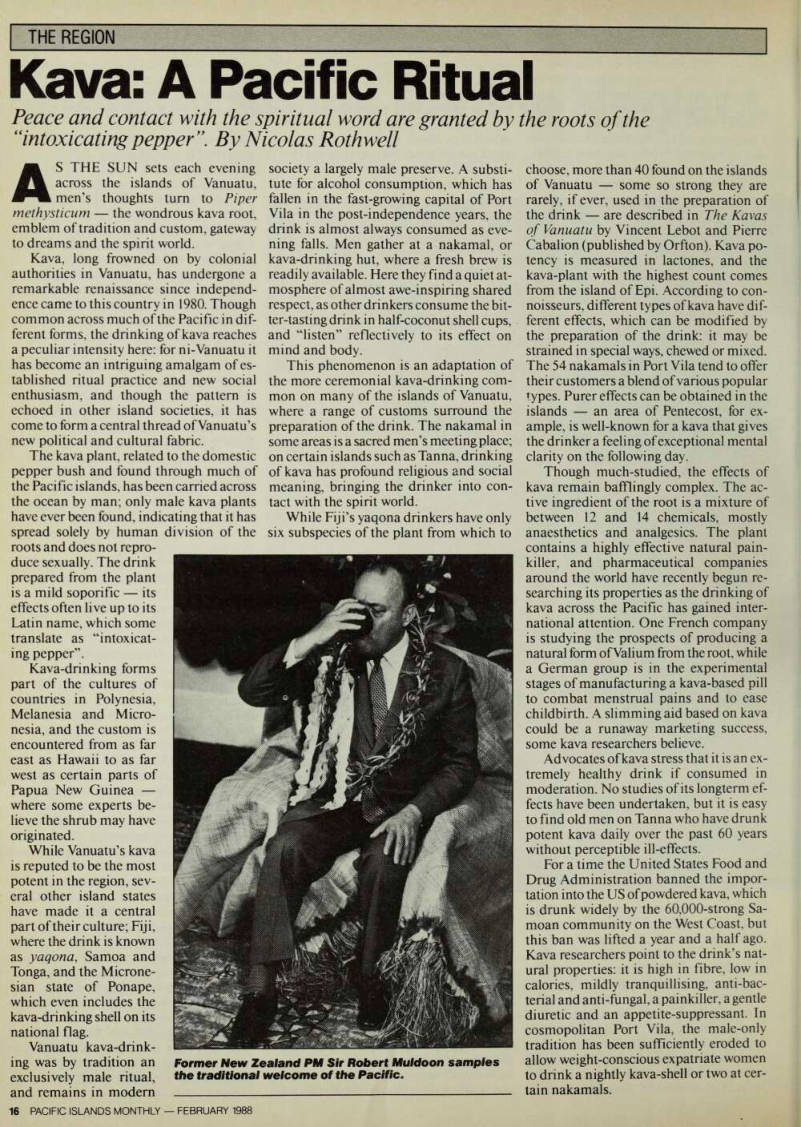
Former New Zealand PM Sir Robert Muldoon samples the traditional welcome of the Pacific.
Unsurprisingly, the Vanuatu Govern ment has decided the export of this pan acea could help its economy, and the Vanuatu Commodities Marketing Board has been entrusted with the task of inter national kava promotion. An engaging leaflet extols the virtues of kava: “Here is a totally natural product, known for cen turies in the Pacific for its wonderful po tential to bring about a sense of calm wellbeing without hangovers or unpleas ant side-effects. Like fine French wines, the kavas of Vanuatu are tended and grown on unique soil types by people who know their properties thoroughly.”
But this image of the sophisticated ni- Vanuatu “kava -culteur" is a slight wester nisation: on Tanna, for example, where the drinking of kava reaches its ritualised peak, the sunset drinking of the potion is seen as a way of enhancing contact with the non material or spirit world.
Pioneering studies on Tanna by Amer
ican-based anthropologist Monty Lindstrom have isolated a ceremony of spitting, after draining the dregs of a kava draught, as a kind of prayer that allows the drinker to alert a particular spirit to a message he is sending. On Tanna, the kava root is traditionally chewed in preparation for drinking by younger men who have not yet had sexual intercourse with women, then mixed with water, squeezed, filtered and drunk fresh. In certain northern islands of Vanuatu, kava is ground using special, stick-shaped reef coral; elsewhere the root is simply pulverised.
The social setting for kava drinking and the reception of the drink by the community also vary greatly from place to place. Mostly, kava is drunk in the nakamal, to enhance peace and discussion about traditional concerns; because of its tranquillising effect, which can banish even thoughts of violence, it is often used to cement agreements and underpin pea-
cemaking ceremonies. On Tanna, kava exchange is central in rituals of clan alli ance; talking while one drinks kava is for bidden on this island.
Kava has always been linked on Van uatu with the magic rituals that form a central thread oflife; with the realm of sor cerers and traditional doctors. Deep myths about kava’s origins, meaning and correct use exist across the islands. “Once you re alise the full story of the origin of kava, you see why it’s such an important plant,” says one informant; but like most reports from Vanuatu’s shimmering magic world, these regards cannot be spoken of without di rect consequences.
On a more secular note, the drinking of kava in Port Vila has a visible effect on the city’s life. Almost crime-free, Vila un like many cities of the South Pacific re tains a strong traditional authority structure through elected leaders of each island community resident in the capital. ►
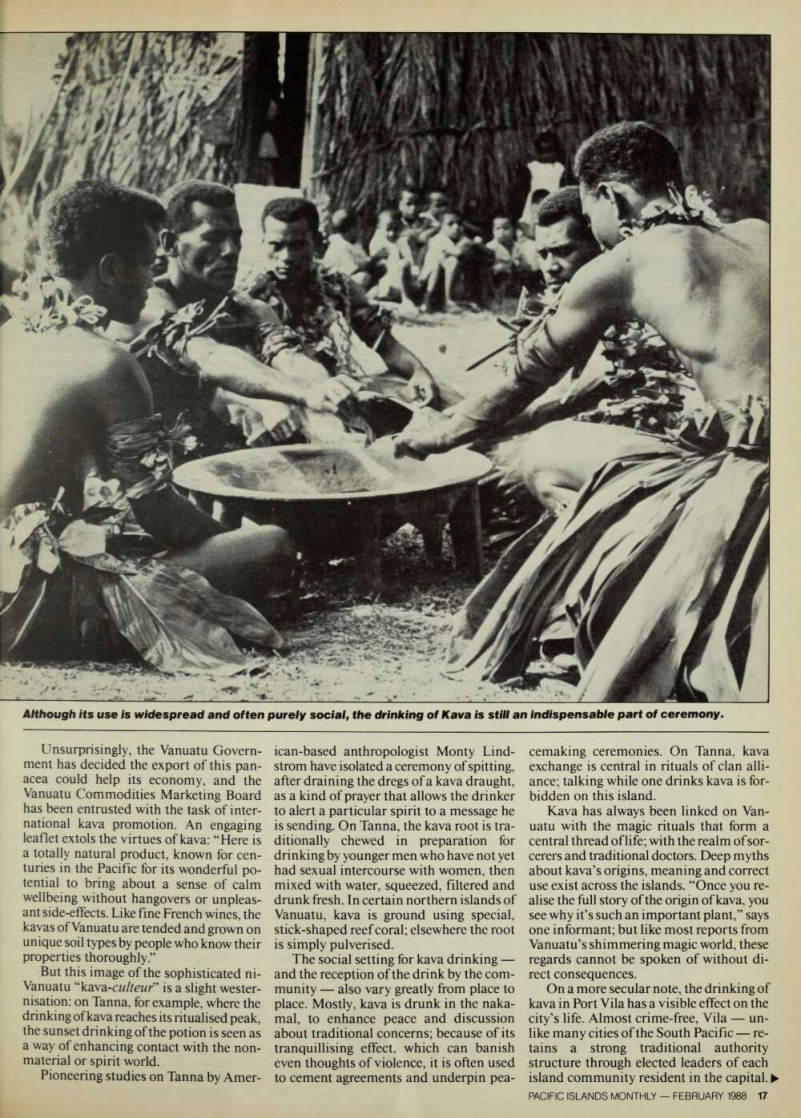
Although its use is widespread and often purely social, the drinking of Kava is still an indispensable part of ceremony.
influence of the church remains strong; but the popularity of kava, increas ingly drunk instead of alcohol, is also a crucial factor. In the late 19705, when the independence movement became a sig nificant force in the then-condominium of the New Hebrides, a revival of tradi tional customs was a natural avenue for the expression of nationalist sentiments. The first nakamal in Vila was opened in 1979, and kava has rapidly become the national drink of Vanuatu. Its use is also increasing fast in the outer islands and is spreading to areas where it was not drunk in the past, or where it was banned by missions.
One of kava’s most enthusiastic advo cates, Vanuatu Cultural Centre anthropol ogist Dr Kirk Huffmann, who has spent the past 13 years in the country, explains succinctly that, “just as God gave the Ar abs oil, so he gave Vanuatu kava.” He de scribes kava’s effects in admiring terms: “It is a very relaxing drink, and makes you very peaceful and thoughtful without affecting your mental or speech processes at all although if you drink several shells of very strong kava it can affect your limbs.
“Used in the proper way, with the right amount of respect for the culture, it’s a very sophisticated way to end the day,” he ventures.
Dr Huffmann stresses that kava is not a hallucinogen, even if “with certain kinds you can get the impression you can hear things, very far away.” It is non-add ictive, though Dr Huffmann contends charmingly that, “what is addictive about it is not the drink itself but the atmosphere in which it is drunk: that friendly, quiet at mosphere. When I’m away from Vila I miss it, but I wouldn’t call that an addic tion so much as a longing.”
He gives a poignant account of the ef fect of Vanuatu kava on the drinker, as he “listens to” its effect: “When you drink kava, you hear the real world. The world falls into its right proportions when you’re in the nakamal and you’re drinking kava, it could be the real world with the atmosphere, you realise whatever worries you may have aren’t really all that impor tant at all.” Yet the evident enthusiasm of ni-Vanuatu men for the kava nakamal has had one pronounced effect in Vila; to some extent, it emphasises the division of the sexes into different worlds.
Mrs Maria Crowby, a newly elected op position MP and one of the first two women to sit in Vanuatu’s post-independ ence parliament, believes kava-drinking has been transformed from its traditional role into a “way of life” in the city. “Maybe once a week would be alright the men may be calm under kava, but they leave everything to the women. All the respon sibility rests with the woman; it’s as if there is no father.”
More pragmatically, Mrs Grace Mol isa, a highly placed government official and women’s council leader, points out that “viewing the way women are affected
by all kinds of things, I would say I prefer men to drink kava than alcohol they are less likely to end up in hospital with bro ken bones. With kava they always come home to look for food and a bed to sleep in, so from that point of view it would be in women’s interests that men drink kava.”
Mrs Molisa concedes that, “having a set time each evening when men are abso lutely absent from the home doesn’t help” in promoting the equal sharing of house hold duties between the sexes, but she feels clearly that the new and evolving role of kava in Vanuatu’s modern society has a great importance: “Kava has a signifi cance; it’s not something you drink just like a juice,” she says, “and kava-drinking will continue to evolve and form a pattern. At the moment it’s good business... and it’s also cheaper than alcohol.”
While kava forms such a central part of both the ritual and secular life of the ni- Vanuatu, the plant has yet to penetrate deep into some other Melanesian coun tries. Both the Solomon Islands and Papua New Guinea are predominantly betel-nut chewing areas, though there are two re gions of Papua New Guinea; one an iso lated West Sepik zone, one in Gogodala, where kava is drunk. Noumea’s first kava nakamal opened recently, and the drink is now becoming popular with Kanaks in New Caledonia ... though ni-Vanuatu visitors say that, at CFP3OO for a single kava shell, the price is exorbitant.
Sadly, kava’s recent transmission to Australia has been less fortunate. North ern Territory Aborigines were introduced to kava in the early 1960 s by two Fijian missionaries, who saw the root as a prom ising substitute for alcohol. Press reports, often of the “killer kava scourge” variety, indicate that Aborigines, unskilled in the proper use of the drink, have been mixing it with spirits or even adulterating the kava powder base. The West Australian Government recently proposed a volun tary ban on kava importation. Dr Huff mann, speaking carefully, comments that, “with the rather sad state of affairs in Aus tralia, I can’t help but have the feeling some Aboriginal groups are in such a difficult and estranged state, the nature of the problems facing them now may force them psychologically to overdo anything that comes along.”
Symbol both of custom’s return and new nationhood, kava in Vanuatu bridges past and present with each shell. And every sunset, as the Pacific’s most unchanging splendour spreads across the islands, the drinking of kava is a ritual made afresh both for the magic realms of passing times, and for the quiet fellowships newborn anew each night in Vila’s nakamals. After kava, men fall silent. They listen gently through the twilight air, a numbness in their mouths, a slowness in their limbs; then a sound seems to reach them from beyond the horizon, and the kava plant whispers its wordless secrets once again. □