Fiji
p. 42 · Read in the full issue
THE takeover in Fiji by Brigadier Rabuka not only signalled the end of Western democracy there, but gave a graphic demonstration of Aus tralian military impotence in the region.
At the time of the first coup in May, the Fijian armed forces totalled just under 3100 regulars with a further 5000 reserves. The 2500-strong army was made up of three infantry battalions (one reserve), an en gineer company and support units. The heaviest equipment was a dozen 81mm mortars. A further 170 served in the navy, which is equipped with three modern 370tonne coastal minesweepers, two with helo-deck facilities.
The majority of this force, however, was on overseas service, one serving with UN IFIL in the Lebanon and the other in Egypt with the Sinai MFO. Since the coup, the army has been expanded to around 8000 by the call-up of reserves but they are now slowly being demobilised to normal lev els. There are increasing reports of moves to upgrade the armed forces by the intro duction of new equipment.
The coup has given an added impetus to the formation of a pan-Melanesian
movement throughout the region. Organ isations such as the Melanesian Spear head group are designed to promote independence for New Caledonia and af ford a greater say for Melanesian states in regional affairs. This movement along with the emergence of a Polynesian group is being seen as a direct challenge to the pre-eminence of Australia and New Zealand.
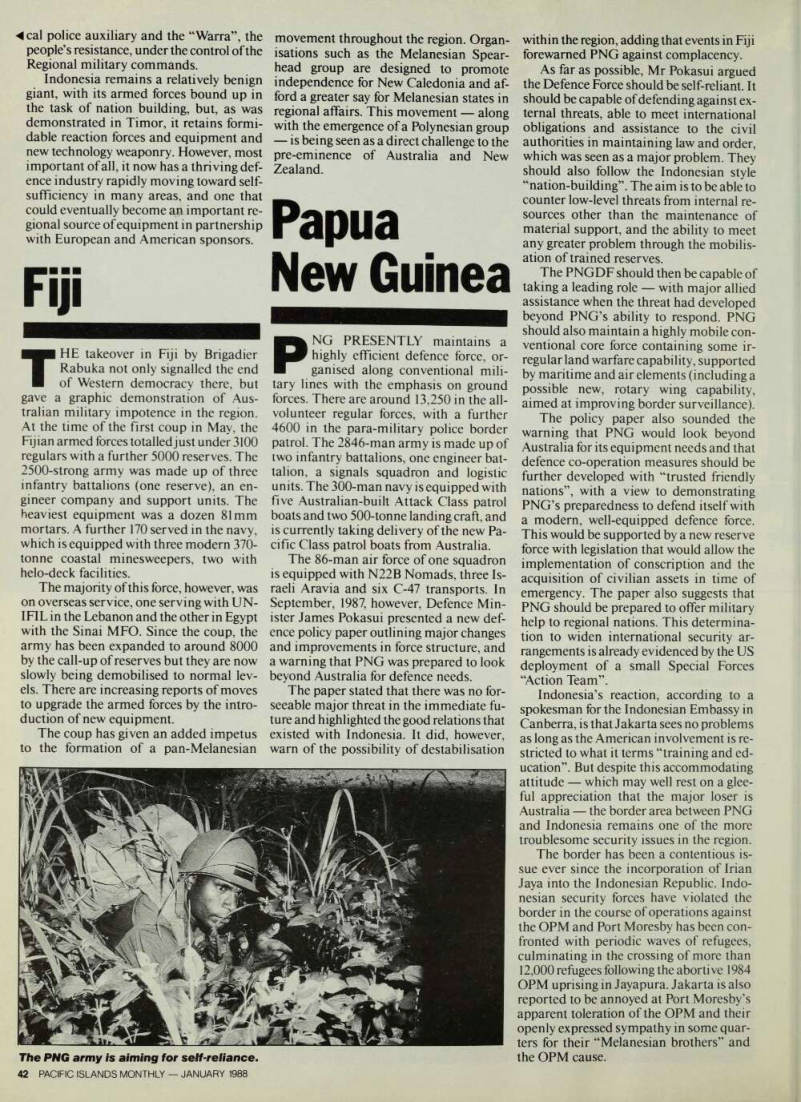
The PNG army is aiming for self-reliance.