Indonesia
pp. 40-42 · Read in the full issue
TO SOME observers, it is Indonesia with its numbers, industrial po tential and military strength that is emerging as the major regional power.
Indonesia maintains first-line armed forces of 281,000, with reserves of around 8000 fed by two-year selective conscrip tion used to man the regular forces. It is well trained and well equipped, with a ma jor re-equipment program underway.
Much of the effort of the Indonesian Armed Forces is directed toward “nation building”, but Jakarta maintains a for midable Strategic Reserve (KOSTRAD) and ready units: an estimated 20,000 men are deployed in East Timor.
The ground force of 216,000 is organ ised into two infantry divisions, one ar moured cavalry brigade, three infantry
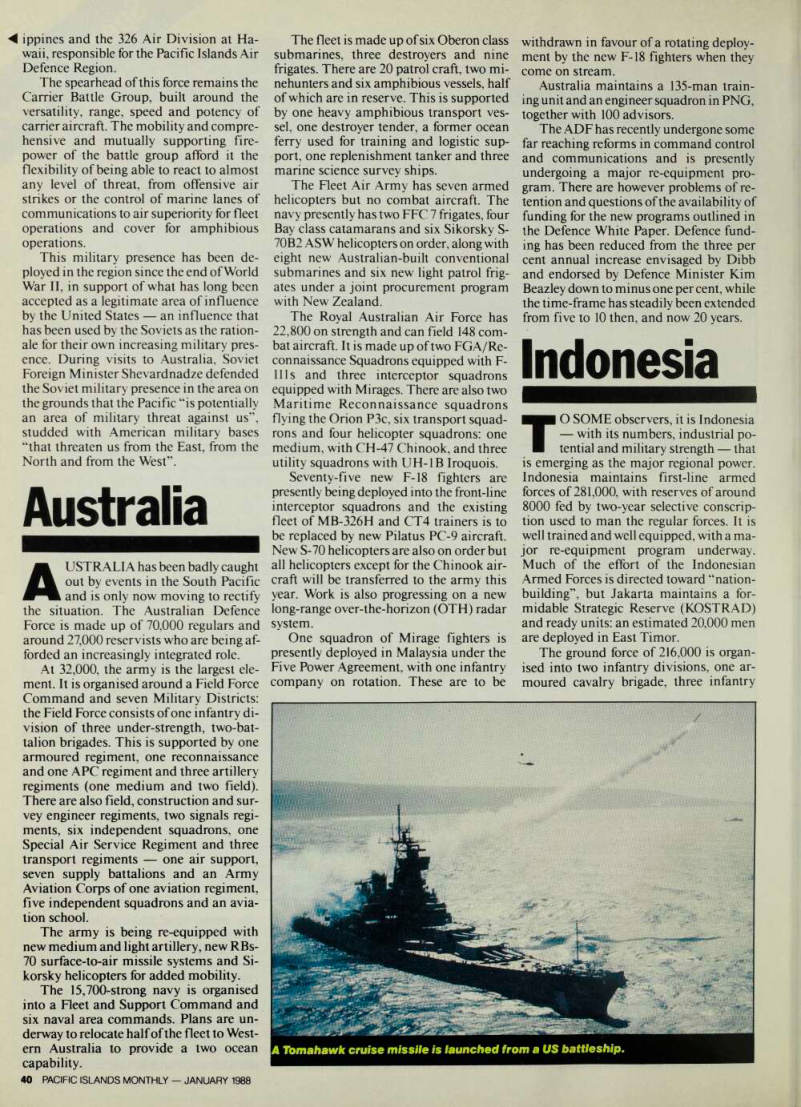
A Tomahawk cruise missile is launched from a US battleship.
brigades, six airborne battalions, two field artillery and one anti-aircraft regiments, a field engineer regiment and four special warfare groups. There are also eight cav alry with four independent airborne and 13 independent field and anti-aircraft bat talions. This is supported by six inde pendent field engineer battalions, three special warfare groups (KOPASSU) and two army aviation squadrons. There are a further 39 independent infantry bat talions allotted to Military Province Commands (KOREM). The army is also in the process of forming a third infantry division.
The 26,000 strong Indonesian Navy is organised into two fleets equipped with six guided weapon frigates (including the re cently acquired two Van Speijk class, equipped with Harpoon surface-to-sur face missiles), six conventional frigates, of which two are about to be retired to the reserve, three Corvettes and four torpedo and patrol fast-attack craft, with an addi tional 31 patrol vessels. The navy has two minesweepers, two command and sup port ships and 12 amphibious vessels.
There are also 19 cargo, training survey and repair ships and three submarines.
The 27,000-strong air force is divided into two Air Operations Areas and is equipped with 84 combat aircraft. These
are organised into two fighter/ground attack and one interceptor squadrons flying Northrop F-5s and A 4 Skyhawks. There is also a Counter-Insurgency Squadron with OV-10F Broncos and a Maritime Reconnaissance squadron, four transport and three helicopter squadrons with C-130 and 140 Hercules, Fokker and Skyvan transport aircraft and Sikorsky S-58, Bell 2048, SA 3301 Puma, Hughes 500 and Indonesian made MBB-105 helicopters.
There is also a 19,000-man Strategic Reserve under the direct control of the
Commander of the Armed Forces made up of two divisions, a cavalry brigade, spe cial forces and support arms and services.
There are also five counter-insurgency battalions supported by six roll-on, roll-off cargo ships and a 3000-strong Special Forces command.
Behind this are 115,000 special police and a Department of Defence and Secu rity police brigade of 12,000, organised into independent companies; a militia of about 300,000 and a large civil defence force and popular units such as the “Kamra”, the lo- ►
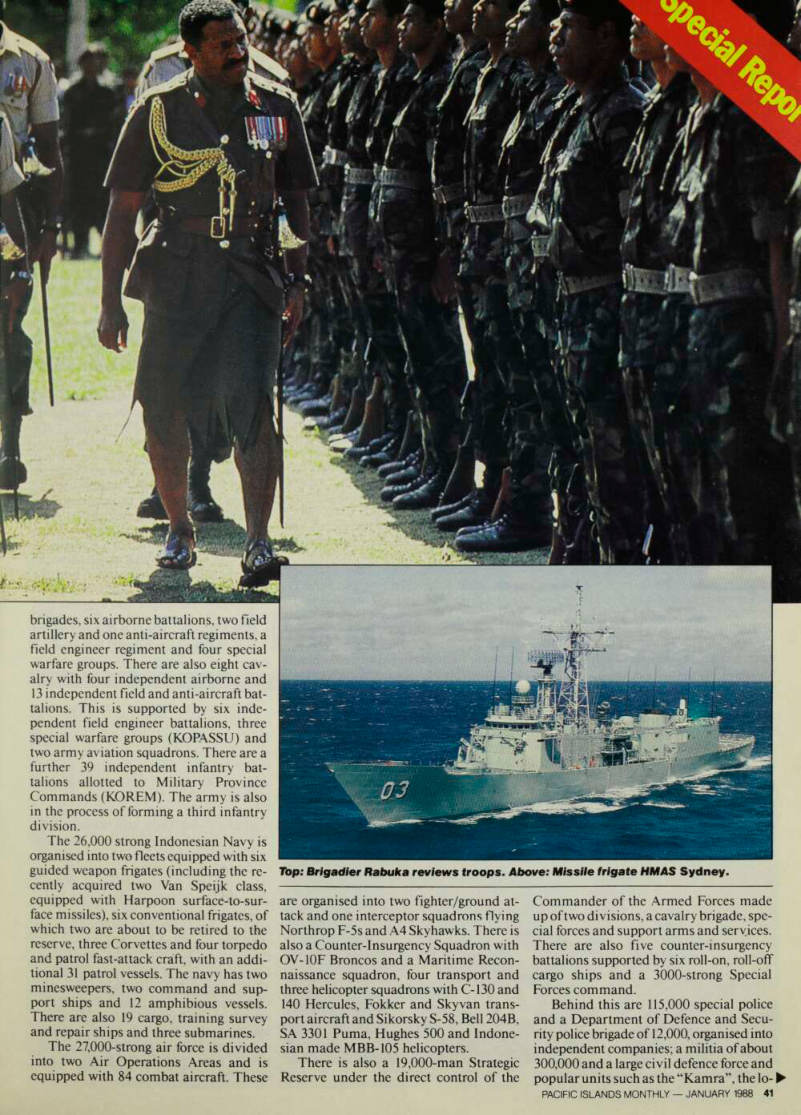
Top: Brigadier Rabuka reviews troops. Above: Missile frigate HMAS Sydney.
◄ cal police auxiliary and the “ Warra”, the people’s resistance, under the control of the Regional military commands.
Indonesia remains a relatively benign giant, with its armed forces bound up in the task of nation building, but, as was demonstrated in Timor, it retains formi dable reaction forces and equipment and new technology weaponry. However, most important of all, it now has a thriving def ence industry rapidly moving toward self sufficiency in many areas, and one that could eventually become an important re gional source of equipment in partnership with European and American sponsors.