The Church Today
pp. 16-18 · Read in the full issue
Forum
The Pacific hosts a variety of religions some traditional, some radical. Yet there are few regions in the world where worship offers so strong a chance for unity and progress. By James S Murray
The peoples of the Pacific have in herited, for the most part, forms of Christianity derived from colonial backgrounds and while independence has largely brought about a severance of for mer colonial ties, with a few notable ex ceptions the Christian inheritance has been retained.
There are now signs of restiveness, es pecially in New Caledonia, where Cathol icism tends to be the faith of the governing and Envangelical Christianity the inspi ration of the kanak independence movement.
In Papua New Guinea, too, there are signs of irritation (to put it at its mildest) with colonial vestiges attached to church organisation, though the word “mission ary” does not seem as dirty as it has be come in parts of Africa and Asia and its synonym with “imperialist” remains un used by most Pacific peoples.
But if the ocean is “pacific”, there is a new mood these days among the region’s Christians that could lead to more ener getic articulations of a Christianity dis tinctively local, as the churches’ leadership and expertise have been increasingly indigenised.
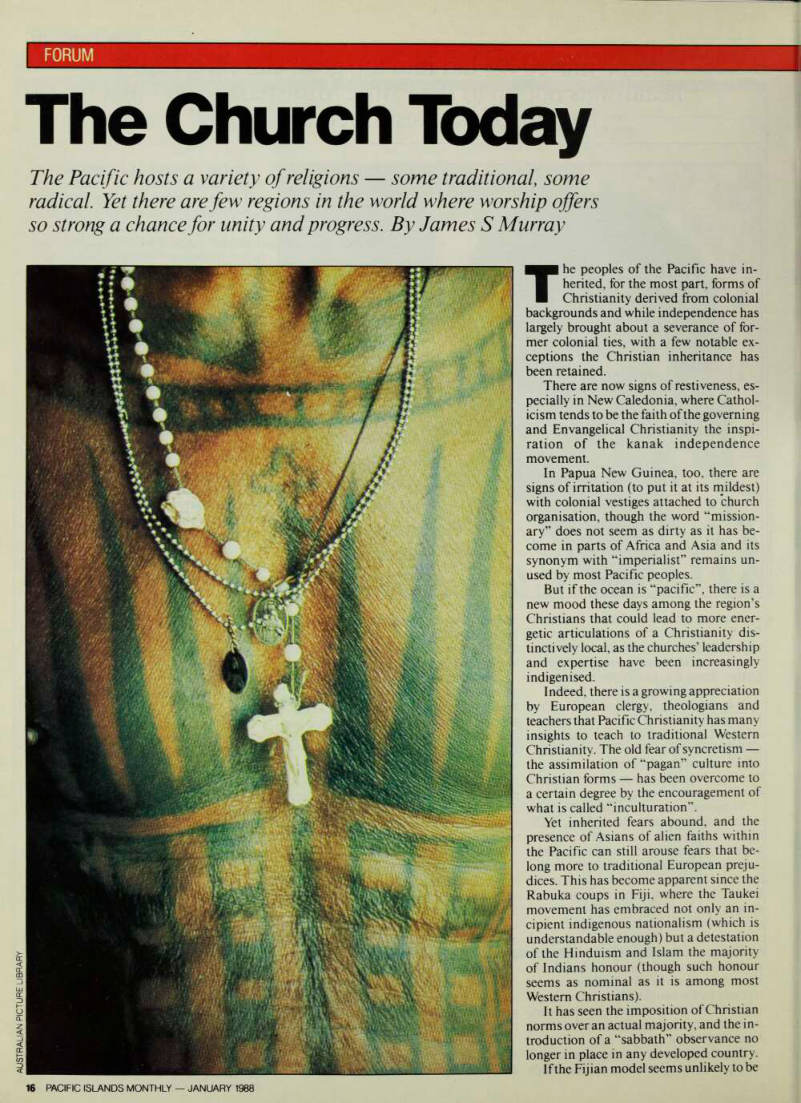
Indeed, there is a growing appreciation by European clergy, theologians and teachers that Pacific Christianity has many insights to teach to traditional Western Christianity. The old fear of syncretism the assimilation of “pagan” culture into Christian forms has been overcome to a certain degree by the encouragement of what is called “inculturation”.
Yet inherited fears abound, and the presence of Asians of alien faiths within the Pacific can still arouse fears that be long more to traditional European preju dices. This has become apparent since the Rabuka coups in Fiji, where the Taukei movement has embraced not only an in cipient indigenous nationalism (which is understandable enough) but a detestation of the Hinduism and Islam the majority of Indians honour (though such honour seems as nominal as it is among most Western Christians).
It has seen the imposition of Christian norms over an actual majority, and the in troduction of a “sabbath” observance no longer in place in any developed country.
If the Fijian model seems unlikely to be
Australian Picture Library
imitated elsewhere in the Pacific, the steady inroads of more arbitrary Protes tantism from the United States should not be underestimated. The increasingly suc cessful evangelism of the Seventh Day Ad ventists in the Pacific could bring with it social practices and taboos as alien to Pa cific cultures as those imposed in Fiji.
One constraint on the process has been the indigenisation of the leadership and pastorate of the churches. Nonetheless, the social ills brought by European interven tion have not only dismayed many church leaders but turned some to patriarchal roles that were not their original preroga tive. The condemnation of alcohol, and of gambling and smoking an evangelistic plank of the Adventists and other funda mental Christians has attracted rather than repelled many Pacific Christians who have seen their cultures and societies un der moral threat.
It is interesting that much of the early evangelism of the Pacific was carried out not by foreign missionaries but by local converts; there was also pressure from paramount and high chiefs who carried their people with them into Christian al legiance, though the material induce ments foreign missionaries could offer played no small part in deciding which de nomination would win the day.
The Catholic Church was often the poor relation in such loyalty competitions, and the Protestant missionaries not the least chary in developing convenient Euro pean-derived prejudices to further the work of salvation. A resort to fear was not unknown, and the ignorance of Christian differences often employed to gain ascendancy.
Pacific cultures, too, found the disci
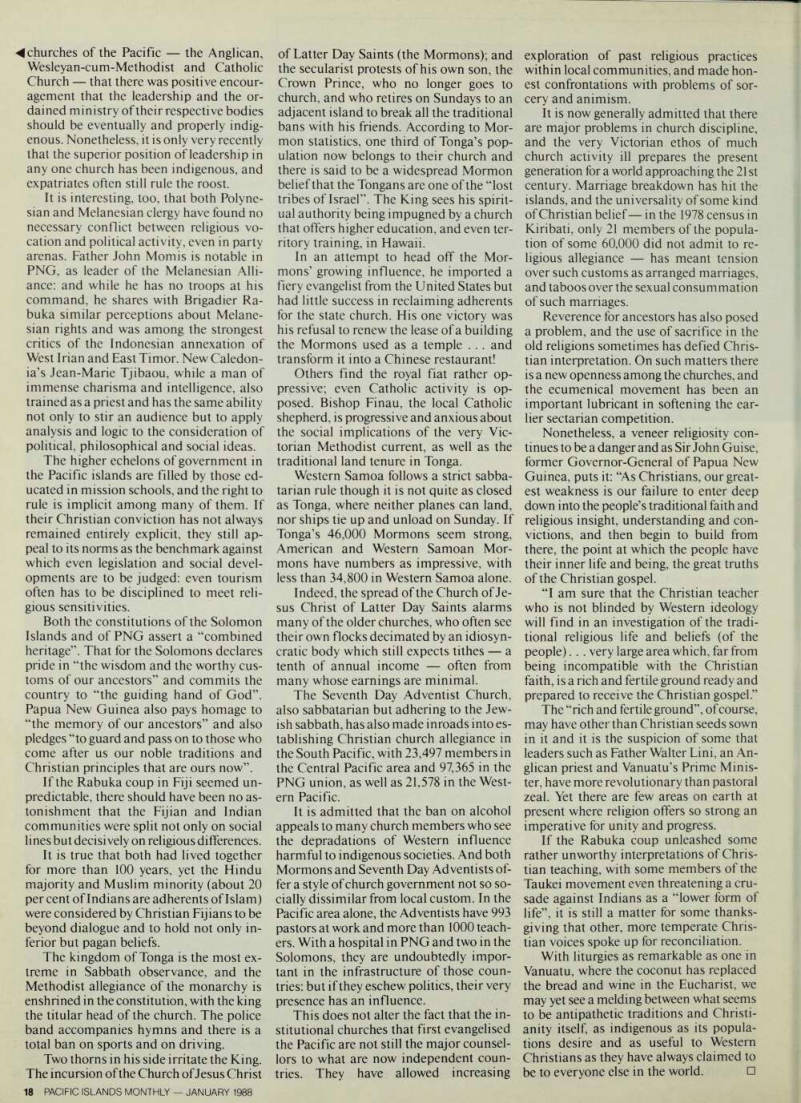
pline of celibacy extraordinary, and even if nuns and brothers showed compassion and lifelong devotion to their work, they seemed somewhat idiosyncratic on islands where family and tribal concepts were already in place. In general, apart from those areas where French influ ence has been predominant, Ca tholicism has made slow progress and its numerical presence is small.
Anglican missionary ac tivity, however, was often vig orous and was conducted by men and women with some char isma. The majority of these mis sionaries came from Australia or New Zealand, and had the early enthusiasm of the Reverend Samuel Marsden, whose honour as an apostle of distinction is leg endary in New Zealand.
The London Missionary So
ciety was also a prime mover, and along with the Wesleyans, showed remarkable influence and power. But their rivalry was often unseemly, and at times dangerously divisive in native societies. It was not surprising that a day would come when missionaries of the same colour as the indigenous peoples would be more readily accepted.
World War II saw influences from the US arriving with some subtlety, and the more traditional churches were soon confronted by well-financed incursions from missionaries of a more aggressive kind, whose funding was often aided by tithing and was dependent on scalps being collected in conversion statistics that would
impress the folks back home in the USA.
In Papua New Guinea such appear ances became a threat to the Christian bodies already settled there, which were soon faced by sizable challenges of recon struction after the ravages of war.
ANGAU the Australian-New Guinea Administration Unit was said by some older missionaries to turn an ob livious post-war eye to the former mu tually workable arrangement that had seen regions of missionary activity assigned to the London Missionary Society, the An glican Church or the Catholic Church.
Now others, seen as sheep-stealers, ar rived on the scene and were neither re buked by authorities nor sent packing.
Cargo-cultism also offered Messianic expectations of plenty to those who had observed the profligacy of war, and the new cults and often livelier churches of American origin seemed to offer a sur-
prising largesse both in spiritual stimuli and material rewards: the “Old Firm” was in rather depressed competitiveness.
Legends had meanwhile developed in the minds of the church supporters back home, both in Australia and those coun tries of Europe where converting the “no ble savage” was still a challenge; and if Father Damien, the leper saint of the Ha waiian island of Molokai, brought tears to the eyes of Catholic memory, Anglicans had more recent martyrs at the hands of the Japanese; these they canonised in an nual memory, if they had no mechanism by which they could become “saints” in the calendar of the church.
Yet it is in the favour of the major ►
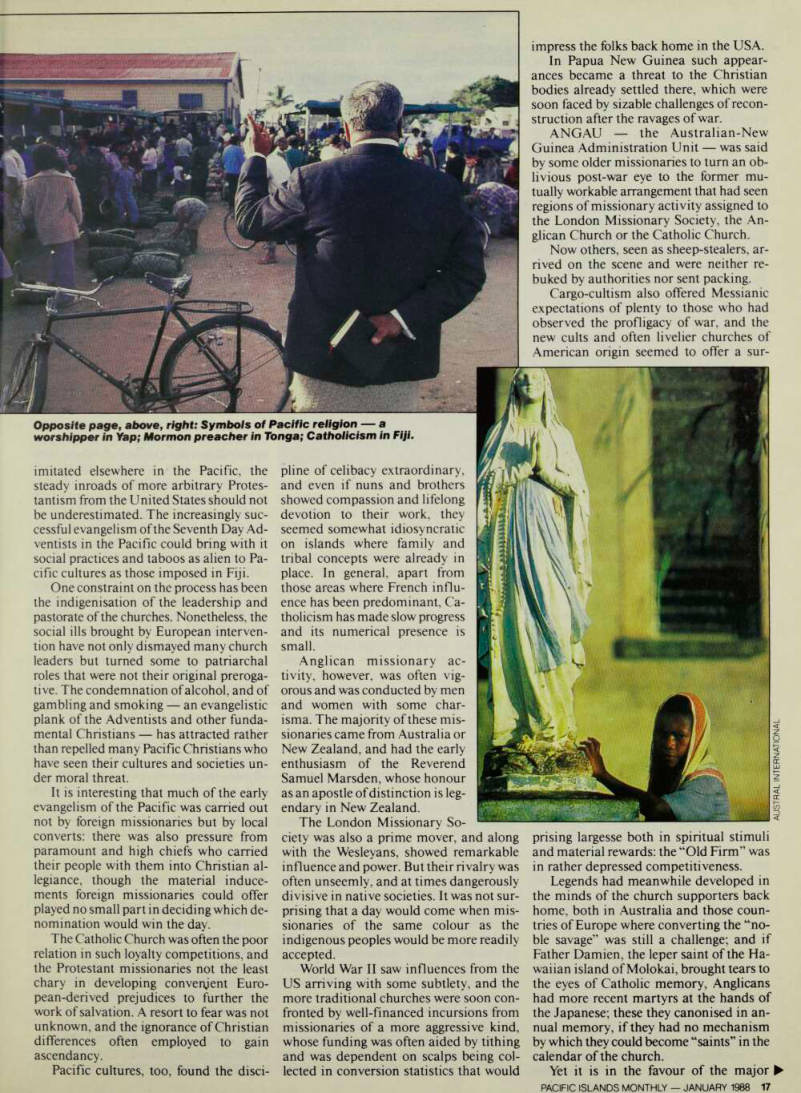
Opposite page, above, right: Symbols of Pacific religion - a worshipper in Yap; Mormon preacher in Tonga; Catholicism in Fiji.
Austral International
◄ churches of the Pacific the Anglican, Wesleyan-cum-Methodist and Catholic Church that there was positive encour agement that the leadership and the or dained ministry of their respective bodies should be eventually and properly indig enous. Nonetheless, it is only very recently that the superior position of leadership in any one church has been indigenous, and expatriates often still rule the roost.
It is interesting, too, that both Polyne sian and Melanesian clergy have found no necessary conflict between religious vo cation and political activity, even in party arenas. Father John Momis is notable in PNG, as leader of the Melanesian Alli ance: and while he has no troops at his command, he shares with Brigadier Ra buka similar perceptions about Melane sian rights and was among the strongest critics of the Indonesian annexation of West Irian and East Timor. New Caledon ia’s Jean-Marie Tjibaou, while a man of immense charisma and intelligence, also trained as a priest and has the same ability not only to stir an audience but to apply analysis and logic to the consideration of political, philosophical and social ideas.
The higher echelons of government in the Pacific islands are filled by those ed ucated in mission schools, and the right to rule is implicit among many of them. If their Christian conviction has not always remained entirely explicit, they still ap peal to its norms as the benchmark against which even legislation and social devel opments are to be judged: even tourism often has to be disciplined to meet reli gious sensitivities.
Both the constitutions of the Solomon Islands and of PNG assert a “combined heritage”. That for the Solomons declares pride in “the wisdom and the worthy cus toms of our ancestors” and commits the country to “the guiding hand of God”.
Papua New Guinea also pays homage to “the memory of our ancestors” and also pledges “to guard and pass on to those who come after us our noble traditions and Christian principles that are ours now”.
If the Rabuka coup in Fiji seemed un predictable, there should have been no as tonishment that the Fijian and Indian communities were split not only on social lines but decisively on religious differences.
It is true that both had lived together for more than 100 years, yet the Hindu majority and Muslim minority (about 20 per cent of Indians are adherents of Islam) were considered by Christian Fijians to be beyond dialogue and to hold not only in ferior but pagan beliefs.
The kingdom of Tonga is the most ex treme in Sabbath observance, and the Methodist allegiance of the monarchy is enshrined in the constitution, with the king the titular head of the church. The police band accompanies hymns and there is a total ban on sports and on driving.
Two thorns in his side irritate the King.
The incursion of the Church of Jesus Christ
of Latter Day Saints (the Mormons); and the secularist protests of his own son, the Crown Prince, who no longer goes to church, and who retires on Sundays to an adjacent island to break all the traditional bans with his friends. According to Mor mon statistics, one third of Tonga’s pop ulation now belongs to their church and there is said to be a widespread Mormon belief that the Tongans are one of the “lost tribes of Israel”. The King sees his spirit ual authority being impugned by a church that offers higher education, and even ter ritory training, in Hawaii.
In an attempt to head off the Mor mons’ growing influence, he imported a fiery evangelist from the United States but had little success in reclaiming adherents for the state church. His one victory was his refusal to renew the lease of a building the Mormons used as a temple . .. and transform it into a Chinese restaurant!
Others find the royal fiat rather op pressive; even Catholic activity is op posed. Bishop Finau, the local Catholic shepherd, is progressive and anxious about the social implications of the very Vic torian Methodist current, as well as the traditional land tenure in Tonga.
Western Samoa follows a strict Sabba tarian rule though it is not quite as closed as Tonga, where neither planes can land, nor ships tie up and unload on Sunday. If Tonga’s 46,000 Mormons seem strong, American and Western Samoan Mor mons have numbers as impressive, with less than 34,800 in Western Samoa alone.
Indeed, the spread of the Church of Je sus Christ of Latter Day Saints alarms many of the older churches, who often see their own flocks decimated by an idiosyn cratic body which still expects tithes a tenth of annual income often from many whose earnings are minimal.
The Seventh Day Adventist Church, also Sabbatarian but adhering to the Jew ish sabbath, has also made inroads into es tablishing Christian church allegiance in the South Pacific, with 23,497 members in the Central Pacific area and 97,365 in the PNG union, as well as 21,578 in the West ern Pacific.
It is admitted that the ban on alcohol appeals to many church members who see the depradations of Western influence harmful to indigenous societies. And both Mormons and Seventh Day Adventists of fer a style of church government not so so cially dissimilar from local custom. In the Pacific area alone, the Adventists have 993 pastors at work and more than 1000 teach ers. With a hospital in PNG and two in the Solomons, they are undoubtedly impor tant in the infrastructure of those coun tries; but if they eschew politics, their very presence has an influence.
This does not alter the fact that the in stitutional churches that first evangelised the Pacific are not still the major counsel lors to what are now independent coun tries. They have allowed increasing
exploration of past religious practices within local communities, and made hon est confrontations with problems of sor cery and animism.
It is now generally admitted that there are major problems in church discipline, and the very Victorian ethos of much church activity ill prepares the present generation for a world approaching the 21 st century. Marriage breakdown has hit the islands, and the universality of some kind of Christian belief in the 1978 census in Kiribati, only 21 members of the popula tion of some 60,000 did not admit to re ligious allegiance has meant tension over such customs as arranged marriages, and taboos over the sexual consummation of such marriages.
Reverence for ancestors has also posed a problem, and the use of sacrifice in the old religions sometimes has defied Chris tian interpretation. On such matters there is a new openness among the churches, and the ecumenical movement has been an important lubricant in softening the ear lier sectarian competition.
Nonetheless, a veneer religiosity con tinues to be a danger and as Sir John Guise, former Governor-General of Papua New Guinea, puts it: “As Christians, our great est weakness is our failure to enter deep down into the people’s traditional faith and religious insight, understanding and con victions, and then begin to build from there, the point at which the people have their inner life and being, the great truths of the Christian gospel.
“I am sure that the Christian teacher who is not blinded by Western ideology will find in an investigation of the tradi tional religious life and beliefs (of the people)... very large area which, far from being incompatible with the Christian faith, is a rich and fertile ground ready and prepared to receive the Christian gospel.”
The “rich and fertile ground”, of course, may have other than Christian seeds sown in it and it is the suspicion of some that leaders such as Father Walter Lini, an An glican priest and Vanuatu’s Prime Minis ter, have more revolutionary than pastoral zeal. Yet there are few areas on earth at present where religion offers so strong an imperative for unity and progress.
If the Rabuka coup unleashed some rather unworthy interpretations of Chris tian teaching, with some members of the Taukei movement even threatening a cru sade against Indians as a “lower form of life”, it is still a matter for some thanks giving that other, more temperate Chris tian voices spoke up for reconciliation.
With liturgies as remarkable as one in Vanuatu, where the coconut has replaced the bread and wine in the Eucharist, we may yet see a melding between what seems to be antipathetic traditions and Christi anity itself, as indigenous as its popula tions desire and as useful to Western Christians as they have always claimed to be to everyone else in the world. □