A Sporting Smokescreen
p. 19 · Read in the full issue
New Caledonia
By Carson Creagh
Politics mars the spirit of the South Pacific Games.
First Impressions Of New Ca
ledonia reveal the bitter irony and contradiction inherent in this troubled corner of French influence. The public address system at Tonlouta Air port, greeting competitors and visitors for the VIII South Pacific Games, inter spersed airline announcements with The Impossible Dream and I Did It My Way ... potent reminders of France’s ambi tions and its determination to ignore crit icism in the region.
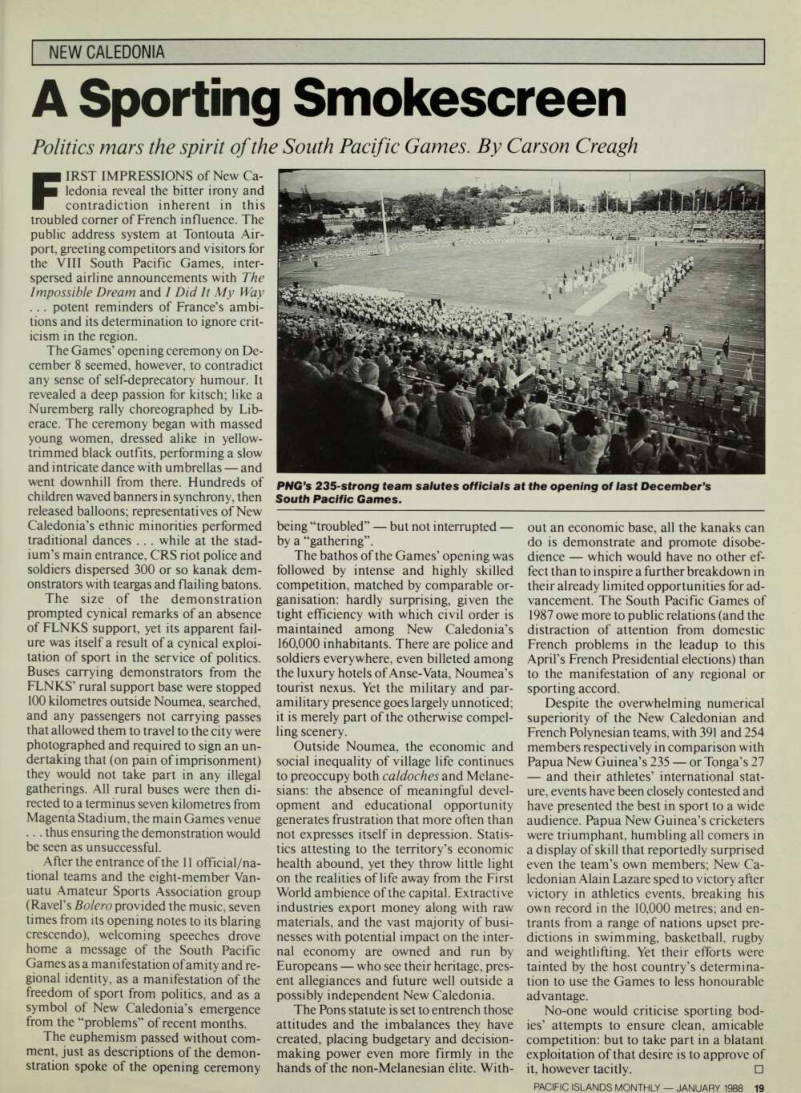
The Games’ opening ceremony on De cember 8 seemed, however, to contradict any sense of self-deprecatory humour. It revealed a deep passion for kitsch; like a Nuremberg rally choreographed by Lib erace. The ceremony began with massed young women, dressed alike in yellow trimmed black outfits, performing a slow and intricate dance with umbrellas and went downhill from there. Hundreds of children waved banners in synchrony, then released balloons; representatives of New Caledonia’s ethnic minorities performed traditional dances ... while at the stad ium’s main entrance, CRS riot police and soldiers dispersed 300 or so kanak dem onstrators with teargas and flailing batons.
The size of the demonstration prompted cynical remarks of an absence of FLNKS support, yet its apparent fail ure was itself a result of a cynical exploi tation of sport in the service of politics.
Buses carrying demonstrators from the FLNKS’ rural support base were stopped 100 kilometres outside Noumea, searched, and any passengers not carrying passes that allowed them to travel to the city were photographed and required to sign an un dertaking that (on pain of imprisonment) they would not take part in any illegal gatherings. All rural buses were then di rected to a terminus seven kilometres from Magenta Stadium, the main Games venue ... thus ensuring the demonstration would be seen as unsuccessful.
After the entrance of the 11 official/na tional teams and the eight-member Van uatu Amateur Sports Association group (Ravel’s Bolero provided the music, seven times from its opening notes to its blaring crescendo), welcoming speeches drove home a message of the South Pacific Games as a manifestation of amity and re gional identity, as a manifestation of the freedom of sport from politics, and as a symbol of New Caledonia’s emergence from the “problems” of recent months.
The euphemism passed without com ment, just as descriptions of the demon stration spoke of the opening ceremony
being “troubled” but not interrupted by a “gathering”.
The bathos of the Games’ opening was followed by intense and highly skilled competition, matched by comparable organisation: hardly surprising, given the tight efficiency with which civil order is maintained among New Caledonia’s 160,000 inhabitants. There are police and soldiers everywhere, even billeted among the luxury hotels of Anse-Vata, Noumea’s tourist nexus. Yet the military and paramilitary presence goes largely unnoticed; it is merely part of the otherwise compelling scenery.
Outside Noumea, the economic and social inequality of village life continues to preoccupy both caldoches and Melanesians: the absence of meaningful development and educational opportunity generates frustration that more often than not expresses itself in depression. Statistics attesting to the territory’s economic health abound, yet they throw little light on the realities of life away from the First World ambience of the capital. Extractive industries export money along with raw materials, and the vast majority of businesses with potential impact on the internal economy are owned and run by Europeans who see their heritage, present allegiances and future well outside a possibly independent New Caledonia.
The Pons statute is set to entrench those attitudes and the imbalances they have created, placing budgetary and decisionmaking power even more firmly in the hands of the non-Melanesian elite. With-
out an economic base, all the kanaks can do is demonstrate and promote disobe dience which would have no other ef feet than to inspire a further breakdown in their already limited opportunities for ad vancement. The South Pacific Games of 1987 owe more to public relations (and the distraction of attention from domestic French problems in the leadup to this April’s French Presidential elections) than to the manifestation of any regional or sporting accord.
Despite the overwhelming numerical superiority of the New Caledonian and French Polynesian teams, with 391 and 254 members respectively in comparison with Papua New Guinea’s 235 or Tonga’s 27 and their athletes’ international stat ure, events have been closely contested and have presented the best in sport to a wide audience. Papua New Guinea’s cricketers were triumphant, humbling all comers in a display of skill that reportedly surprised even the team’s own members; New Ca ledonian Alain Lazare sped to victory after victory in athletics events, breaking his own record in the 10,000 metres; and en trants from a range of nations upset pre dictions in swimming, basketball, rugby and weightlifting. Yet their efforts were tainted by the host country’s determina tion to use the Games to less honourable advantage.
No-one would criticise sporting bod ies’ attempts to ensure clean, amicable competition: but to take part in a blatant exploitation of that desire is to approve of it, however tacitly. □
PNG’s 235 -strong team salutes officials at the opening of last December’s South Pacific Games.