Lini Blocks Sope’s Power Bid
pp. 13-15 · Read in the full issue
Vanuatu
By John Dunn
Vanuatu’s leader is still a force to be reckoned with.
VANUATU’S future role in the South Pacific will be one of the area’s greatest question marks, and one of its most fascinating studies, as the new year gets underway.
Until his stroke in Washington last February, 44-year-old Prime Minister Father Walter Lini had led his 130,000 people along an independent, non-aligned (or, as some would describe it, a relatively radical) road. There had been the connec tion with the Soviet Union in the form of the one-year, SA2 million fishing agree ment signed last January.
Then there had been the flirtation with Libya, in the form of training in Tripoli, in “journalism” and as bodyguards, of some 30 or 40 young party men. To this was added an attempt, albeit clumsy, by two Libyan agents to set up a bureau in Port Vila: a move that was wisely cancelled by the Vanuatu Government. Throughout all this has been the contretemps with the French over Vanuatu’s support for the in dependence-seeking kanaks in New Caledonia.
Father Lini’s illness and his recupera tion have taken him and his country out of the political limelight over recent months, though some issues kept simmering.
As the country’s election campaign geared up, difficulties with the French flared again. Vanuatu expelled French ambassador Henri Crepin-Leblond, claiming France was funding the Union of Moderate Parties (UMP) opposition, led by 43-year-old lawyer Vincent Boulekone.
A furious France denied the charges and withdrew almost all its diplomatic staffin Port Vila.
The election is now over and Lini’s Vanua’aku Party has retained govern ment, winning 26 of the 46 seats in the ex panded parliament. But instead of solving the arguments and settling the issues the election has opened a whole new set of possibilities, producing a situation that makes Vanuatu an even greater enigma.
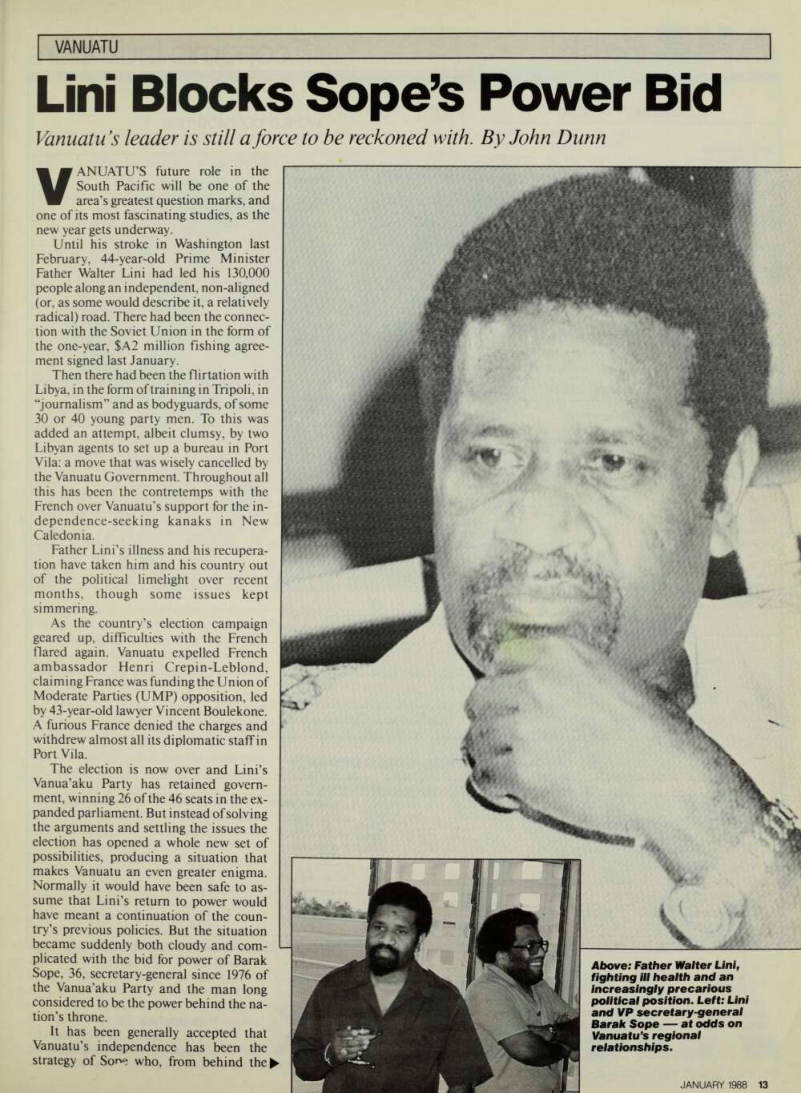
Normally it would have been safe to as sume that Lini’s return to power would have meant a continuation of the coun try’s previous policies. But the situation became suddenly both cloudy and com plicated with the bid for power of Barak Sope, 36, secretary-general since 1976 of the Vanua’aku Party and the man long considered to be the power behind the na tion’s throne.
It has been generally accepted that Vanuatu’s independence has been the strategy of Sone who, from behind the|
Above: Father Walter Lini, fighting ill health and an increasingly precarious political position. Left: Lini and VP secretary-general Barak Sope - at odds on Vanuatu’s regional relationships.
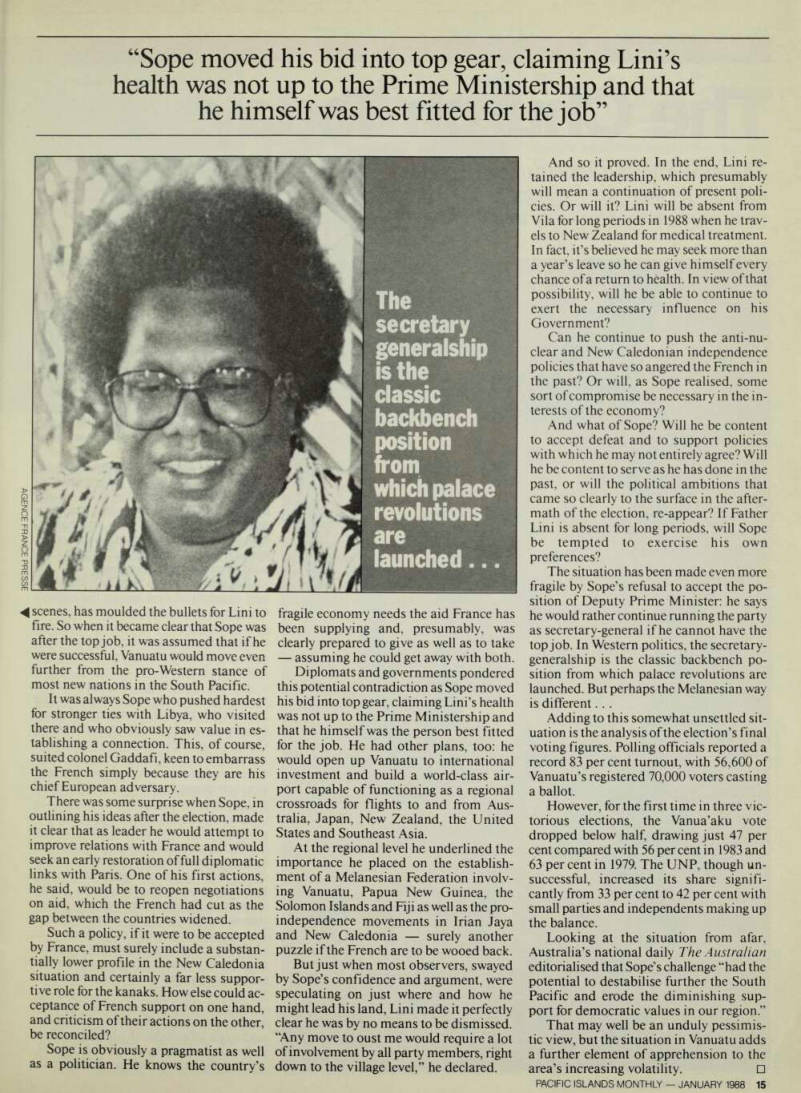
“Sope moved his bid into top gear, claiming Lini’s health was not up to the Prime Ministership and that he himself was best fitted for the job”
<4 scenes, has moulded the bullets for Lini to fire. So when it became clear that Sope was after the top job, it was assumed that if he were successful, Vanuatu would move even further from the pro-Western stance of most new nations in the South Pacific.
It was always Sope who pushed hardest for stronger ties with Libya, who visited there and who obviously saw value in es tablishing a connection. This, of course, suited colonel Gaddafi, keen to embarrass the French simply because they are his chief European adversary.
There was some surprise when Sope, in outlining his ideas after the election, made it clear that as leader he would attempt to improve relations with France and would seek an early restoration of full diplomatic links with Paris. One of his first actions, he said, would be to reopen negotiations on aid, which the French had cut as the gap between the countries widened.
Such a policy, if it were to be accepted by France, must surely include a substan tially lower profile in the New Caledonia situation and certainly a far less suppor tive role for the kanaks. How else could ac ceptance of French support on one hand, and criticism of their actions on the other, be reconciled?
Sope is obviously a pragmatist as well as a politician. He knows the country’s
fragile economy needs the aid France has been supplying and, presumably, was clearly prepared to give as well as to take assuming he could get away with both, Diplomats and governments pondered this potential contradiction as Sope moved his bid into top gear, claiming Lini’s health was not up to the Prime Ministership and that he himself was the person best fitted for the job. He had other plans, too: he would open up Vanuatu to international investment and build a world-class air port capable of functioning as a regional crossroads for flights to and from Aus tralia, Japan, New Zealand, the United States and Southeast Asia, At the regional level he underlined the importance he placed on the establish ment of a Melanesian Federation involv ing Vanuatu, Papua New Guinea, the Solomon Islands and Fiji as well as the pro independence movements in Irian Jaya and New Caledonia surely another puzzle if the French are to be wooed back, But just when most observers, swayed by Sope’s confidence and argument, were speculating on just where and how he might lead his land, Lini made it perfectly clear he was by no means to be dismissed, “Any move to oust me would require a lot of involvement by all party members, right down to the village level,” he declared.
And so it proved. In the end, Lini re tained the leadership, which presumably will mean a continuation of present poli cies. Or will it? Lini will be absent from Vila for long periods in 1988 when he trav els to New Zealand for medical treatment.
In fact, it’s believed he may seek more than a year’s leave so he can give himself every chance of a return to health. In view of that possibility, will he be able to continue to exert the necessary influence on his Government?
Can he continue to push the anti-nu clear and New Caledonian independence policies that have so angered the French in the past? Or will, as Sope realised, some sort of compromise be necessary in the in terests of the economy?
And what of Sope? Will he be content to accept defeat and to support policies with which he may not entirely agree? Will he be content to serve as he has done in the past, or will the political ambitions that came so clearly to the surface in the after math of the election, re-appear? If Father Lini is absent for long periods, will Sope be tempted to exercise his own preferences?
The situation has been made even more fragile by Sope’s refusal to accept the po sition of Deputy Prime Minister: he says he would rather continue running the party as secretary-general if he cannot have the top job. In Western politics, the secretary generalship is the classic backbench po sition from which palace revolutions are launched. But perhaps the Melanesian way is different.. .
Adding to this somewhat unsettled sit uation is the analysis of the election’s final voting figures. Polling officials reported a record 83 per cent turnout, with 56,600 of Vanuatu’s registered 70,000 voters casting a ballot.
However, for the first time in three vic torious elections, the Vanua’aku vote dropped below half, drawing just 47 per cent compared with 56 per cent in 1983 and 63 per cent in 1979. The UNP, though un successful, increased its share signifi cantly from 33 per cent to 42 per cent with small parties and independents making up the balance.
Looking at the situation from afar, Australia’s national daily The Australian editorialised that Sope’s challenge “had the potential to destabilise further the South Pacific and erode the diminishing sup port for democratic values in our region.”
That may well be an unduly pessimis tic view, but the situation in Vanuatu adds a further element of apprehension to the area’s increasing volatility. □
Agence France Presse
The secretary generalship is the classic backbench position from which palace revolutions are launched...