Diro Scandal Escalates
pp. 14-15 · Read in the full issue
Papua New Guinea
The timber inquiry unleashes a series of sensations.
By Frank Senge
THE Commission of Inquiry into the PNG timber industry looks set to be one of the country’s most con troversial investigations.
The inquiry cuts a path through six countries Australia, Hong Kong, In donesia, Malaysia, Singapore and Vanu atu. The “cast of characters” that has come under scrutiny by the inquiry involves the Governments of PNG and Vanuatu, an Indonesian army commander and busi nessmen from Australia, Malaysia, PNG and Singapore.
PNG’s foreign exchange and customs regulations and leadership code have been broken at various times, according to doc uments before the commission.
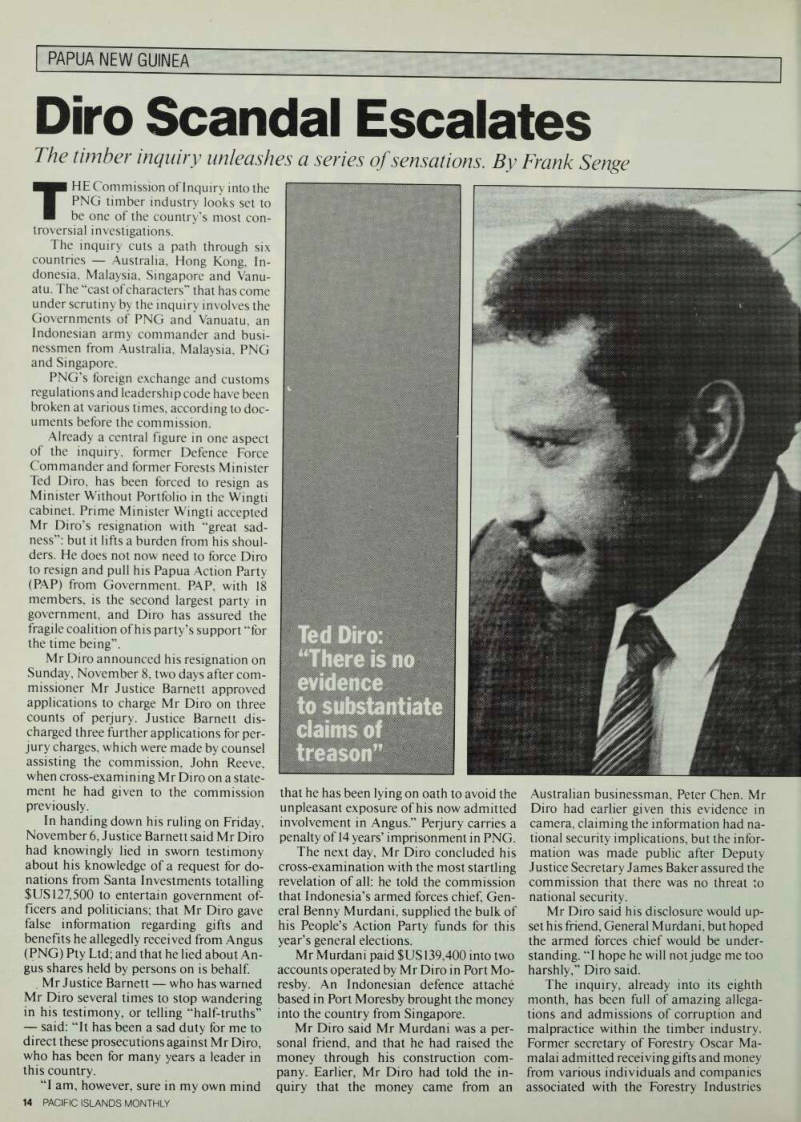
Already a central figure in one aspect of the inquiry, former Defence Force Commander and former Forests Minister Ted Diro, has been forced to resign as Minister Without Portfolio in the Wingti cabinet. Prime Minister Wingti accepted Mr Diro’s resignation with “great sad ness”: but it lifts a burden from his shoul ders. He does not now need to force Diro to resign and pull his Papua Action Party (PAP) from Government. PAP, with 18 members, is the second largest party in government, and Diro has assured the fragile coalition of his party’s support “for the time being”.
Mr Diro announced his resignation on Sunday, November 8, two days after com missioner Mr Justice Barnett approved applications to charge Mr Diro on three counts of perjury. Justice Barnett dis charged three further applications for per jury charges, which were made by counsel assisting the commission, John Reeve, when cross-examining Mr Diro on a state ment he had given to the commission previously.
In handing down his ruling on Friday, November 6, Justice Barnett said Mr Diro had knowingly lied in sworn testimony about his knowledge of a request for do nations from Santa Investments totalling SUS 127,500 to entertain government of ficers and politicians; that Mr Diro gave false information regarding gifts and benefits he allegedly received from Angus (PNG) Pty Ltd; and that he lied about An gus shares held by persons on is behalf. . Mr Justice Barnett who has warned Mr Diro several times to stop wandering in his testimony, or telling “half-truths” said: “It has been a sad duty for me to direct these prosecutions against Mr Diro, who has been for many years a leader in this country.
“I am, however, sure in my own mind
that he has been lying on oath to avoid the unpleasant exposure of his now admitted involvement in Angus.” Perjury carries a penalty of 14 years’ imprisonment in PNG.
The next day, Mr Diro concluded his cross-examination with the most startling revelation of all: he told the commission that Indonesia’s armed forces chief, Gen eral Benny Murdani, supplied the bulk of his People’s Action Party funds for this year’s general elections.
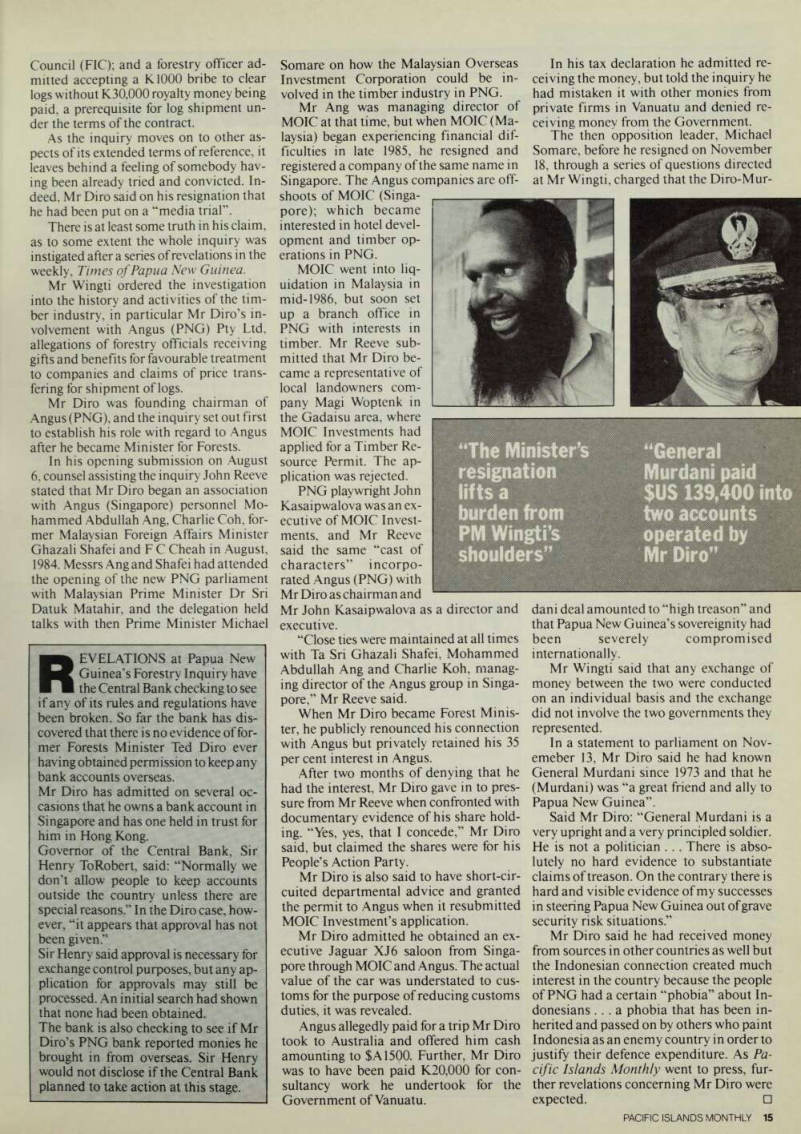
Mr Murdani paid SUS 139,400 into two accounts operated by Mr Diro in Port Mo resby. An Indonesian defence attache based in Port Moresby brought the money into the country from Singapore.
Mr Diro said Mr Murdani was a per sonal friend, and that he had raised the money through his construction com pany. Earlier, Mr Diro had told the in quiry that the money came from an
Australian businessman, Peter Chen. Mr Diro had earlier given this evidence in camera, claiming the information had na tional security implications, but the infor mation was made public after Deputy Justice Secretary James Baker assured the commission that there was no threat to national security.
Mr Diro said his disclosure would up set his friend, General Murdani, but hoped the armed forces chief would be under standing. “I hope he will not judge me too harshly,” Diro said.
The inquiry, already into its eighth month, has been full of amazing allega tions and admissions of corruption and malpractice within the timber industry.
Former secretary of Forestry Oscar Ma malai admitted receiving gifts and money from various individuals and companies associated with the Forestry Industries
Ted Diro: "There is no evidence to subatantiate claims of treason"
Council (FIC); and a forestry officer ad mitted accepting a KlOOO bribe to clear logs without K 30,000 royalty money being paid, a prerequisite for log shipment un der the terms of the contract.
As the inquiry moves on to other as pects of its extended terms of reference, it leaves behind a feeling of somebody hav ing been already tried and convicted. In deed, Mr Diro said on his resignation that he had been put on a “media trial”.
There is at least some truth in his claim, as to some extent the whole inquiry was instigated after a series of revelations in the weekly, Times of Papua New Guinea.
Mr Wingti ordered the investigation into the history and activities of the tim ber industry, in particular Mr Diro’s in volvement with Angus (PNG) Pty Ltd, allegations of forestry officials receiving gifts and benefits for favourable treatment to companies and claims of price trans fering for shipment of logs.
Mr Diro was founding chairman of Angus (PNG), and the inquiry set out first to establish his role with regard to Angus after he became Minister for Forests.
In his opening submission on August 6, counsel assisting the inquiry John Reeve stated that Mr Diro began an association with Angus (Singapore) personnel Mo hammed Abdullah Ang, Charlie Coh, for mer Malaysian Foreign Affairs Minister Ghazali Shafei and F C Cheah in August, 1984. Messrs Ang and Shafei had attended the opening of the new PNG parliament with Malaysian Prime Minister Dr Sri Datuk Matahir, and the delegation held talks with then Prime Minister Michael
Revelations at Papua New Guinea’s Forestry Inquiry have the Central Bank checking to see if any of its rules and regulations have been broken. So far the bank has dis covered that there is no evidence of for mer Forests Minister Ted Diro ever having obtained permission to keep any bank accounts overseas.
Mr Diro has admitted on several oc casions that he owns a bank account in Singapore and has one held in trust for him in Hong Kong.
Governor of the Central Bank, Sir Henry Toßobert, said: “Normally we don't allow people to keep accounts outside the country unless there are special reasons ” In the Diro case, how ever, “it appears that approval has not been given.”
Sir Henry said approval is necessary for exchange control purposes, but any ap plication for approvals may still be processed. An initial search had shown that none had been obtained.
The bank is also checking to see if Mr Diro’s PNG bank reported monies he brought in from overseas. Sir Henry would not disclose if the Central Bank planned to take action at this stage.
Somare on how the Malaysian Overseas Investment Corporation could be in volved in the timber industry in PNG.
Mr Ang was managing director of MOIC at that time, but when MOIC (Ma laysia) began experiencing financial dif ficulties in late 1985, he resigned and registered a company of the same name in Singapore. The Angus companies are off
shoots of MOIC (Singa pore); which became interested in hotel devel opment and timber op erations in PNG.
MOIC went into liq uidation in Malaysia in mid-1986, but soon set up a branch office in PNG with interests in timber. Mr Reeve sub mitted that Mr Diro be came a representative of local landowners com pany Magi Woptenk in the Gadaisu area, where MOIC Investments had applied for a Timber Re source Permit. The ap plication was rejected.
PNG playwright John Kasaipwalova was an ex ecutive of MOIC Invest ments, and Mr Reeve said the same “cast of characters” incorpo rated Angus (PNG) with Mr Diro as chairman and
Mr John Kasaipwalova as a director and executive.
“Close ties were maintained at all times with Ta Sri Ghazali Shafei, Mohammed Abdullah Ang and Charlie Koh, manag ing director of the Angus group in Singa pore,” Mr Reeve said.
When Mr Diro became Forest Minis ter, he publicly renounced his connection with Angus but privately retained his 35 per cent interest in Angus.
After two months of denying that he had the interest, Mr Diro gave in to pres sure from Mr Reeve when confronted with documentary evidence of his share hold ing. “Yes, yes, that I concede,” Mr Diro said, but claimed the shares were for his People’s Action Party.
Mr Diro is also said to have short-cir cuited departmental advice and granted the permit to Angus when it resubmitted MOIC Investment’s application.
Mr Diro admitted he obtained an ex ecutive Jaguar XJ6 saloon from Singa pore through MOIC and Angus. The actual value of the car was understated to cus toms for the purpose of reducing customs duties, it was revealed.
Angus allegedly paid for a trip Mr Diro took to Australia and offered him cash amounting to SAISOO. Further, Mr Diro was to have been paid K 20,000 for con sultancy work he undertook for the Government of Vanuatu.
In his tax declaration he admitted re ceiving the money, but told the inquiry he had mistaken it with other monies from private firms in Vanuatu and denied re ceiving money from the Government.
The then opposition leader, Michael Somare, before he resigned on November 18, through a series of questions directed at Mr Wingti, charged that the Diro-Mur-
dani deal amounted to “high treason” and that Papua New Guinea’s sovereignity had been severely compromised internationally.
Mr Wingti said that any exchange of money between the two were conducted on an individual basis and the exchange did not involve the two governments they represented.
In a statement to parliament on Nov emeber 13, Mr Diro said he had known General Murdani since 1973 and that he (Murdani) was “a great friend and ally to Papua New Guinea”.
Said Mr Diro: “General Murdani is a very upright and a very principled soldier.
He is not a politician ... There is abso lutely no hard evidence to substantiate claims of treason. On the contrary there is hard and visible evidence of my successes in steering Papua New Guinea out of grave security risk situations.”
Mr Diro said he had received money from sources in other countries as well but the Indonesian connection created much interest in the country because the people of PNG had a certain “phobia” about In donesians ... a phobia that has been in herited and passed on by others who paint Indonesia as an enemy country in order to justify their defence expenditure. As Pa cific Islands Monthly went to press, fur ther revelations concerning Mr Diro were expected. □
"The Minister's resignation lifts a burden from PM Wingti's shoulders”
“General Murdani paid $US 139,400 into two accounts operated by Mr Diro”