Pons Autonomy Plan “a Sham”
p. 12 · Read in the full issue
New Caledonia
Bernard Pons’ long-awaited plan for New Caledonia draws criticism.
THE PLAN for New Caledonian au tonomy announced in October by French Minister for Overseas De partments and Territories, Bernard Pons, and adopted by the conservative Chirac Government early in November, has drawn sharp criticism both from New Ca ledonian separatists and the President of France, Francois Mitterrand.
A spokeswoman for President Mitter rand said he feared “these questionable measures” could “quickly become intol erable to a large part of New Caledonia’s population”, and that he believed it would have been more appropriate to adopt the proposal “at a time of greater peace”.
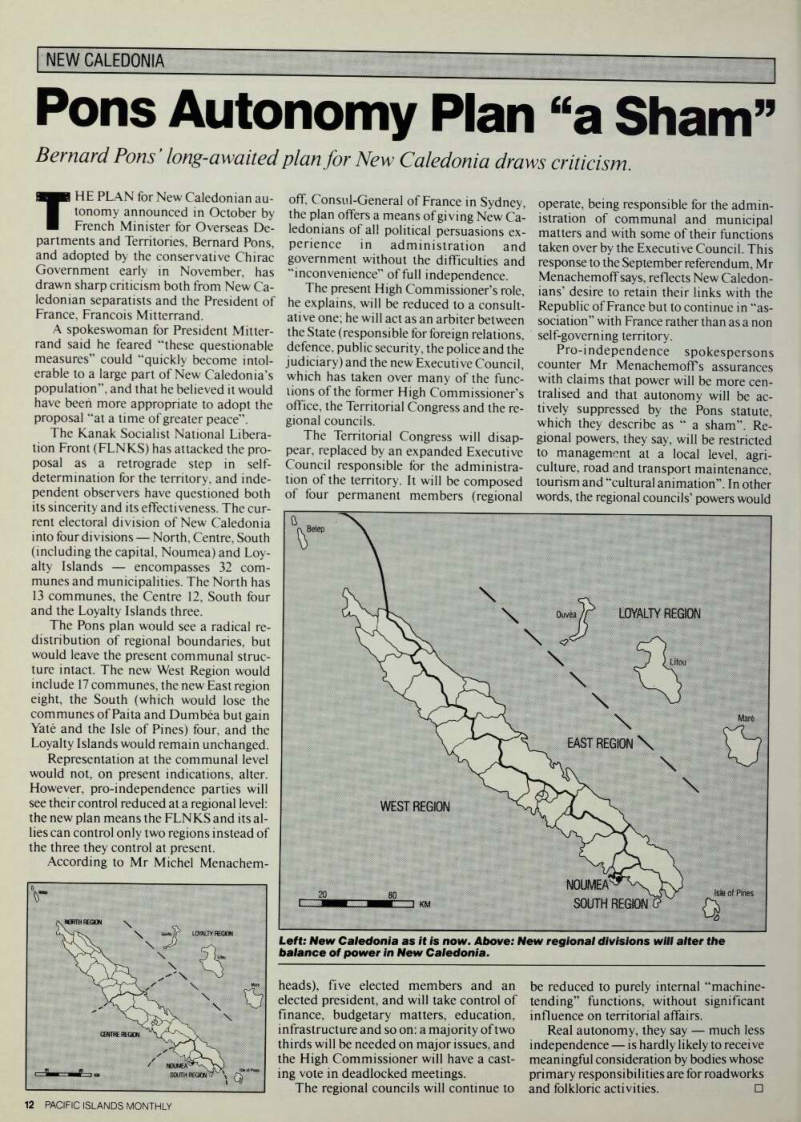
The Kanak Socialist National Libera tion Front (FLNKS) has attacked the pro posal as a retrograde step in self determination for the territory, and inde pendent observers have questioned both its sincerity and its effectiveness. The cur rent electoral division of New Caledonia into four divisions North, Centre, South (including the capital, Noumea) and Loy alty Islands encompasses 32 com munes and municipalities. The North has 13 communes, the Centre 12, South four and the Loyalty Islands three.
The Pons plan would see a radical re distribution of regional boundaries, but would leave the present communal struc ture intact. The new West Region would include 17 communes, the new East region eight, the South (which would lose the communes of Paita and Dumbea but gain Yate and the Isle of Pines) four, and the Loyalty Islands would remain unchanged.
Representation at the communal level would not, on present indications, alter.
However, pro-independence parties will see their control reduced at a regional level: the new plan means the FLNKS and its al lies can control only two regions instead of the three they control at present.
According to Mr Michel Menachem-
off, Consul-General of France in Sydney, the plan offers a means of giving New Ca ledonians of all political persuasions ex perience in administration and government without the difficulties and “inconvenience” of full independence.
The present High Commissioner’s role, he explains, will be reduced to a consult ative one; he will act as an arbiter between the State (responsible for foreign relations, defence, public security, the police and the judiciary) and the new Executive Council, which has taken over many of the func tions of the former High Commissioner’s office, the Territorial Congress and the re gional councils.
The Territorial Congress will disap pear, replaced by an expanded Executive Council responsible for the administra tion of the territory. It will be composed of four permanent members (regional
heads), five elected members and an elected president, and will take control of finance, budgetary matters, education, infrastructure and so on: a majority of two thirds will be needed on major issues, and the High Commissioner will have a casting vote in deadlocked meetings.
The regional councils will continue to
operate, being responsible for the admin istration of communal and municipal matters and with some of their functions taken over by the Executive Council. This response to the September referendum, Mr Menachemoff says, reflects New Caledon ians’ desire to retain their links with the Republic of France but to continue in “as sociation” with France rather than as a non self-governing territory.
Pro-independence spokespersons counter Mr Menachemoffs assurances with claims that power will be more cen tralised and that autonomy will be ac tively suppressed by the Pons statute, which they describe as “ a sham”. Re gional powers, they say, will be restricted to management at a local level, agri culture, road and transport maintenance, tourism and “cultural animation”. In other words, the regional councils’ powers would
be reduced to purely internal “machine tending” functions, without significant influence on territorial affairs, Real autonomy, they say much less independence is hardly likely to receive meaningful consideration by bodies whose primary responsibilities are for roadworks and folkloric activities. □
Left: New Caledonia as it is now. Above: New regional divisions will alter the balance of power in New Caledonia.