Papeete Erupts
p. 11 · Read in the full issue
French Polynesia
Long-simmering discontent in Tahiti reaches boiling point.
By John Dunn
STRIFE HAS come to Tahiti, laying to rest, perhaps forever, its image as a carefree, idyllic tropical para dise. The transformation began in late Oc tober when some 500 rioters, mostly youths, rampaged through the streets of Papeete throwing stones and petrol bombs and looting shops.
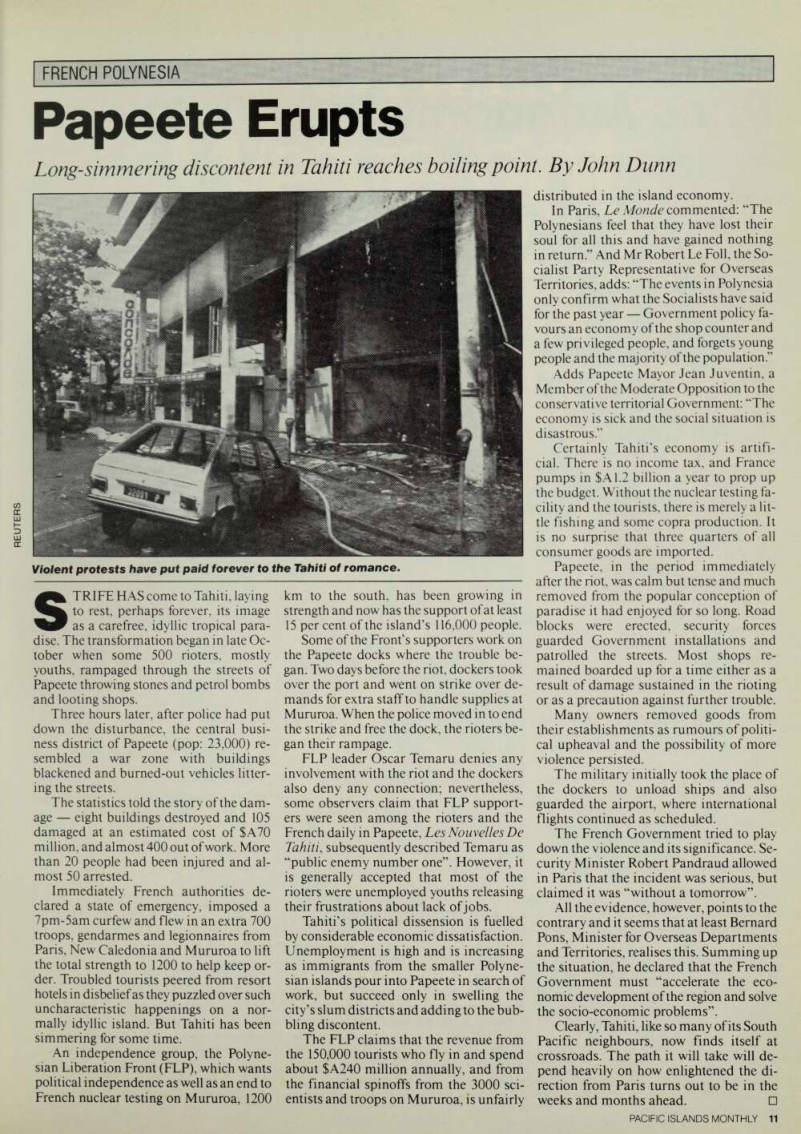
Three hours later, after police had put down the disturbance, the central busi ness district of Papeete (pop: 23,000) re sembled a war zone with buildings blackened and burned-out vehicles litter ing the streets.
The statistics told the story of the dam age eight buildings destroyed and 105 damaged at an estimated cost of SA7O million, and almost 400 out of work. More than 20 people had been injured and al most 50 arrested.
Immediately French authorities de clared a state of emergency, imposed a 7pm-sam curfew and flew in an extra 700 troops, gendarmes and legionnaires from Paris, New Caledonia and Mururoa to lift the total strength to 1200 to help keep or der. Troubled tourists peered from resort hotels in disbelief as they puzzled over such uncharacteristic happenings on a nor mally idyllic island. But Tahiti has been simmering for some time.
An independence group, the Polyne sian Liberation Front (FLP), which wants political independence as well as an end to French nuclear testing on Mururoa, 1200
km to the south, has been growing in strength and now has the support of at least 15 per cent of the island’s 116,000 people.
Some of the Front’s supporters work on the Papeete docks where the trouble be gan. Two days before the riot, dockers took over the port and went on strike over de mands for extra staff to handle supplies at Mururoa. When the police moved in to end the strike and free the dock, the rioters be gan their rampage.
FTP leader Oscar Temaru denies any involvement with the riot and the dockers also deny any connection; nevertheless, some observers claim that FTP support ers were seen among the rioters and the French daily in Papeete, Les Nouvelles De Tahiti, subsequently described Temaru as “public enemy number one”. However, it is generally accepted that most of the rioters were unemployed youths releasing their frustrations about lack of jobs.
Tahiti’s political dissension is fuelled by considerable economic dissatisfaction.
Unemployment is high and is increasing as immigrants from the smaller Polyne sian islands pour into Papeete in search of work, but succeed only in swelling the city’s slum districts and adding to the bub bling discontent.
The FTP claims that the revenue from the 150,000 tourists who fly in and spend about SA24O million annually, and from the financial spinoffs from the 3000 sci entists and troops on Mururoa, is unfairly
distributed in the island economy.
In Paris, Le Monde commented: “The Polynesians feel that they have lost their soul for all this and have gained nothing in return.” And Mr Robert Le Foil, the So cialist Party Representative for Overseas Territories, adds: “The events in Polynesia only confirm what the Socialists have said for the past year Government policy fa vours an economy of the shop counter and a few privileged people, and forgets young people and the majority of the population.”
Adds Papeete Mayor Jean Juventin, a Member of the Moderate Opposition to the conservative territorial Government: “The economy is sick and the social situation is disastrous.”
Certainly Tahiti’s economy is artifi cial. There is no income tax, and France pumps in SAI.2 billion a year to prop up the budget. Without the nuclear testing fa cility and the tourists, there is merely a lit tle fishing and some copra production. It is no surprise that three quarters of all consumer goods are imported.
Papeete, in the period immediately after the riot, was calm but tense and much removed from the popular conception of paradise it had enjoyed for so long. Road blocks were erected, security forces guarded Government installations and patrolled the streets. Most shops re mained boarded up for a time either as a result of damage sustained in the rioting or as a precaution against further trouble.
Many owners removed goods from their establishments as rumours of politi cal upheaval and the possibility of more violence persisted.
The military initially took the place of the dockers to unload ships and also guarded the airport, where international flights continued as scheduled.
The French Government tried to play down the violence and its significance. Se curity Minister Robert Pandraud allowed in Paris that the incident was serious, but claimed it was “without a tomorrow”.
All the evidence, however, points to the contrary and it seems that at least Bernard Pons, Minister for Overseas Departments and Territories, realises this. Summing up the situation, he declared that the French Government must “accelerate the eco nomic development of the region and solve the socio-economic problems”.
Clearly, Tahiti, like so many of its South Pacific neighbours, now finds itself at crossroads. The path it will take will de pend heavily on how enlightened the di rection from Paris turns out to be in the weeks and months ahead. □
Violent protests have put paid forever to the Tahiti of romance.