Kim Beazley’s Island Odyssey
pp. 8-10 · Read in the full issue
The Region
By Fia Cumming
The Defence Minister asserts Australia’s Pacific perspective.
AUSTRALIAN Defence Minister Kim Beazley regards his South Pacific tour last month as a complete success. In the two-week tour, which covered Papua New Guinea, the Solomons, Vanuatu, Tuvalu and Kiribati, Mr Beazley became the first Australian Minister for Defence to visit the region for eight years, In doing so, he was able to gel to know the politicians with whom he has been dealing and will deal in forging closer relations between Australia and the Pacific, and to explain Australia’s new recognition of the importance of its own region to its strategic and military interests.
The area visited by Mr Beazley is one of critical military interest to Australia and was defined in this year’s White Paper on
South Pacific trip was also concerned with maturing relationships with South Pacific countries, and this was one of its main achievements. “If you are putting it in the broad, it was my first general trip to the South Pacific; my primary purpose was to get to know the individuals with whom we are dealing,” Mr Beazley said. “From that point of view, it was a howling success!
“The second purpose was to explain what has been evident since I made a statement on the Pacific in February, and in the White Paper, that Australia has changed its orientation in its defence plan ning to give a much higher priority to re lationships with countries in the Pacific area,” Mr Beazley said, “The value of the visit in those circum-
Defence, which set out the Government’s blueprint for strategic thinking.
The paper divided Australia’s strategic environment into two categories of inter est direct military interest and strategic concern. In rough terms, a line from Northern Papua New Guinea through the Solomons and Vanuatu defines the direct military interest zone up to about 1600 kilometres from Australia’s coastline. This is the area considered most vital to Aus tralia’s security, and the area in which it should be capable of “extensive defence operations”.
But according to the Minister, the
stances was to bring into focus what seemed a series of disparate activities, and to put them in a policy framework that is readily comprehensible to other politi cians. Sometimes the sorts of things we do in the Defence Co-operation Program get missed at a political level, and it helps to have someone in a position to discuss it with his counterparts.
“From another angle, for me it was very important to be able to state that part of the reason we want these changes in our relationships, and why the area is signifi cant to us, is that we recognise that the South Pacific presents a very different re
gional entity in the international political community than it did 10 years ago.”
Even a decade ago, Mr Beazley feels, most Pacific countries were either newly independent or about to become inde pendent, and nation-building tasks preoc cupied them. Today, they are established as separate nations and are turning to more international questions. “So we are deal ing with people who are now independent entities, entitled to respect on those grounds, and who have developed foreign policies,” he said. “Basically, the trip was a chance to say ‘we acknowledge this po sition, and we are here on the basis of equals, discussing matters of mutual concern’.”
That was, he believes, the attitude the Pacific nations wanted to see in Australia and one they have welcomed and ac cepted. On the broad question of Pacific relations, Mr Beazley made the point that a more relaxed, mature attitude was needed between neighbours sharing long term interests. He expressed it as a rela tionship on two planes.
“One is that Australia is in the region forever; we are geographically located here and we are not a classic metropolitan power. Therefore we have common, en during interests with the countries of the region in the area’s stability and its devel opment. Whatever happens in our day-to day relationships, this element should al ways be acknowledged in this country . . . and elsewhere.
“Then there is the second plane of ac tivities; how we do respond to day-to-day events, and what will our general inter national political outlooks constitute?
“We have to recognise that there will be differences of views, both on develop ments in the region and on international political systems in general, and we have to be able to live with and to respect the views of those who seek alignment or non alignment and we’re happy to do that.”
One of the constant topics during the tour, and one that provided the most co gent example of maturing relations, was the military takeover of Fiji just before the Minister set out. Mr Beazley said he pre sented Australia’s condemnation of the Rabuka coup strongly, but did not at tempt to impose this view on his host countries.
“It provided an opportunity simply to present our views, which are that we can not stand indifferent to an overthrow of a democratic government; that democracy is the ideology by which this country en dures,” he said. “We also have clear-cut
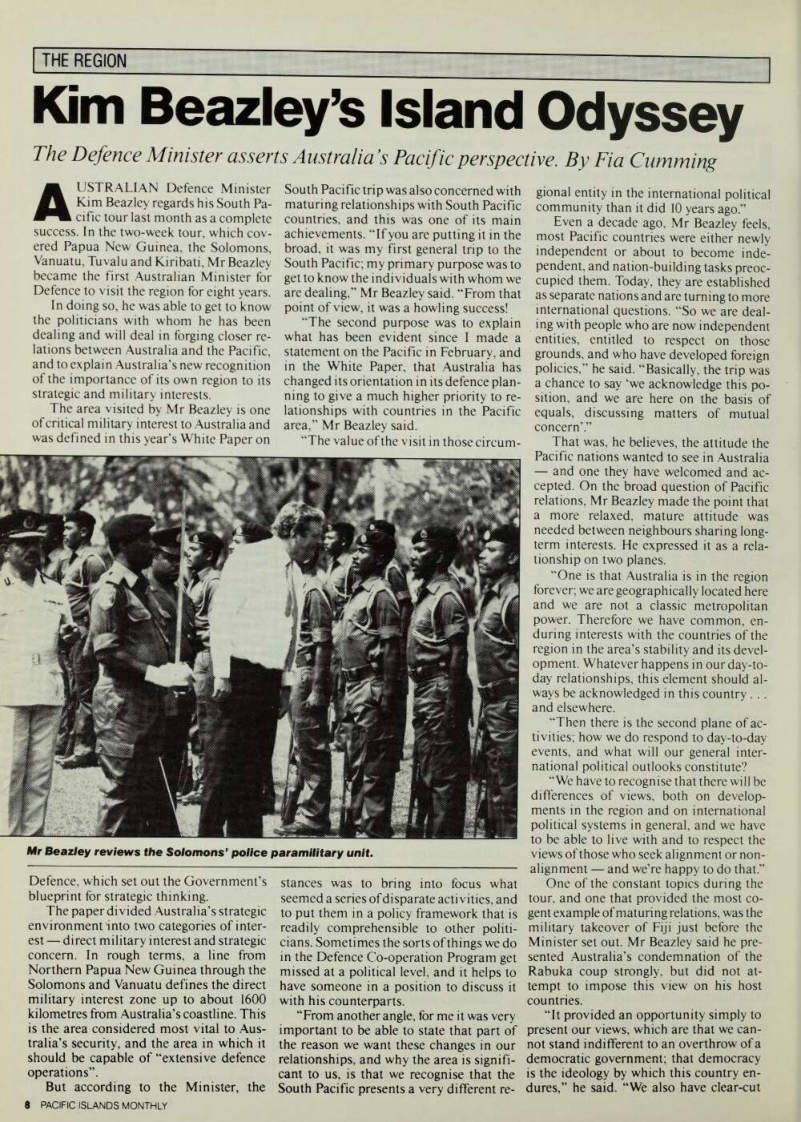
Mr Beazley reviews the Solomons’ police paramilitary unit.
views on the role of the military in de mocracies, and they don’t include govern ment. Nobody should assume that we accommodate developments in disagree ment with that easily.
“I think that view was largely respected in the area; they all have different attitudes about how they should approach their bilateral relations with Fiji in future, and obviously they pursue those views.
“We don’t seek to influence them in one way or another; we merely seek an under standing of why we adopt the views we do.”
The non-interventionist policy of the Hawke Government was also demon strated in Vanuatu. Despite past tensions including a ban on defence visits Mr Beazley claims differences have now been resolved in an atmosphere of mutual re spect. “We accept their right to determine their foreign policy in the way they see fit,”
he said. “Vanuatu has now given us an indication of what it requires in terms of infor mation and notice on such things as ship visits. We see Vanuatu’s position as reason able, and we’ll conform to it.
And there have recently been ship visits to Vanuatu.”
Mr Beazley said the issue
of Libyan involvement in Vanuatu was not even raised, though Australia’s concern
over growing links lay behind the former tensions. “We have made our point and said what we consider important, and I think the point’s been noted in the region; so there wasn’t any necessity to pursue it.”
In what could be seen as a veiled criticism of Foreign Affairs Minister Bill Hayden for his comments over Libya, Mr Beazley said, “I think we need to be more relaxed about it, not to view it as a crisis if somebody comes out and says something we don’t like. 1 can understand the way Bill Hay den has been conducting our foreign relations in the region
it’s essentially the same thing.
“I think there’s an understanding in the region that Australia doesn’t shoot from the hip when something is said with which we don’t agree, and that we’re prepared to act with patient diplomacy based on re spect for the right of other countries to have different views.”
On a more pragmatic level, Mr Bea zley’s trip was concerned with the nuts and bolts of defence relations, the Defence Co operation Program, and with maritime
East Sepik dancers greet the Minister on arrival at Wewak, PNG.
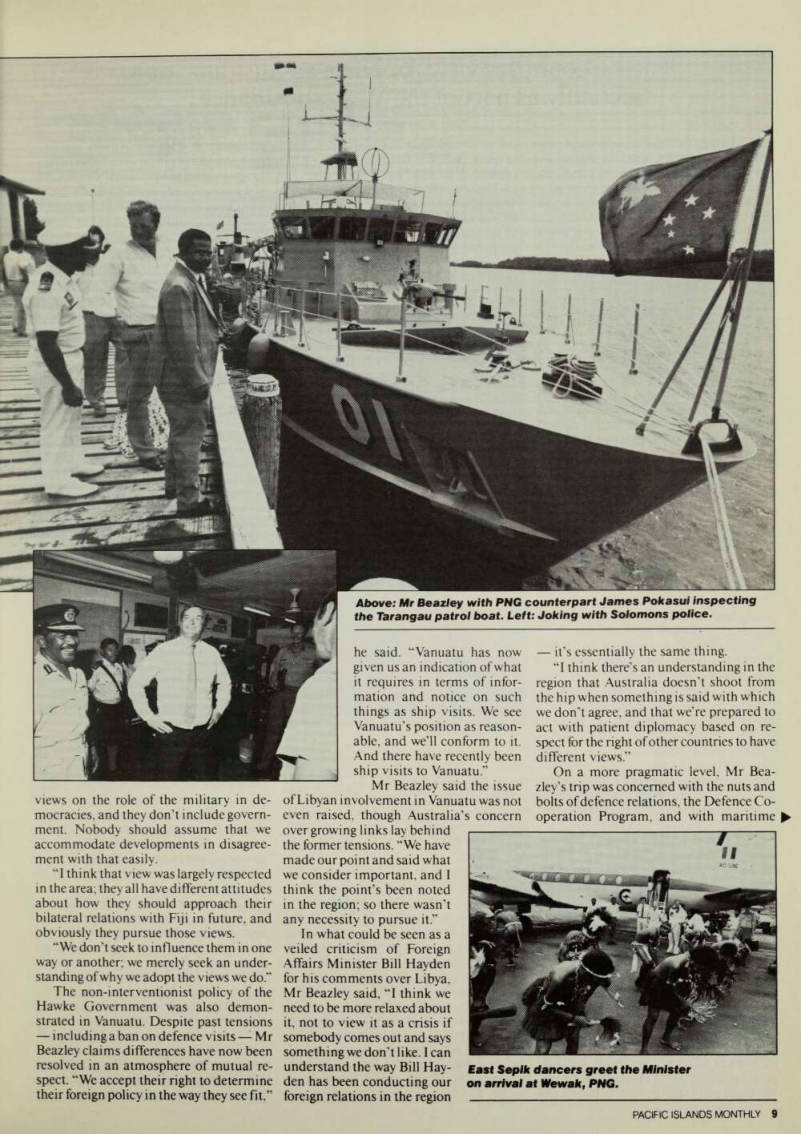
Above: Mr Beazley with PNG counterpart James Pokasui inspecting the Tarangau patrol boat. Left: Joking with Solomons police.
“Pacific countries view Australia as Australia: only secondly as part of the Western Alliance.”
surveillance. Defence co-operation talks ranged from patrol boats to engineering projects and communications assistance.
The net result is that Australia’s co-oper ation with the region will be massively in creased in line with the White Paper priorities to about the same level as cur rently exists with Southeast Asia. “We agreed to whole phalanxes of things in dif ferent countries,” Mr Beazley said. “Bas ically, there will be from all this a very substantial increase in the amounts budg eted in the Defence Co-operation Pro gram in countries I visited.”
As Australia’s largest and closest Pa cific neighbour, Papua New Guinea will get the lion’s share of the new co-opera tion. But it will also benefit from a very significant change in relations with Aus tralia, symbolised by the formal defence agreement expected to be signed by the two countries’ Prime Ministers later this year.
While the wording of the defence sec tion of the agreement remains secret, Mr Beazley disclosed that it would be very close to that used in the Five Power Def ence Agreement signed by Australia, Brit ain, Malaysia, New Zealand and Singapore in 1971, which refers roundly to mutual se curity concerns. Every country visited on the tour was keen to know more about the coming Australia-PNG agreement, which would remove “colonial overtones” from the existing military arrangements.
Unlike the other countries he visited, PNG has a developed military force that makes its defence relationship with Aus tralia inherently different. There is much less emphasis on civil development proj ects such as water supplies (as in Vanuatu) or wharf building. Projects discussed in PNG included upgrading of the patrol boat base at Manus Island, location of the air transport wing at Lae and the provision of funds to move it to Port Moresby, and the four new Pacific patrol boats that were handed over to PNG on October 31.
The nature of links between the two defence forces was also discussed. “We in dicated that perhaps we should be moving away from the concept of advisers, which is essentially a 1960 s form of arrangement, or a rundown of a colonial army form, and into the area of an exchange of personnel in much the same way that we have with the British or New Zealanders,” Mr Bea zley said. “I think that is a more politically acceptable means of conducting our rela tionship in the light of those changes, and that seemed to strike a response in Papua New Guinea.”
At present, Australia has a plethora of advisers in different roles inside virtually all areas of the PNG military. In future, Australia will examine what benefit it can
derive not only from sending its personnel to serve in PNG, but from having PNG experts on secondment in Australia.
The tour was also the first opportunity for Mr Beazley to inspect PNG military facilities at first hand. “The PNG armed forces are capable,” he said. “They demonstrated that at the independence of Vanuatu and, as far as I can see, that remains the case.
“There are resources they would like to
have access to, there are some things we can do usefully together and things we can do usefully to assist them.”
The patrol boat program, in PNG and the other four countries visited, is playing an increasing role in Australia’s military involvement in the region. During his tour, Mr Beazley confirmed that Australia would also make its own boats and patrol aircraft available for Pacific surveillance.
“We are changing the nature of our pa trol boat deployment,” Mr Beazley ex plained. “I think we are actually using patrol boats now in the manner they are best able to be used. They are essentially a vessel for coastal surveillance, particu larly attuned to operations in our north ern waters; roughly the same sorts of conditions as in most of the South Pacific.
“So we intend to concentrate our own patrol boat activities on the north, and in the South Pacific area. We have shifted the headquarters of our patrol boats from Sydney to Cairns, and we stand ready to
co-operate in joint surveillance activities with any country in the area Most of them have indicated to us that that’s acceptable and we’ve already done a bit of joint ac tivity with PNG and will with Vanuatu on delivery of their boat”
The Solomon Islands will take its first patrol boat next year, and already has clear views on how it will be used In general Mr Beazley said, relations with the Solo mon Islands were extremely good though 6
it was the only country he visited that was concerned about the future of ANZUS and the state of the Western Alliance. “I don’t think it was seen as a significant concern in most of the other countries we visited, though it was certainly raised in the Sol omons,” Mr Beazley said. “The Pacific countries tend to view Australia simply as Australia only secondly as part of the Western Alliance.”
Signs of a tendency to non-alignment (in Vanuatu, for example) have alarmed some Pacific observers. But Mr Beazley said there was a range of views on align ment in the Pacific, but no hostility to Australia’s US alliance in the evolving politics of the region, “I think the style of the Pacific is one of live and let live, and if Australia has particular views on how it wants to con duct its international relations, our posi tion should be respected,” he said. “I think there is also an expectation we would have the same attitude to them.” □
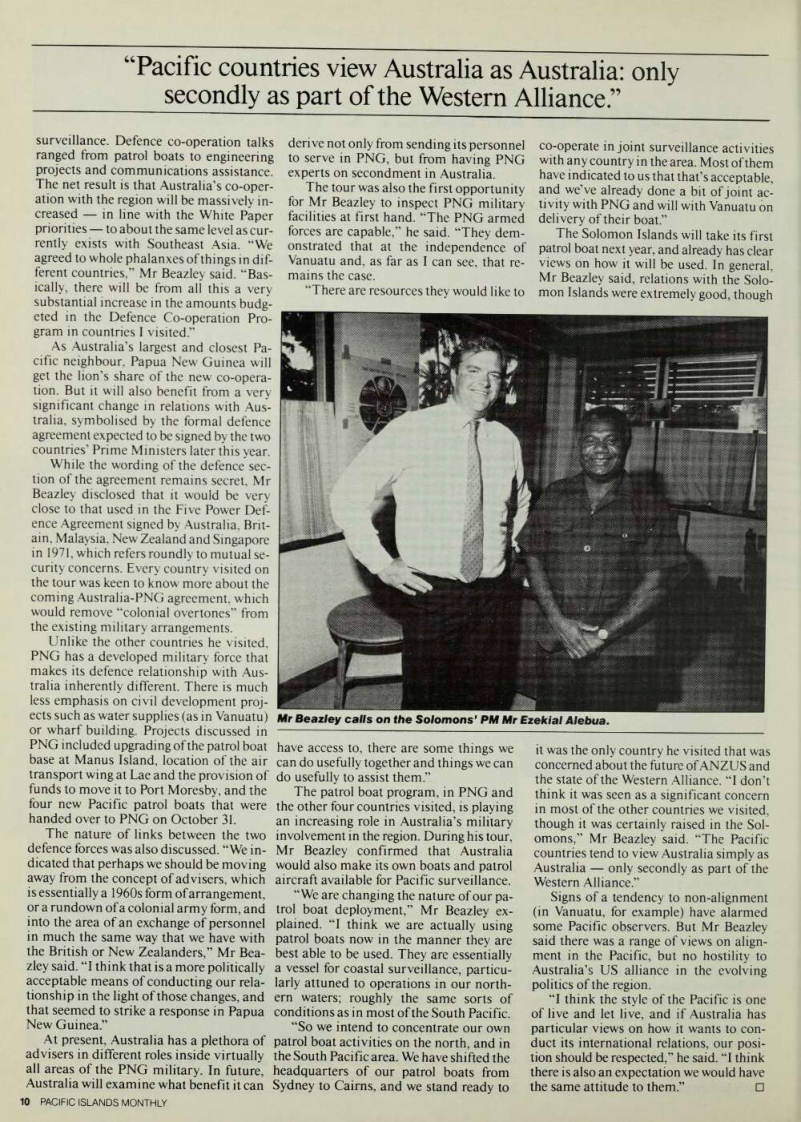
Mr Beazley calls on the Solomons’ PM Mr Ezekial Alebua.