Shakeup at Ok Tedi
p. 21 · Read in the full issue
Papua New Guinea
Problems are over, says new chief.
By John Dunn.
Papua new guinea’s Ok Tedi, one of the world’s biggest gold and copper mines, has, in the words of its new Managing Director, Mr Dick Carter: “Turned the corner”. He adds: “Quite frankly, it has been something of a problem child for us over the years but now all that is past.”
Carter has just taken over as Managing Director and Chief Executive Officer of Ok Tedi Mining Ltd, an appointment that co incided with Australia’s biggest company, BHP, assuming the position of managing shareholder for two years from October 1, with provisions for extensions.
Previously, Carter, who is also Execu tive Director of BHP Gold Mines, had been Chairman of the Ok Tedi board.
The change in the management struc ture follows the departure of Mr Roy Shipes, who had been General Manager since 1985 and who sought an early release from his contract. Also gone, somewhat suddenly, is the Deputy General Man ager, Mr Don Podobnik, These moves resulted in an emergency Ok Tedi board meeting in Hawaii in Au gust to discuss what some saw as a man agement crisis. The present arrangement, with Carter at the helm and a replacement for Shipes, emerged from that meeting.
The new General Manager is Mr Glen An drews, who formerly occupied a similar position with Utah Mines, the unit of BHP-Utah Minerals International which operates the Group’s copper mine at Van couver Island, Canada.
Certainly the Ok Tedi operation looks more settled now, which is something that its partners BHP, Amoco, a German group and the Papua New Guinea Government will appreciate in view of its occasionally stormy past.
The mine’s worst problems were en countered at the construction stage with environmental embarrassments such as the loss of canisters of cyanide from a barge just north of the Great Barrier Reef and the washing of excess cyanide down the Fly River system.
The hostile environment was also a dif ficulty. Carter recalls that the engineering tasks and the logistics were much more difficult than had been expected. “We had to take a bigger spending approach than the project could really stand and we over ran our budget substantially,” he says. “We didn’t get all the facilities we had antici pated such as the hydro power scheme and the tailings dam ”
Carter admits that was “damaging to the morale of the shareholders while the
Government’s expectations were not re alised either.”
Consequently, in 1984 there was a period of quite strained relations between the partners and the PNG Government which resulted in the mine closing for six weeks during February and March of 1985.
Several aspects, such as the nature, size and sequence of the facilities were re-ne gotiated during this period. “The result,” says Carter, “was that we got all the dirty water off our respective chests. Good re lations were restored and now are better than ever.”
Another result was that expenditure was able to be contained and the mine’s start-up figure of SUSI. 4 billion was, in Carter’s words, “not too far over our orig inal cost estimate”.
Throughout this preparation period there was, and remains, the difficulty of operating in one of the world’s most hos tile environments. Ok Tedi lies in an ex traordinarily remote and primitive region.
As recently as two decades ago tribal com munities in the area did not know of the existence of others less than 20 kilometres away.
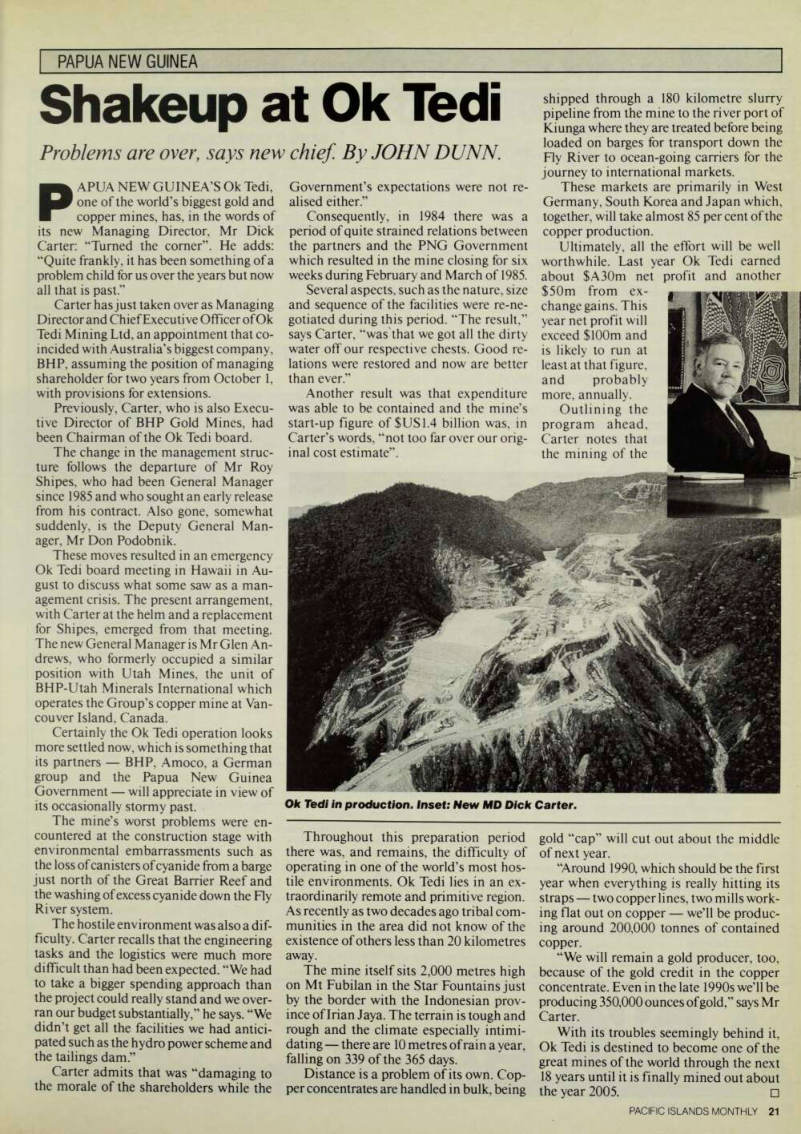
The mine itself sits 2,000 metres high on Mt Fubilan in the Star Fountains just by the border with the Indonesian prov ince of Irian Jaya. The terrain is tough and rough and the climate especially intimi dating there are 10 metres of rain a year, falling on 339 of the 365 days.
Distance is a problem of its own. Cop per concentrates are handled in bulk, being
shipped through a 180 kilometre slurry pipeline from the mine to the river port of Kiunga where they are treated before being loaded on barges for transport down the Fly River to ocean-going carriers for the journey to international markets.
These markets are primarily in West Germany, South Korea and Japan which, together, will take almost 85 per cent of the copper production.
Ultimately, all the effort will be well worthwhile. Last year Ok Tedi earned about $A3Om net profit and another
ssom from ex change gains. This year net profit will exceed SlOOm and is likely to run at least at that figure, and probably more, annually.
Outlining the program ahead.
Carter notes that the mining of the
gold “cap” will cut out about the middle of next year.
“Around 1990, which should be the first year when everything is really hitting its straps two copper lines, two mills work ing flat out on copper we’ll be produc ing around 200,000 tonnes of contained copper.
“We will remain a gold producer, too, because of the gold credit in the copper concentrate. Even in the late 1990 s we’ll be producing 350,000 ounces of gold,” says Mr Carter.
With its troubles seemingly behind it, Ok Tedi is destined to become one of the great mines of the world through the next 18 years until it is finally mined out about the year 2005. □
Ok Tedi in production. Inset: New MD Dick Carter.