Hard Lessons for Lawmakers
p. 23 · Read in the full issue
The Region
Think tanks report that the US has a lot to learn about Pacific affairs.
UNITED STATES policy makers for the South Pacific have two recent analyses to draw upon as they match their concerns against the often conflicting interests of the regional nations.
A group of West Coast and Pacific “think tanks” has, following a visit to the South Pacific, produced a report which gives strong support to many regional aims, while the Congressional Research Service has provided Capitol Hill law makers in Washington with an updated backgrounder to guide them in decision
making on an area too many know too lit tle about.
The political and racial differences of Fiji and New Caledonia, nuclear issues, the still-to-be-ratified South Pacific regional fishing treaty, foreign aid, the Libyan presence and an expanded Japanese fi nancial role in the area are all addressed in a way which shows how complicated dealing with the South Pacific has become for the United States.
In their joint report, which may pro vide the impetus for a conference on the South Pacific next year, the Institute of East Asian Studies of the University of California at Berkeley, the private Pacific Forum group in Honolulu and the Asia Foundation Centre in San Francisco, say that while recent United States decisions have disappointed the area, the current at mosphere “is not one of hostility but of sincere hope that America will display greater attention to the region”.
More specifically, the private groups say that the United States should consider its opposition to the South Pacific N uclear Free Zone Treaty and separate itself more
clearly from current French policies, not only as regards nuclear testing, but also in relation to New Caledonia.
“The United States needs to align itself with the aspirations of the people in the region for a recognition of their right to dignity and that degree of development that accords with their culture.”
As has already been widely noted throughout the region, the think tank an alysts acknowledge that politically the US has paid a price that appeared to the South Pacific to be unnecessary for its refusal to
endorse the protocols of the Treaty of Rarotonga when the treaty itself adequately safe-guarded the US position.
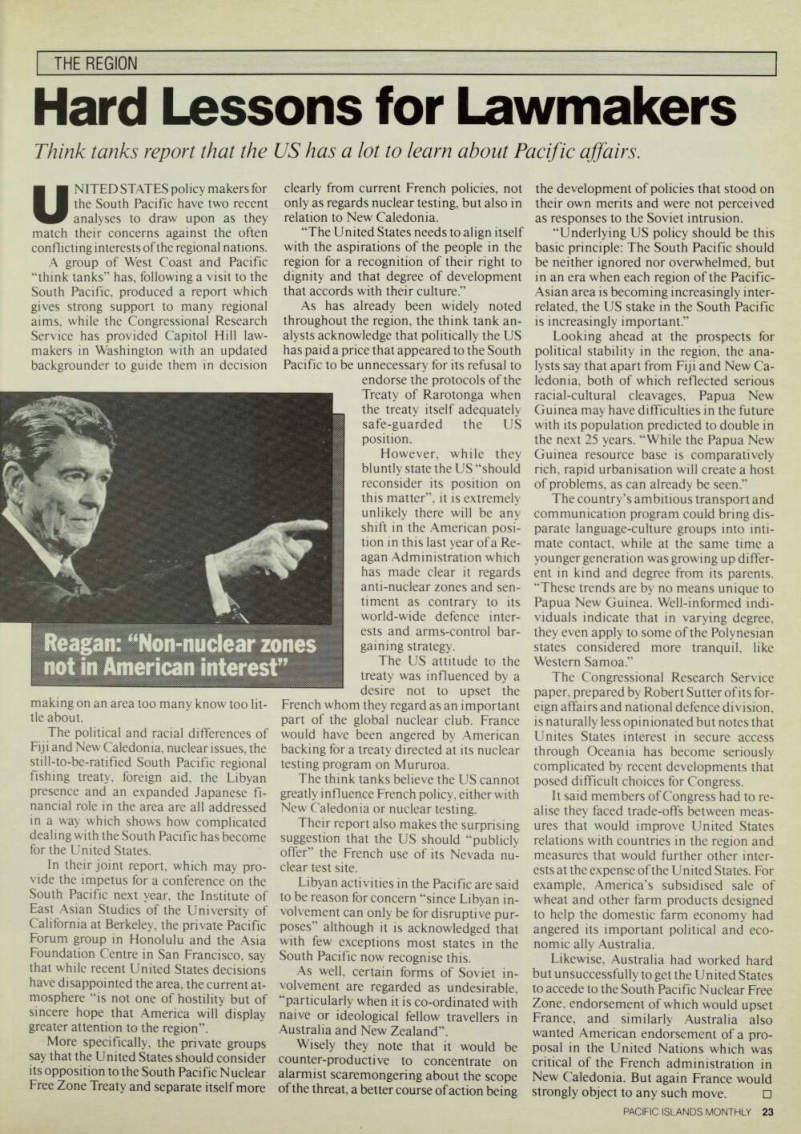
However, while they bluntly state the US “should reconsider its position on this matter”, it is extremely unlikely there will be any shift in the American posi tion in this last year of a Re agan Administration which has made clear it regards anti-nuclear zones and sen timent as contrary to its world-wide defence inter ests and arms-control bar gaining strategy.
The US attitude to the treaty was influenced by a desire not to upset the
French whom they regard as an important part of the global nuclear club. France would have been angered by American backing for a treaty directed at its nuclear testing program on Mururoa.
The think tanks believe the US cannot greatly influence French policy, either with New Caledonia or nuclear testing.
Their report also makes the surprising suggestion that the US should “publicly offer” the French use of its Nevada nu clear test site.
Libyan activities in the Pacific are said to be reason for concern “since Libyan in volvement can only be for disruptive pur poses” although it is acknowledged that with few exceptions most states in the South Pacific now recognise this.
As well, certain forms of Soviet in volvement are regarded as undesirable, “particularly when it is co-ordinated with naive or ideological fellow travellers in Australia and New Zealand”.
Wisely they note that it would be counter-productive to concentrate on alarmist scaremongering about the scope of the threat, a better course of action being
the development of policies that stood on their own merits and were not perceived as responses to the Soviet intrusion.
“Underlying US policy should be this basic principle: The South Pacific should be neither ignored nor overwhelmed, but in an era when each region of the Pacific- Asian area is becoming increasingly inter related, the US stake in the South Pacific is increasingly important.”
Looking ahead at the prospects for political stability in the region, the ana lysts say that apart from Fiji and New Ca ledonia, both of which reflected serious racial-cultural cleavages, Papua New Guinea may have difficulties in the future with its population predicted to double in the next 25 years. “While the Papua New Guinea resource base is comparatively rich, rapid urbanisation will create a host of problems, as can already be seen.”
The country’s ambitious transport and communication program could bring dis parate language-culture groups into inti mate contact, while at the same time a younger generation was growing up differ ent in kind and degree from its parents.
“These trends are by no means unique to Papua New Guinea. Well-informed indi viduals indicate that in varying degree, they even apply to some of the Polynesian states considered more tranquil, like Western Samoa.”
The Congressional Research Service paper, prepared by Robert Sutter of its for eign affairs and national defence division, is naturally less opinionated but notes that Unites States interest in secure access through Oceania has become seriously complicated by recent developments that posed difficult choices for Congress.
It said members of Congress had to re alise they faced trade-offs between meas ures that would improve United States relations with countries in the region and measures that would further other inter ests at the expense of the United States. For example, America’s subsidised sale of wheat and other farm products designed to help the domestic farm economy had angered its important political and eco nomic ally Australia.
Likewise, Australia had worked hard but unsuccessfully to get the United States to accede to the South Pacific Nuclear Free Zone, endorsement of which would upset France, and similarly Australia also wanted American endorsement of a pro posal in the United Nations which was critical of the French administration in New Caledonia. But again France would strongly object to any such move. □
Reagan: “Non-nuclear zones not in American interest”