Fighting for a Future
p. 20 · Read in the full issue
Nauru
A Commission battles to save the almost mined-out republic.
By John Dunn.
AN INDEPENDENT Commission headed by a Sri Lankan judge, and assisted by an Australian engineer and a Nauru Government official, is just more than half-way through a year-long inquiry which may bring a fresh future to the Republic of Nauru.
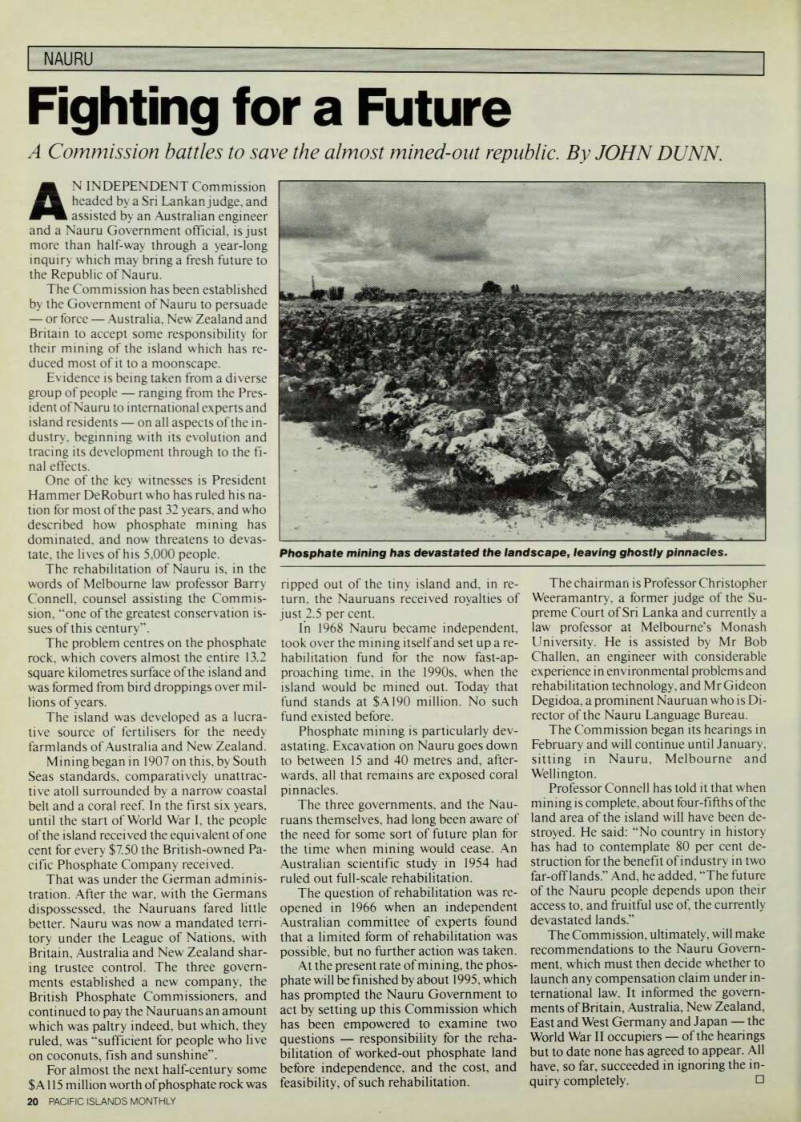
The Commission has been established by the Government of Nauru to persuade or force Australia, New Zealand and Britain to accept some responsibility for their mining of the island which has re duced most of it to a moonscape.
Evidence is being taken from a diverse group of people ranging from the Pres ident of Nauru to international experts and island residents on all aspects of the in dustry, beginning with its evolution and tracing its development through to the fi nal effects.
One of the key witnesses is President Hammer Deßoburt who has ruled his na tion for most of the past 32 years, and who described how phosphate mining has dominated, and now threatens to devas tate, the lives of his 5,000 people.
The rehabilitation of Nauru is, in the words of Melbourne law professor Barry Connell, counsel assisting the Commis sion, “one of the greatest conservation is sues of this century”.
The problem centres on the phosphate rock, which covers almost the entire 13.2 square kilometres surface of the island and was formed from bird droppings over mil lions of years.
The island was developed as a lucra tive source of fertilisers for the needy farmlands of Australia and New Zealand.
Mining began in 1907 on this, by South Seas standards, comparatively unattrac tive atoll surrounded by a narrow coastal belt and a coral reef. In the first six years, until the start of World War I, the people of the island received the equivalent of one cent for every $7.50 the British-owned Pa cific Phosphate Company received.
That was under the German adminis tration. After the war, with the Germans dispossessed, the Nauruans fared little better. Nauru was now a mandated terri tory under the League of Nations, with Britain, Australia and New Zealand shar ing trustee control. The three govern ments established a new company, the British Phosphate Commissioners, and continued to pay the Nauruans an amount which was paltry indeed, but which, they ruled, was “sufficient for people who live on coconuts, fish and sunshine”.
For almost the next half-century some $ All 5 million worth of phosphate rock was
ripped out of the tiny island and, in re turn, the Nauruans received royalties of just 2.5 per cent.
In 1968 Nauru became independent, took over the mining itself and set up a re habilitation fund for the now fast-ap proaching time, in the 19905, when the island would be mined out. Today that fund stands at SAI9O million. No such fund existed before.
Phosphate mining is particularly dev astating. Excavation on Nauru goes down to between 15 and 40 metres and, after wards, all that remains are exposed coral pinnacles.
The three governments, and the Nau ruans themselves, had long been aware of the need for some sort of future plan for the time when mining would cease. An Australian scientific study in 1954 had ruled out full-scale rehabilitation.
The question of rehabilitation was re opened in 1966 when an independent Australian committee of experts found that a limited form of rehabilitation was possible, but no further action was taken.
At the present rate of mining, the phos phate will be finished by about 1995, which has prompted the Nauru Government to act by setting up this Commission which has been empowered to examine two questions responsibility for the reha bilitation of worked-out phosphate land before independence, and the cost, and feasibility, of such rehabilitation.
The chairman is Professor Christopher Weeramantry, a former judge of the Su preme Court of Sri Lanka and currently a law professor at Melbourne’s Monash University. He is assisted by Mr Bob Challen, an engineer with considerable experience in environmental problems and rehabilitation technology, and Mr Gideon Degidoa, a prominent Nauruan who is Di rector of the Nauru Language Bureau.
The Commission began its hearings in February and will continue until January, sitting in Nauru, Melbourne and Wellington.
Professor Connell has told it that when mining is complete, about four-fifths of the land area of the island will have been de stroyed. He said: “No country in history has had to contemplate 80 per cent de struction for the benefit of industry in two far-off lands.” And, he added, “The future of the Nauru people depends upon their access to, and fruitful use of, the currently devastated lands.”
The Commission, ultimately, will make recommendations to the Nauru Govern ment, which must then decide whether to launch any compensation claim under in ternational law. It informed the govern ments of Britain, Australia, New Zealand, East and West Germany and Japan the World War II occupiers of the hearings but to date none has agreed to appear. All have, so far, succeeded in ignoring the in quiry completely. □
Phosphate mining has devastated the landscape, leaving ghostly pinnacles.