Sporting Chance for SP Games
pp. 18-19 · Read in the full issue
New Caledonia
Keen competition should save the South Pacific Games.
By Gabriel Singh.
NOUMEA IS THE setting for next month’s eighth South Pacific Games the island nations Olympics. But the quadrennial event may struggle to live up to its reputation as a spectacle. Organisers are dismayed at an expected drop in competitors to well be low the 2500 athletes at the last Games in Apia, Western Samoa.
The Kanak independence struggle prompted security fears and uncertainty surrounded the event, until South Pacific Games Council chairman Western Sa moan Peter Paul gave Noumea the “all clear” in September after a personal in spection of facilities and security arrangements.
Paul met and received a personal as surance on the safely of the competitors from FLNKS leader Jean-Marie Tjibaou.
He was shown a special police report on security for the duration of the Games from December 8-20.
Paul gave Noumea the go-ahead and the news was met with joy by thousands of sportsmen and women. But just as organ isers sighed with relief, they were hit by a boycott call by South Pacific Forum Chairman, Western Samoan Prime Min ister Kolone. Forum countries, however, have not reacted favourably to Kolone’s call but the harsher realities of depressive economic trends could still put paid to hopes of turning this event into the usual spectacular. Already Western Samoan squash and volleyball teams have said they can’t afford the trip.
Scarcity of money is felt throughout the region and some countries such as Fiji may not even be able to send even half their projected 300 entries. Fiji soccer became the first sport from the newly declared re public to withdraw from the Games after Colonel Rabuka imposed a total ban on Sunday sports and trading, which brought soccer to a halt. The Fiji Football Associ ation’s major earner, the four-day inter district tournament, was to have provided the 5F25,000 needed to equip the national soccer side. The tournament, to have been played over the 1970 October Independ ence holiday weekend, was cancelled and local soccer indefinitely suspended.
Other sports federations in Fiji face a similar problem in trying to send a full complement. Fundraising efforts have been low key because of the political up heaval and there is little hope of a govern ment grant.
Sports federations in other countries also face serious problems in raising the money needed to send teams.
This eighth Games is expected to be dominated by New Caledonia and Tahiti.
Fiji soccer’s withdrawal means the French contestants will share gold and silver med als. Fiji played Tahiti in the last two SPG gold medal games, held in Apia in 1983 and in Suva in 1979.
Swimming will be another event to have a strong French flavour, with perhaps to ken resistance coming from Fiji and Papua New Guinea.
Athletics is the one sport that could go ahead unscathed and provide spine-tin gling drama and excitement. Many new stars will emerge and there are old scores to be settled.
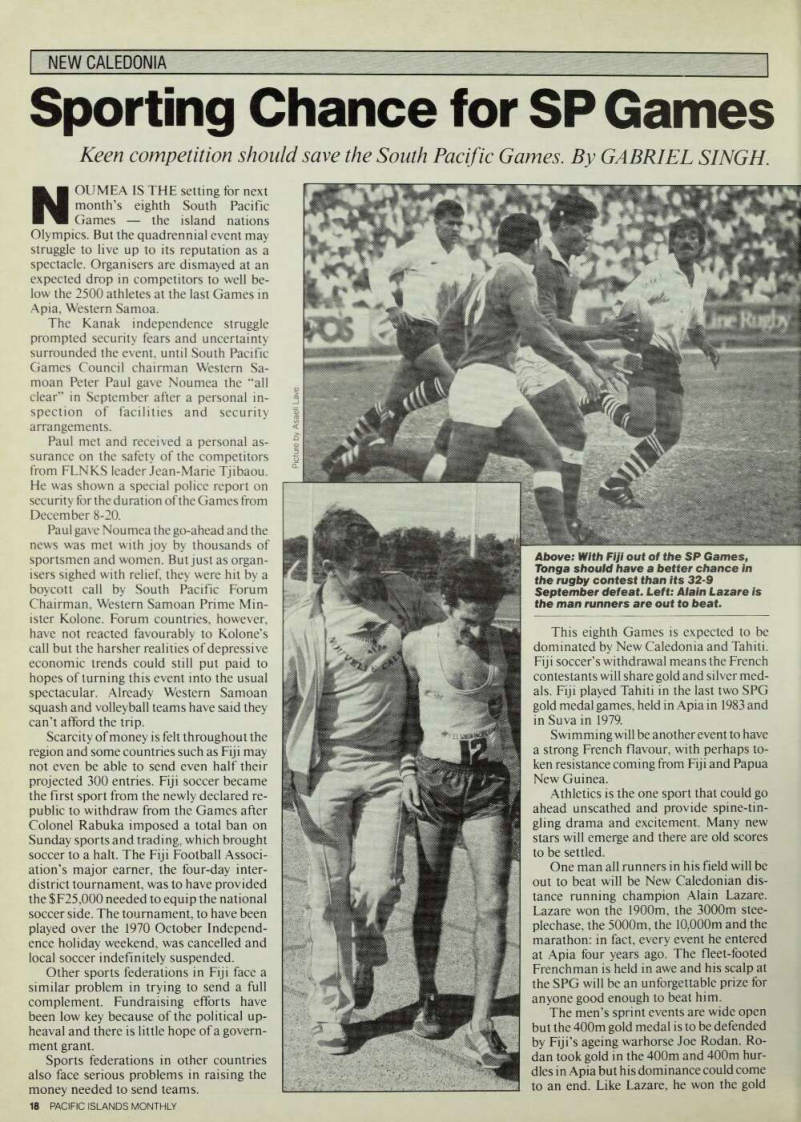
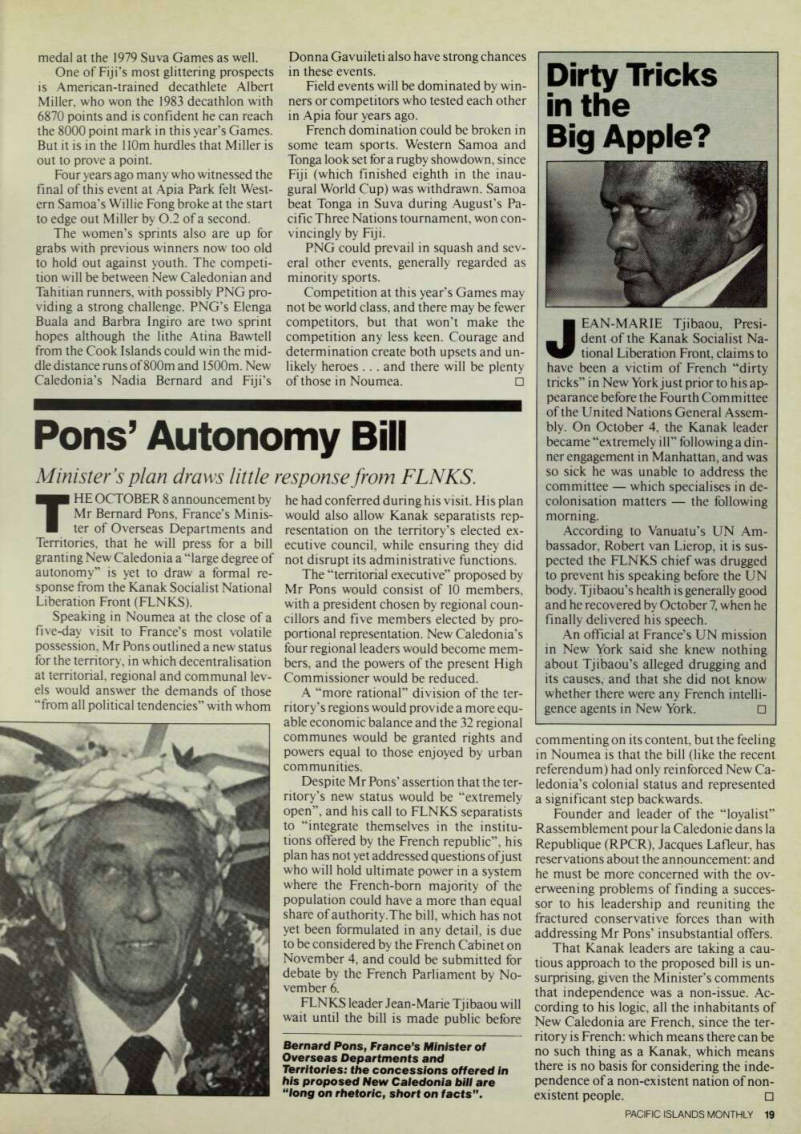
One man all runners in his field will be out to beat will be New Caledonian dis tance running champion Alain Lazare.
Lazare won the 1900 m, the 3000 m stee plechase, the 5000 m, the 10,000 m and the marathon: in fact, every event he entered at Apia four years ago. The fleet-footed Frenchman is held in awe and his scalp at the SPG will be an unforgettable prize for anyone good enough to beat him.
The men’s sprint events are wide open but the 400 m gold medal is to be defended by Fiji’s ageing warhorse Joe Rodan. Ro dan took gold in the 400 m and 400 m hur dles in Apia but his dominance could come to an end. Like Lazare, he won the gold
Picture by Asaeli Lave.
Above: With Fiji out of the SP Games, Tonga should have a better chance in the rugby contest than its 32-9 September defeat. Left: Alain Lazare is the man runners are out to beat.
medal at the 1979 Suva Games as well.
One of Fiji’s most glittering prospects is American-trained decathlete Albert Miller, who won the 1983 decathlon with 6870 points and is confident he can reach the 8000 point mark in this year’s Games.
But it is in the 110 m hurdles that Miller is out to prove a point.
Four years ago many who witnessed the final of this event at Apia Park felt West ern Samoa’s Willie Fong broke at the start to edge out Miller by 0.2 of a second.
The women’s sprints also are up for grabs with previous winners now too old to hold out against youth. The competi tion will be between New Caledonian and Tahitian runners, with possibly PNG pro viding a strong challenge. PNG’s Elenga Buala and Barbra Ingiro are two sprint hopes although the lithe Atina Bawtell from the Cook Islands could win the mid dle distance runs ofBoom and 1500 m. New Caledonia’s Nadia Bernard and Fiji’s
Donna Gavuileti also have strong chances in these events.
Field events will be dominated by win ners or competitors who tested each other in Apia four years ago.
French domination could be broken in some team sports. Western Samoa and Tonga look set for a rugby showdown, since Fiji (which finished eighth in the inau gural World Cup) was withdrawn. Samoa beat Tonga in Suva during August’s Pa cific Three Nations tournament, won con vincingly by Fiji.
PNG could prevail in squash and sev eral other events, generally regarded as minority sports.
Competition at this year’s Games may not be world class, and there may be fewer competitors, but that won’t make the competition any less keen. Courage and determination create both upsets and un likely heroes . . . and there will be plenty of those in Noumea. □