Champion of Non-Alignment
pp. 16-17 · Read in the full issue
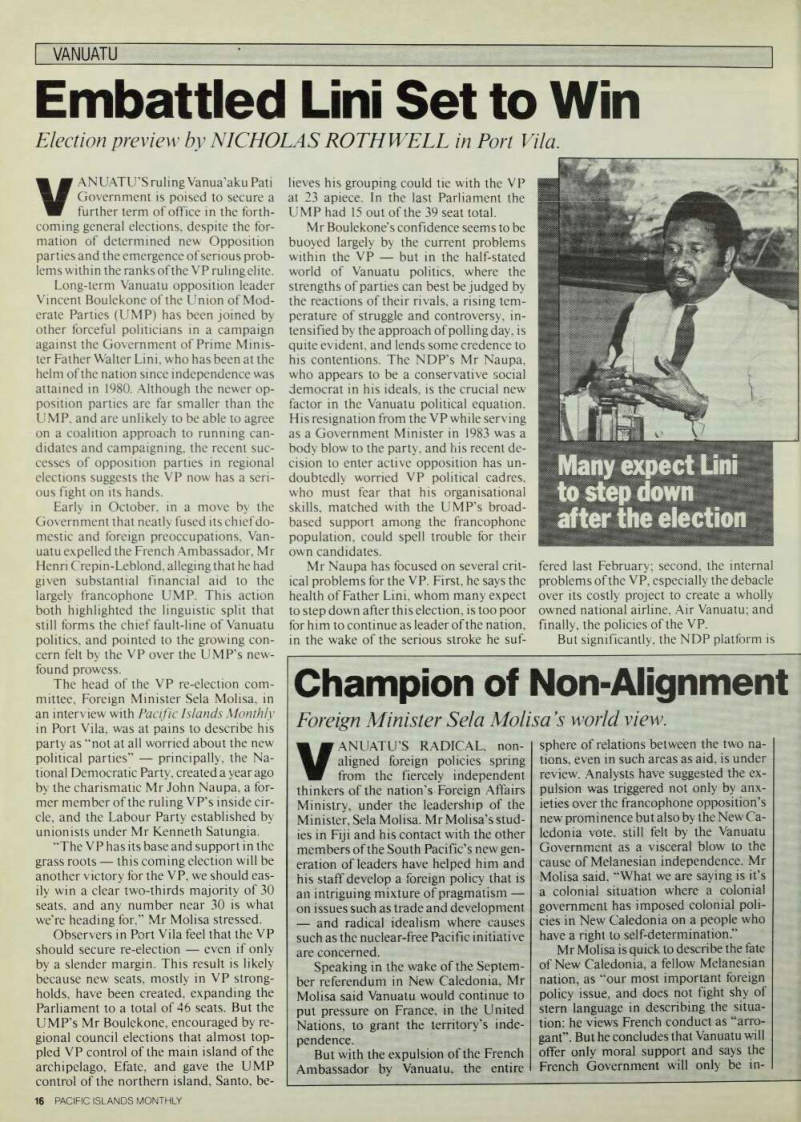
Foreign Minister Sela Molisa’s world view.
Vanuatu’S Radical, Non
aligned foreign policies spring from the fiercely independent thinkers of the nation’s Foreign Affairs Ministry, under the leadership of the Minister, Sela Molisa. Mr Molisa’sstud ies in Fiji and his contact with the other members of the South Pacific’s new gen eration of leaders have helped him and his staff develop a foreign policy that is an intriguing mixture of pragmatism on issues such as trade and development and radical idealism where causes such as the nuclear-free Pacific initiative are concerned.
Speaking in the wake of the Septem ber referendum in New Caledonia, Mr Molisa said Vanuatu would continue to pul pressure on France, in the United Nations, to grant the territory’s inde pendence.
But with the expulsion of the French Ambassador by Vanuatu, the entire
sphere of relations between the two na tions, even in such areas as aid, is under review. Analysts have suggested the ex pulsion was triggered not only by anx ieties over the francophone opposition’s new prominence but also by the New Ca ledonia vote, still felt by the Vanuatu Government as a visceral blow to the cause of Melanesian independence. Mr Molisa said, “What we are saying is it’s a colonial situation where a colonial government has imposed colonial poli cies in New Caledonia on a people who have a right to self-determination.”
Mr Molisa is quick to describe the fate of New Caledonia, a fellow Melanesian nation, as ”our most important foreign policy issue, and does not fight shy of stern language in describing the situa tion: he views French conduct as “arro gant”. But he concludes that Vanuatu will offer only moral support and says the French Government will only be in
duced to shift its stance “when the Kan aks and oppressed people force them to do so”.
Vanuatu’s well-known policy of op position to the carefully-worded South Pacific Nuclear-Free Zone Treaty (SPNFZ) advocated by Australia is not set in stone, Mr Molisa indicated. “Our stand has been that we agree in principle with the treaty some areas are far short of what we had expected ”
Mr Molisa hit out at Australian re porting of Vanuatu’s ties with Libya, stressing that the issue was not a “ma jor” one in his country and saying the publicity “in our view was not absolutely true”.
“The thing about achieving inde pendence is you follow what you believe in, not necessarily what Canberra or Washington says. We believe all our pol icies are correct, and Vanuatu considers it is right to establish diplomatic rela tions with Libya we don’t feel guilty but we don’t live in isolation, and we have to be aware of what our neighbours say, and we expect Australia to be the same”
Speaking just before the second mil itary coup in Fiji in late September, the Foreign Minister would only stress the need, highlighted by Fiji’s instability, for “people’s aspirations” to be met.
Mr Molisa noted that the South Pa cific Forum had made an offer of assist ance to Fiji “let’s just leave it at that,” he ventured, keeping to his Govern ment’s position that Fijians should try to work out their own problems.
Although Vanuatu’s foreign policy is consistent across the Pacific Port Vila wants independence not only for New Caledonia but also for France’s other Pa cific territory, French Polynesia the crucial emphasis is placed on Melane sian solidarity, and now on the Melane sian Spearhead group, formed at Papua New Guinea’s suggestion by PNG, Van uatu and the Solomons to press for Kanak independence in New Caledonia.
“It is important Melanesia survives in the modern world, but our group has broader interests than just New Cale donia traditionally, culturally, our people used to travel up and down Me lanesia and today we share a lot of
political views among the Melanesian countries”
On superpower relations, Mr Molisa explained his Government’s controver sial sl.sm fishing rights agreement with Moscow in purely commercial terms: “Without that deal we would have had much more trouble recently, because our aid was cut ”
The Foreign Minister stressed that traditional ties between Vanuatu and the US were excellent “In my father’s gen eration, people regarded the Americans as their saviours from the Japanese.
“But they disagree with us on nuclear issues we hope that it will improve, we’d like to have better working relations with the US in the future and we are hop ing the US will help us and the region in development aspirations.”
During his visit to Washington made with Father Lini last February the oc casion when Lini was felled by his stroke the Foreign Minister made some blunt points to his American hosts: “I told them they can shout and shout until kingdom come, but unless they do something we will not heed their shouts.” □