Embattled Lini Set to Win
pp. 16-17 · Read in the full issue
Vanuatu
Embattled Lini Set to Win Election preview by NICHOLAS ROTHWELL in Port Vila.
VANUATU’S ruling Vanua’aku Pati Government is poised to secure a further term of office in the forth coming general elections, despite the for mation of determined new Opposition parties and the emergence of serious prob lems within the ranks of the VP ruling elite.
Long-term Vanuatu opposition leader Vincent Boulekone of the Union of Mod erate Parties (UMP) has been joined by other forceful politicians in a campaign against the Government of Prime Minis ter Father Walter Lini, who has been at the helm of the nation since independence was attained in 1980. Although the newer op position parties are far smaller than the UMP, and are unlikely to be able to agree on a coalition approach to running can didates and campaigning, the recent suc cesses of opposition parlies in regional elections suggests the VP now has a seri ous fight on its hands.
Early in October, in a move by the Government that neatly fused its chief do mestic and foreign preoccupations, Van uatu expelled the French Ambassador, Mr Henri Crepin-Leblond. alleging that he had given substantial financial aid to the largely francophone UMP. This action both highlighted the linguistic split that still forms the chief fault-line of Vanuatu politics, and pointed to the growing con cern felt by the VP over the UMP’s new found prowess.
The head of the VP re-election com mittee, Foreign Minister Sela Molisa, in an interview with Pacific Islands Monthly in Port Vila, was at pains to describe his party as “not at all worried about the new political parties” principally, the Na tional Democratic Party, created a year ago by the charismatic Mr John Naupa, a for mer member of the ruling VP's inside cir cle, and the Labour Party established by unionists under Mr Kenneth Satungia.
“The VP has its base and support in the grass roots this coming election will be another victory for the VP, we should eas ily win a clear two-thirds majority of 30 seats, and any number near 30 is what we’re heading for,” Mr Molisa stressed.
Observers in Port Vila feel that the VP should secure re-election even if only by a slender margin. This result is likely because new seats, mostly in VP strong holds, have been created, expanding the Parliament to a total of 46 seats. But the UMP’s Mr Boulekone, encouraged by re gional council elections that almost top pled VP control of the main island of the archipelago, Efate, and gave the UMP control of the northern island, Santo, be
lieves his grouping could tie with the VP at 23 apiece. In the last Parliament the UMP had 15 out of the 39 seat total.
Mr Boulekone’s confidence seems to be buoyed largely by the current problems within the VP but in the half-stated world of Vanuatu politics, where the strengths of parties can best be judged by the reactions of their rivals, a rising tem perature of struggle and controversy, in tensified by the approach of polling day, is quite evident, and lends some credence to his contentions. The NDP’s Mr Naupa, who appears to be a conservative social democrat in his ideals, is the crucial new factor in the Vanuatu political equation.
His resignation from the VP while serving as a Government Minister in 1983 was a body blow to the party, and his recent de cision to enter active opposition has un doubtedly worried VP political cadres, who must fear that his organisational skills, matched with the UMP’s broad based support among the francophone population, could spell trouble for their own candidates.
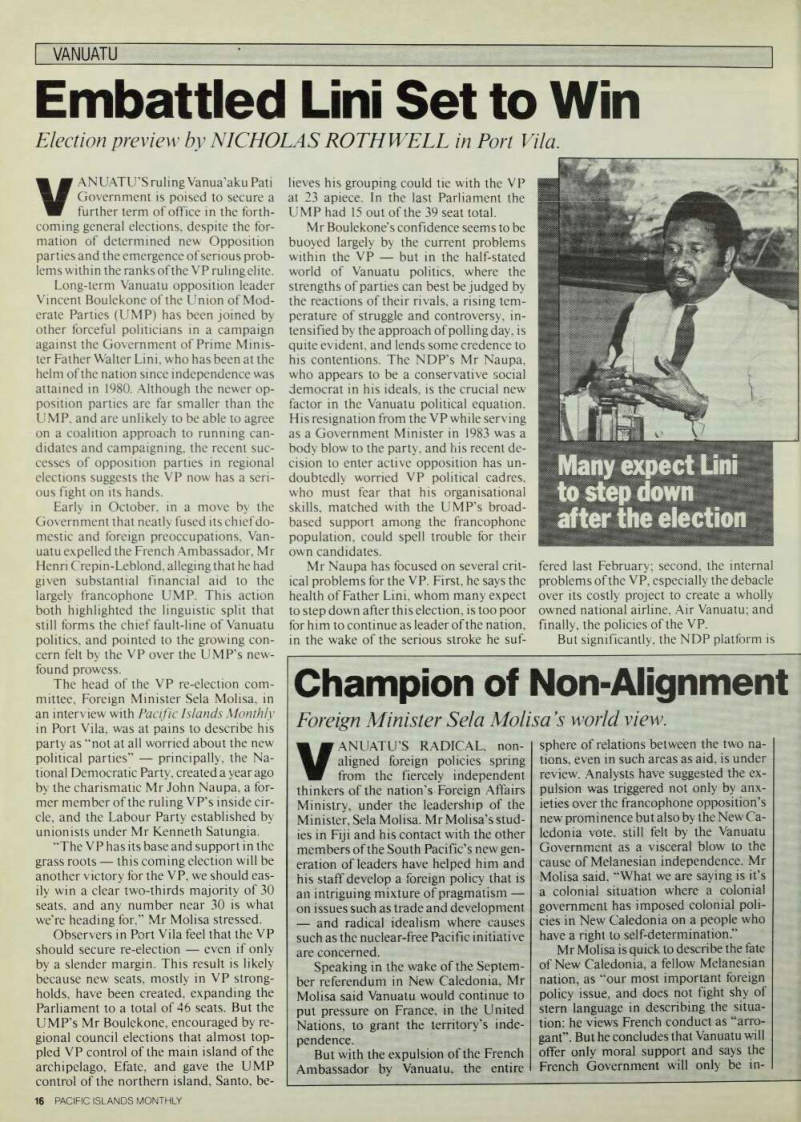
Mr Naupa has focused on several crit ical problems for the VP. First, he says the health of Father Lini, whom many expect to step down after this election, is too poor for him to continue as leader of the nation, in the wake of the serious stroke he suf-
fered last February; second, the internal problems of the VP, especially the debacle over its costly project to create a wholly owned national airline, Air Vanuatu; and finally, the policies of the VP.
But significantly, the NDP platform is
Many expect Lini to step down alter the election
in many respects identical to that of the VP, and Mr Naupa says, “the VP has not followed its own ideology”. He feels Father Lini is no longer in charge, and will be pushed out after the elections have been safely won by the VP under his leadership.
“The NDP is looking at the possibility of two or three seats if we and the UMP can co-ordinate, the chances for the Op position are good, and we have offered co ordination.”
The NDP leader is among local ob servers who see the current election cam paign as a crucial challenge for the VP precisely because of the party’s internal divisions. This school of thought traces a split between Father Lini’s “northern group” which includes Foreign Minister Molisa and his influential wife Grace, and the “Vila group” based around the pow erful politicians from Ifira Island in the capital’s harbour. Their number includes Lini’s current deputy Kalpokor Kalsakau and the VP Secretary-General, Barak Sope, whom many see as the real power in Vanuatu. But a question-mark hangs over Mr Sope’s political future following a re ported dispute with Father Lini over his role in the Air Vanuatu affair.
If the UMP and NDP pose problems for the VP, the ruling party, which once was the unquestioned dominating force in Vanuatu politics, also faces challenges from another quarter: two small parties repre senting interests formerly assumed to be sympathetic to the VP have appeared. One, the New Peoples’ Party, speaks for disaf fected junior civil servants and is led by Mr Fraser Sine, while the other, poten tially a vital force in Vanuatu’s political development, is the Labour Party, which
was established by trade unionists. La bour’s Mr Ephraim Kalsadau, who is also a full-time officer of the trade union con gress, believes the VP Government has been hostile towards organised labour and has a “paternalistic attitude” to workers.
Labour only expects to win one seat in the elections, although it will run four candi
“We should easily win a two-thirds majority”
Molisa
dates but even one seat would give it a say in parliament.
More importantly, the creation of an independent, progressive party deals a blow to the legitimacy of VP claims to rep resent the ordinary workers of Vanuatu.
But Foreign Minister Molisa, at the helm of the VP re-election drive, dis misses all suggestion of serious problems confronting his party.
Gains by opposition groups in regional votes he puts down to the difference be tween the two systems proportional representation for the regions, first past the post in the national election. He doubts the opposition can form a viable coalition be cause they cannot agree on “who should be their candidate for Prime Minister”.
Mr Molisa warned that any “further traces” of financial ties between the UMP
and New Caledonia parties will not be tol erated during the campaign period, but re garded as “foreign intervention in the domestic affairs of this country”. Re cently, the Vanuatu Mobile Force was dis patched on a mission to raid a number of houses of UMP sympathisers, and a “sig nificant” cache of arms was uncovered.
This alarmed VP leaders and doubtless confirmed their determination to keep all links between the UMP and French inter ests under surveillance.
For Mr Molisa, the VP itself is a model of collectivity and will be returned pre cisely because “people in this country know what’s going on”. He discounts the Air Vanuatu scandal, and stresses that his Government has been quite candid about the expense of the venture and the prob lems it has encountered. Father Lini, he says, is “getting stronger every day” and he parries comment about splits within the VP elite by noting that “all parties have to disagree on some things that’s normal.”
He dismisses the claims of the new La bour Party, stressing that not all unionists are with Labour and that the unionised workforce is a tiny percentage of the electorate.
Despite the emergence of the new-look Vanuatu opposition, complete with party offices, leaflet-printing operations and combative ideologies, the VP is still seen by local analysts as one of the toughest and best-organised political parties in the Pa cific region. Its internal difficulties not withstanding, the VP is still well-tuned to the fine art of getting, and keeping, politi cal power. This skill should be enough to guarantee it four more years in charge in Port Vila. □