Pons’ Autonomy Bill
p. 19 · Read in the full issue
Minister’s plan draws little response from FLNKS.
THE OCTOBER 8 announcement by Mr Bernard Pons, France’s Minis ter of Overseas Departments and Territories, that he will press for a bill granting New Caledonia a “large degree of autonomy” is yet to draw a formal re sponse from the Kanak Socialist National Liberation Front (FLNKS).
Speaking in Noumea at the close of a five-day visit to France’s most volatile possession, Mr Pons outlined a new status for the territory, in which decentralisation at territorial, regional and communal lev els would answer the demands of those “from all political tendencies” with whom
he had conferred during his visit. His plan would also allow Kanak separatists rep resentation on the territory’s elected ex ecutive council, while ensuring they did not disrupt its administrative functions.
The “territorial executive” proposed by Mr Pons would consist of 10 members, with a president chosen by regional coun cillors and five members elected by pro portional representation. New Caledonia’s four regional leaders would become mem bers, and the powers of the present High Commissioner would be reduced.
A “more rational” division of the ter ritory’s regions would provide a more equ able economic balance and the 32 regional communes would be granted rights and powers equal to those enjoyed by urban communities.
Despite Mr Pons’ assertion that the ter ritory’s new status would be “extremely open”, and his call to FLNKS separatists to “integrate themselves in the institu tions offered by the French republic”, his plan has not yet addressed questions ofjust who will hold ultimate power in a system where the French-born majority of the population could have a more than equal share of authority. The bill, which has not yet been formulated in any detail, is due to be considered by the French Cabinet on November 4, and could be submitted for debate by the French Parliament by No vember 6.
FLNKS leader Jean-Marie Tjibaou will wait until the bill is made public before
commenting on its content, but the feeling in Noumea is that the bill (like the recent referendum) had only reinforced New Ca ledonia’s colonial status and represented a significant step backwards.
Founder and leader of the “loyalist”
Rassemblement pour la Caledonie dans la Republique (RPCR), Jacques Lafleur, has reservations about the announcement: and he must be more concerned with the ov erweening problems of finding a succes sor to his leadership and reuniting the fractured conservative forces than with addressing Mr Pons’ insubstantial offers.
That Kanak leaders are taking a cau tious approach to the proposed bill is un surprising, given the Minister’s comments that independence was a non-issue. Ac cording to his logic, all the inhabitants of New Caledonia are French, since the ter ritory is French: which means there can be no such thing as a Kanak, which means there is no basis for considering the inde pendence of a non-existent nation of non existent people. □
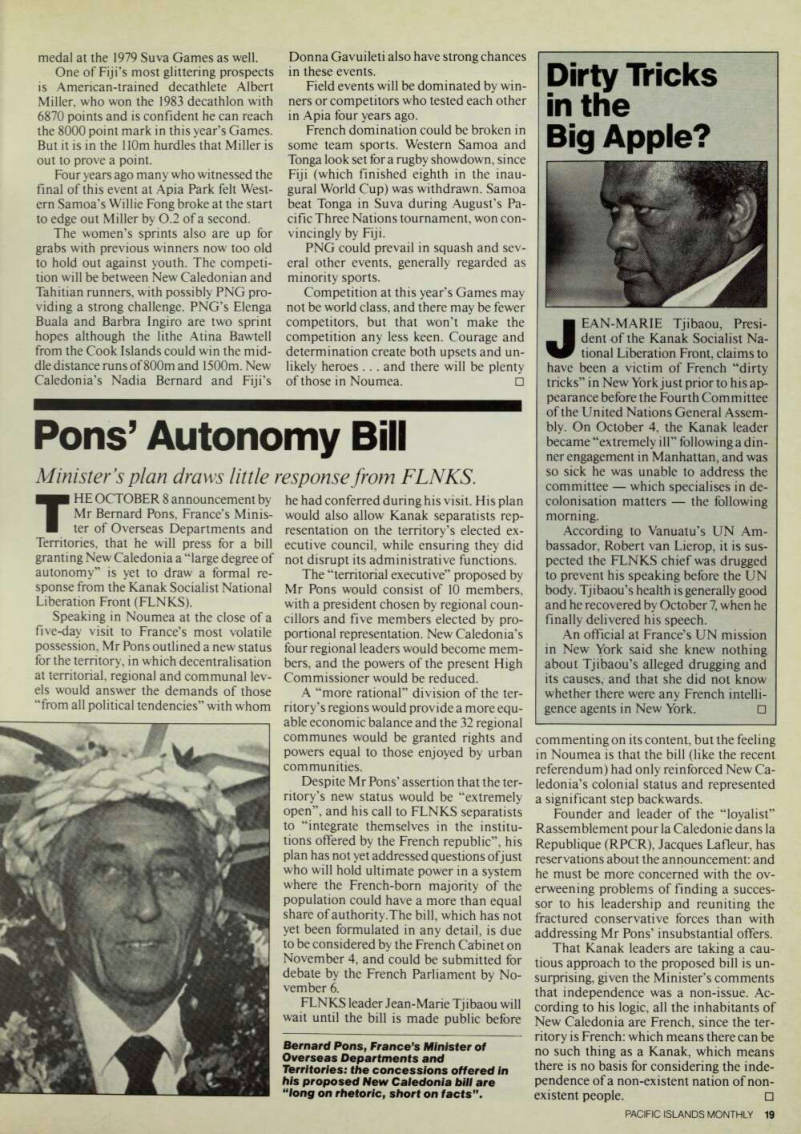
Bernard Pons, France's Minister of Overseas Departments and Territories: the concessions offered in his proposed New Caledonia bill are “long on rhetoric, short on facts”.