Commonwealth Heads
p. 12 · Read in the full issue
CHOGM: Fiji Out in the Cold
of Government formally de clared that Fiji is no longer a member of the Commonwealth at the CHOGM leaders' retreat. Lake Okan agan, Canada, on October 18.
Despite a plea from Colonel Ra buka, membership has lapsed with the emergence of the new republic; but the door to readmittance has been left open with an announcement that “a resolu tion of the problem by the people of Fiji” if necessary, with Common wealth assistance could see a recon sideration of Fiji’s membership at the next CHOGM conference in 1990.
The formal statement, delivered by Canadian Prime Minister Brian Mul roney, indicated that Fiji might reapply for membership once acceptable con stitutional arrangements had been made and expressed Commonwealth leaders’ “sadness” at the proclamation of the new republic and the resignation on October 16 of Fijian Governor Gen eral Ratu Sir Penaia Ganilau.
Official Fijian response reflects some division about the republic’s at titude to Commonwealth member ship. Mr Jona Senilagakali, permanent secretary of the Foreign Affairs Min istry, said on Saturday, October 17 that Fiji would reapply for membership within six months, while his Minister, Mr Filipe Bole, told AAP next day that Fiji would not make any hasty deci sions. The republic would “develop a strategy bearing in mind that the new Constitution would guarantee ethnic Fijian supremacy in Parliament,” he said, adding that Commonwealth membership had lapsed. “We were not expelled,” he stressed.
The CHOGM conference was the scene of heated discussion over Fiji’s membership status, with British PM Margaret Thatcher standing virtually alone against a coalition that included
Australian PM Bob Hawke, India’s Rajiv Gandhi, New Zealand PM David Lange, Dr Kenneth Kaunda ofZambia and Mr Robert Mugabe of Zimbabwe.
With the support of fellow Com monwealth leaders and the Queen, Mr Hawke managed to outmanoeuvre Mrs Thatcher, who sought to keep Fiji within the Commonwealth, declaring her position “an untenable charade”.
Mrs Thatcher’s refusal to consider any more than token sanctions against South Africa so angered other leaders that all 47 of them supported Mr Hawke’s attack on what he claimed was a campaign of disinformation by Mrs Thatcher.
Although Commonwealth leaders were united in their opposition to Mrs Thatcher, Indian Prime Minister Ra jiv Gandhi took a harder line against Fiji than Mr Hawke, comparing the military-backed republic’s constitu tional changes with the situation in South Africa. The Fijian minority, he said, had “taken over the political and human rights” of the Indian majority.
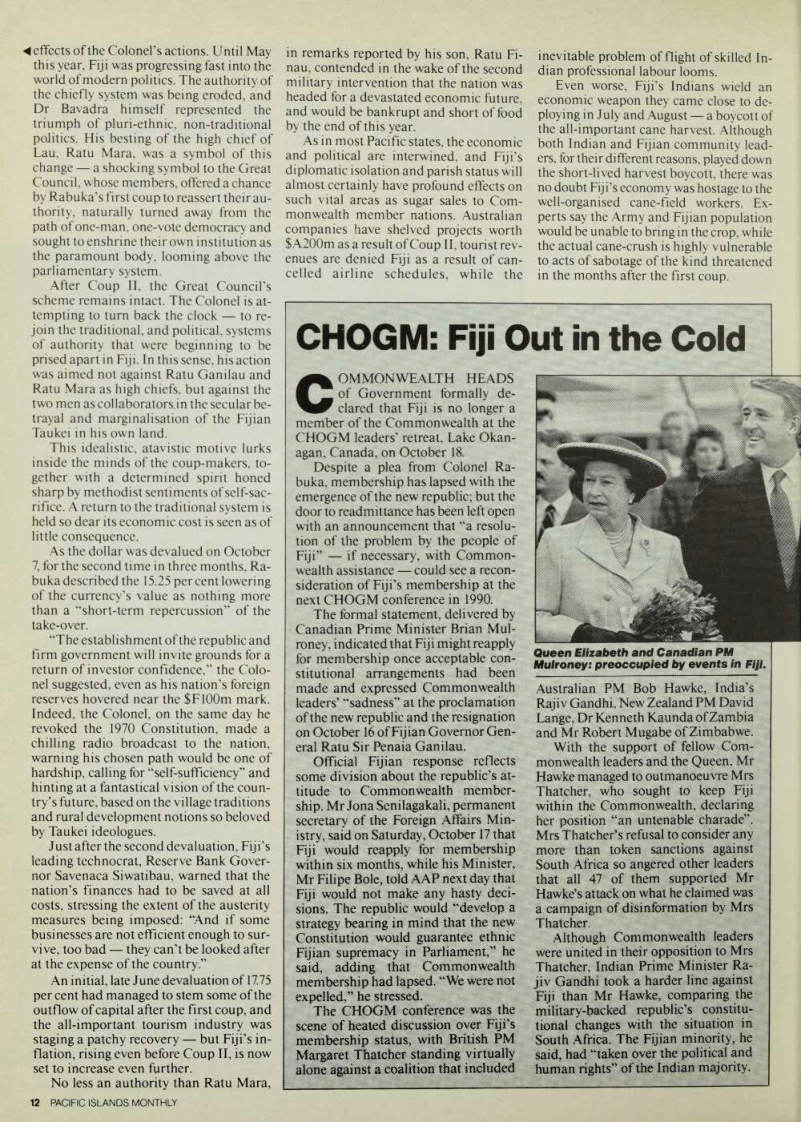
Queen Elizabeth and Canadian PM Mulroney: preoccupied by events in Fiji.