Rabuka’s Republic
pp. 10-12 · Read in the full issue
Fiji
The Colonel and his untried Council face a future beset with questions and problems. History will judge their success.
Colonel Sitiveni Rabuka’S
newly-declared Fijian Republic inherits a wealth of problems, a dearth of leaders and an economic out look redolent of the Third World.
When the Colonel proclaimed his na tion a republic, making his announce ment with theatrical timing at midnight on October 6, he was already aware interna tional opinion had condemned his second military take-over and the economic con sequences would be staggering; but even the possibility of sanctions did not per turb him. Of course, if imposed, they would hurt, he conceded, but Fiji would “survive”.
The Colonel’s second intervention has a steely resolve absent from the May take over. The September 26 coup was swiftly followed by the revocation of the 1970 Constitution, Rabuka’s proclamation that he was now “head of state”, the further de valuation of the Fijian dollar, declaration of a republic and announcement of a new Council of Ministers. All was done at breakneck speed, with little compromis ing or consultation.
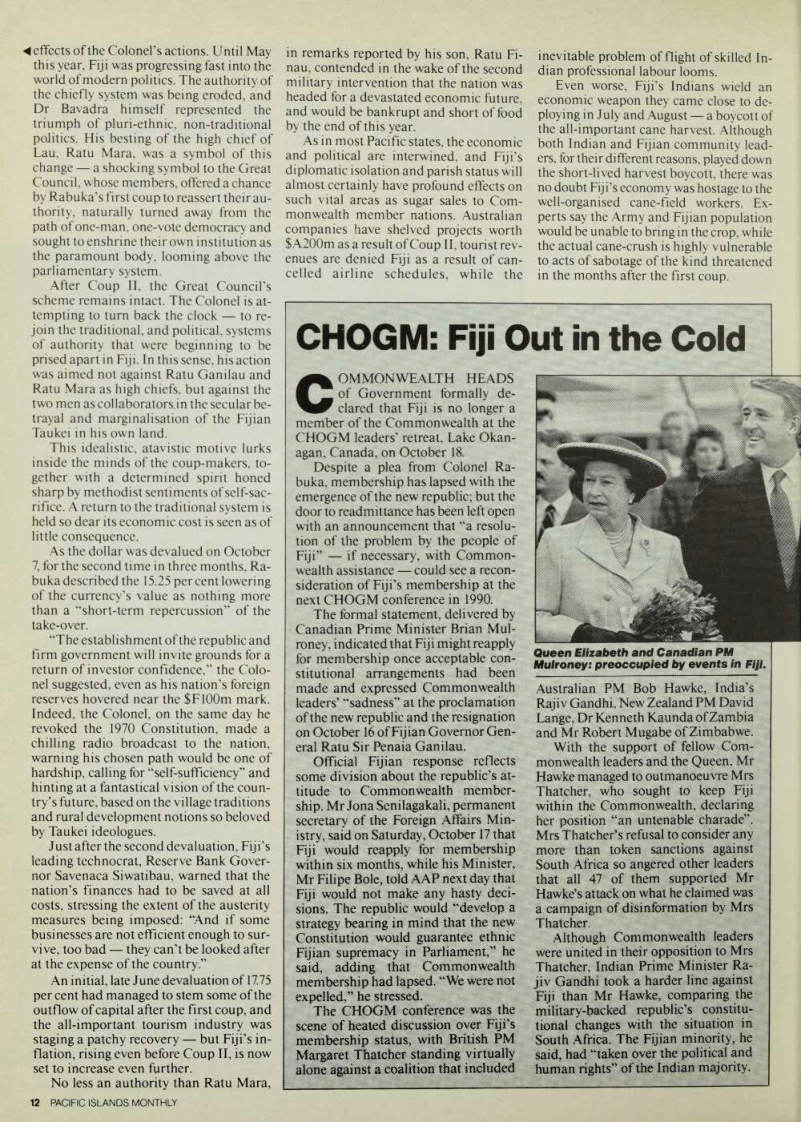
The Commonwealth Heads of Government, meeting in Vancouver in mid-October, decided after hurried con sultations to expel Fiji from their ranks; Queen Elizabeth announced the Gover nor General, Ratu Sir Penaia Ganilau, was stepping aside. The declaration of the Fi jian Republic was accepted as a fait ac compli despite murmurs of regret from Buckingham Palace. Commonwealth leaders had clearly decided to minimise the confrontation with the new regime in Suva British diplomats are believed to have sent a message to the Colonel, sug gesting that as far as possible Fiji would not be adversely affected by the expulsion, widely seen as a temporary measure.
Australian Prime Minister Bob Hawke was in the vanguard of those advocating an expulsion for a suitable period; but Fi jian officials, relieved by the course fol lowed at the Vancouver conference, were confident their international relations would not be wrecked by the move. “We will apply to be readmitted as soon as we receive official notification of our re moval,” one senior regime figure said after the CHOGM conference.
Colonel Rabuka always knew there would initially be determined resistance to his scheme; he detained key political
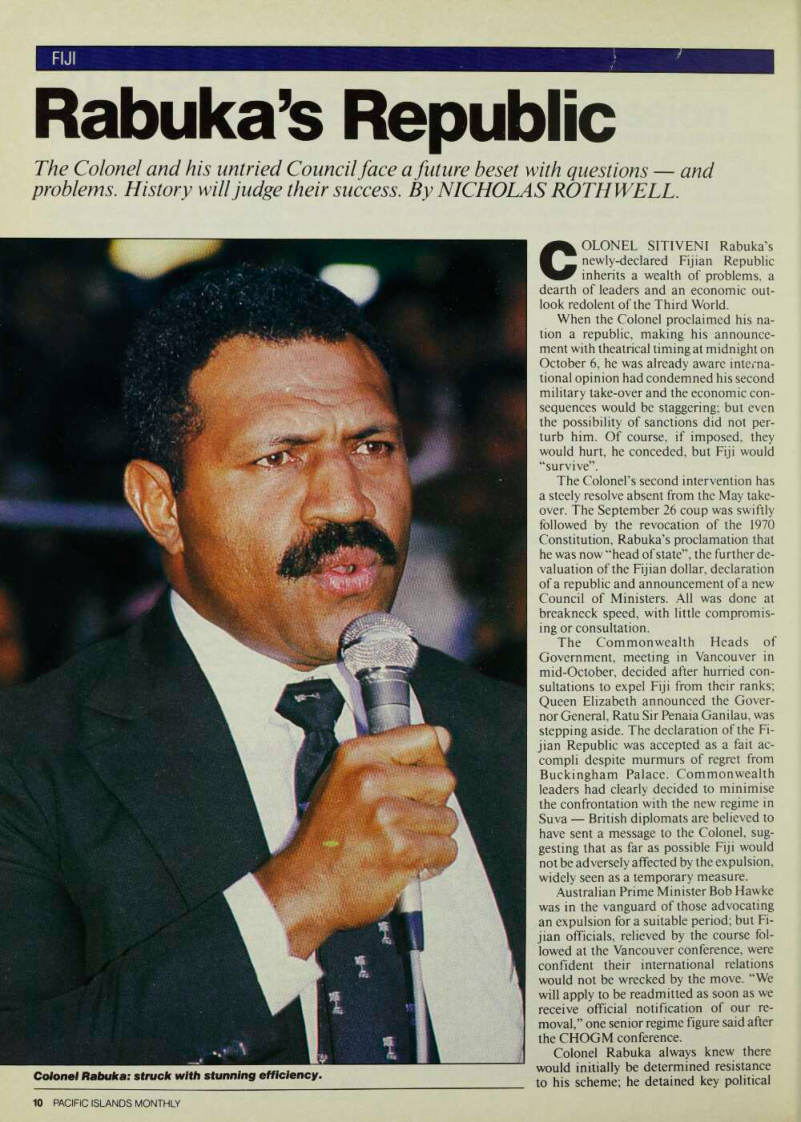
Colonel Rabuka: struck with stunning efficiency.
opponents and intimidated mainstream leaders of the establishment Alliance Party, which largely represented Fijians, while his soldiers consolidated their re newed grip on power during the first days of “Coup II”. He isolated the Governor General, Ratu Sir Penaia Ganilau in Government House, closed down or con trolled the local media and placed limits on the freedom of the overseas press corps.
Repression of trade unions came swiftly in the wake of the declaration of the re public; political activities by the Coalition parties of the Prime Minister deposed in the May coup, Dr Timoci Bavadra, have been limited. Functions of the senior members of the judiciary, loyal to the Governor General, were simply sus pended, and the public service purged.
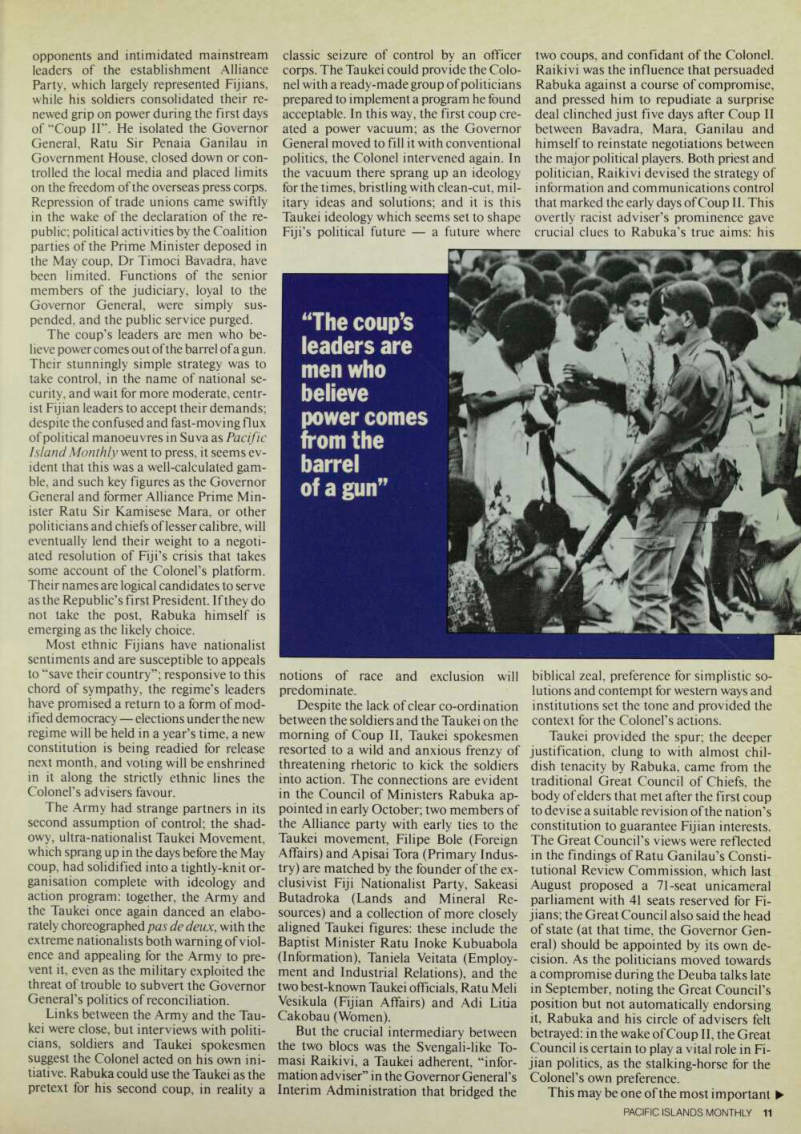
The coup’s leaders are men who be lieve power comes out of the barrel of a gun.
Their stunningly simple strategy was to take control, in the name of national se curity, and wait for more moderate, centr ist Fijian leaders to accept their demands; despite the confused and fast-moving flux of political manoeuvres in Suva as Pacific Island Monthly went to press, it seems ev ident that this was a well-calculated gam ble, and such key figures as the Governor General and former Alliance Prime Min ister Ratu Sir Kamisese Mara, or other politicians and chiefs of lesser calibre, will eventually lend their weight to a negoti ated resolution of Fiji’s crisis that takes some account of the Colonel’s platform.
Their names are logical candidates to serve as the Republic’s first President. If they do not take the post, Rabuka himself is emerging as the likely choice.
Most ethnic Fijians have nationalist sentiments and are susceptible to appeals to “save their country”; responsive to this chord of sympathy, the regime’s leaders have promised a return to a form of mod ified democracy elections under the new regime will be held in a year’s time, a new constitution is being readied for release next month, and voting will be enshrined in it along the strictly ethnic lines the Colonel’s advisers favour.
The Army had strange partners in its second assumption of control; the shad owy, ultra-nationalist Taukei Movement, which sprang up in the days before the May coup, had solidified into a tightly-knit or ganisation complete with ideology and action program: together, the Army and the Taukei once again danced an elabo rately choreographed pas de deux , with the extreme nationalists both warning of viol ence and appealing for the Army to pre vent it, even as the military exploited the threat of trouble to subvert the Governor General’s politics of reconciliation.
Links between the Army and the Tau kei were close, but interviews with politi cians, soldiers and Taukei spokesmen suggest the Colonel acted on his own ini tiative. Rabuka could use the Taukei as the pretext for his second coup, in reality a
classic seizure of control by an officer corps. The Taukei could provide the Colo nel with a ready-made group of politicians prepared to implement a program he found acceptable. In this way, the first coup cre ated a power vacuum; as the Governor General moved to fill it with conventional politics, the Colonel intervened again. In the vacuum there sprang up an ideology for the times, bristling with clean-cut, mil itary ideas and solutions; and it is this Taukei ideology which seems set to shape Fiji’s political future a future where
notions of race and exclusion will predominate.
Despite the lack of clear co-ordination between the soldiers and the Taukei on the morning of Coup 11, Taukei spokesmen resorted to a wild and anxious frenzy of threatening rhetoric to kick the soldiers into action. The connections are evident in the Council of Ministers Rabuka ap pointed in early October; two members of the Alliance party with early ties to the Taukei movement, Filipe Bole (Foreign Affairs) and Apisai Tora (Primary Indus try) are matched by the founder of the ex clusivist Fiji Nationalist Party, Sakeasi Butadroka (Lands and Mineral Re sources) and a collection of more closely aligned Taukei figures: these include the Baptist Minister Ratu Inoke Kubuabola (Information), Taniela Veitata (Employ ment and Industrial Relations), and the two best-known Taukei officials, Ratu Meli Vesikula (Fijian Affairs) and Adi Litia Cakobau (Women).
But the crucial intermediary between the two blocs was the Svengali-like To masi Raikivi, a Taukei adherent, “infor mation adviser” in the Governor General’s Interim Administration that bridged the
two coups, and confidant of the Colonel.
Raikivi was the influence that persuaded Rabuka against a course of compromise, and pressed him to repudiate a surprise deal clinched just five days after Coup II between Bavadra, Mara, Ganilau and himself to reinstate negotiations between the major political players. Both priest and politician, Raikivi devised the strategy of information and communications control that marked the early days of Coup 11. This overtly racist adviser’s prominence gave crucial clues to Rabuka’s true aims: his
biblical zeal, preference for simplistic so lutions and contempt for western ways and institutions set the tone and provided the context for the Colonel’s actions.
Taukei provided the spur; the deeper justification, clung to with almost chil dish tenacity by Rabuka, came from the traditional Great Council of Chiefs, the body of elders that met after the first coup to devise a suitable revision of the nation’s constitution to guarantee Fijian interests.
The Great Council’s views were reflected in the findings of Ratu Ganilau’s Consti tutional Review Commission, which last August proposed a 71-seat unicameral parliament with 41 seats reserved for Fi jians; the Great Council also said the head of state (at that time, the Governor Gen eral) should be appointed by its own de cision. As the politicians moved towards a compromise during the Deuba talks late in September, noting the Great Council’s position but not automatically endorsing it, Rabuka and his circle of advisers felt betrayed: in the wake of Coup 11, the Great Council is certain to play a vital role in Fi jian politics, as the stalking-horse for the Colonel’s own preference.
This may be one of the most important I
“The coup’s leaders are men who believe power comes from the barrel of a gun”
of the Colonel’s actions. Until May this year, Fiji was progressing fast into the world of modern politics. The authority of the chiefly system was being eroded, and Dr Bavadra himself represented the triumph of pluri-ethnic, non-traditional politics. His besting of the high chief of Lau, Ratu Mara, was a symbol of this change a shocking symbol to the Great Council, whose members, offered a chance by Rabuka’s first coup to reassert their au thority, naturally turned away from the path of one-man, one-vote democracy and sought to enshrine their own institution as the paramount body, looming above the parliamentary system.
After Coup 11, the Great Council’s scheme remains intact. The Colonel is at tempting to turn back the clock to re join the traditional, and political, systems of authority that were beginning to be prised apart in Fiji. In this sense, his action was aimed not against Ratu Ganilau and Ratu Mara as high chiefs, but against the two men as collaborators.in the secular be trayal and marginalisation of the Fijian Taukei in his own land.
This idealistic, atavistic motive lurks inside the minds of the coup-makers, to gether with a determined spirit honed sharp by methodist sentiments of self-sac rifice. A return to the traditional system is held so dear its economic cost is seen as of little consequence.
As the dollar was devalued on October 7, for the second time in three months, Ra buka described the 15.25 per cent lowering of the currency’s value as nothing more than a “short-term repercussion” of the take-over.
“The establishment of the republic and firm government will invite grounds for a return of investor confidence,” the Colo nel suggested, even as his nation’s foreign reserves hovered near the SFIOOm mark.
Indeed, the Colonel, on the same day he revoked the 1970 Constitution, made a chilling radio broadcast to the nation, warning his chosen path would be one of hardship, calling for “self-sufficiency” and hinting at a fantastical vision of the coun try’s future, based on the village traditions and rural development notions so beloved by Taukei ideologues.
Just after the second devaluation, Fiji’s leading technocrat, Reserve Bank Gover nor Savenaca Siwatibau, warned that the nation’s finances had to be saved at all costs, stressing the extent of the austerity measures being imposed: “And if some businesses are not efficient enough to sur vive, too bad they can’t be looked after at the expense of the country.”
An initial, late June devaluation of 17.75 per cent had managed to stem some of the outflow of capital after the first coup, and the all-important tourism industry was staging a patchy recovery but Fiji’s in flation, rising even before Coup 11, is now set to increase even further.
No less an authority than Ratu Mara,
in remarks reported by his son, Ratu Fi nau, contended in the wake of the second military intervention that the nation was headed for a devastated economic future, and would be bankrupt and short of food by the end of this year.
As in most Pacific states, the economic and political are interwined, and Fiji’s diplomatic isolation and parish status will almost certainly have profound effects on such vital areas as sugar sales to Com monwealth member nations. Australian companies have shelved projects worth $A2OOm as a result of Coup 11, tourist rev enues are denied Fiji as a result of can celled airline schedules, while the
inevitable problem of flight of skilled In dian professional labour looms.
Even worse, Fiji’s Indians wield an economic weapon they came close to de ploying in July and August a boycott of the all-important cane harvest. Although both Indian and Fijian community lead ers, for their different reasons, played down the short-lived harvest boycott, there was no doubt Fiji’s economy was hostage to the well-organised cane-field workers. Ex perts say the Army and Fijian population would be unable to bring in the crop, while the actual cane-crush is highly vulnerable to acts of sabotage of the kind threatened in the months after the first coup.