“Rabuka may find he is obliged to keep Fiji a police state,
p. 13 · Read in the full issue
complete with curfews and news blackouts”
The unspoken fear of all observers is that the rapidly-expanded Fijian army’s raw recruits, well-armed and under pres sure, may not be able to cope with the in evitable tensions the second coup will force to the surface. The cycle of reactions to such a take-over is well-known, and some reported its emergence after the May coup.
Shock, dismay, fear and anger give way to resolve and resistance. As the moderate Indian leaders have been intimidated or frozen out of the political process, the way is left clear for extremists to emerge. The prospect of compromise and the near-rev erential authority in which the Indian community holds Dr Bavadra, a constant voice of calm, have until now kept a lid on terrorism; but Rabuka may well find he is obliged to keep Fiji a police state, com plete with road-blocks, curfews and news black-outs, if only to prevent the country descending into of ethnic violence.
Yet all these effects and potential de velopments, difficult to quantify, are less significant over the short-term than the definite change in Fiji’s state wrought at a stroke by the two coups.
Once the showpiece of the Pacific, held up as a model multi-racial democracy and political and diplomatic leader of the newly independent island nations, Fiji is now, even if unfairly, perceived as the Ocean’s trouble-spot, symbol of failed institu tions, broken trust and hostility between rival peoples and cultures the post-co lonial experiment that went bad, the ex ample every contending Pacific party
draws on to show what must not be repeated.
This has led to a sharp change in the attitudes Pa cific region states take to wards Fiji. The reasoning follows simple lines: one coup may be carelessness; a second is harder to for give. Not only did the top pling of Bavadra pose an exquisite dilemma for the more radical, newly-inde pendent Melanesian states, confronted with the spectacle of a “progres sive” government ousted
by their own brother Melanesian nation alists; the continued disturbance of the democratic processes most island nations respect has opened a new range of possi bilities for the entire region.
Suddenly, the Pacific seems a cockpit of social and political tensions, with Fiji itself, crossroads of Melanesian and Po lynesian influence, meeting-point of post colonial design and native intent, perhaps only the first country to redefine its own internal system.
The “great powers” of the Pacific, Fiji’s traditional allies Great Britain, the USA, Australia and New Zealand, have all con demned the coup, as have the Melanesian Spearhead member nations Vanuatu, Papua New Guinea and the Solomon Is lands although Vanuatu’s Prime Min ister Walter Lini and Papua New Guinea’s
Paias Wingti have both stressed the view that Fi jians should be allowed to resolve their own prob lems. But Polynesian Tonga, intriguingly the major cultural influence on Fiji in the years preced ing British colonisation, also has much in common with post-coup Fiji; it is a monarchy that leaves little room for other races and enshrines methodism as a state religion.
For all the Colonel’s confidence that he was
fulfilling his obligations to Fiji’s people by intervening once again, he may have dealt not only his country, but also the entire re gion’s political culture, a savage blow.
Under the surface of well-policed calm, Fiji is now impossibly divided, its key leaders still possessing different visions.
The communities are split down stark eth nic lines: the largely Indian population west of the main island could well aim at secession, while even the traditional chiefs, clear beneficiaries of the second coup, are far from unified.
As Colonel Rabuka seeks to gather up the shattered fragments of the nation he hoped to unify in the proud spirit of its tra ditions, he could well cast his mind back to the reality behind the prelapsarian Fiji he imagines existed before the British came.
As the Fiji Museum catalogue sug gests, the Taukei dogmas of Fijian racial purity are unfounded: “The archaeolog ical record establishes that the Fijian people and culture varied widely with time, evolving through thousands of years of dynamic and confused blending of an cestral Polynesian, Melanesian and west Polynesian peoples.”
As for the idyll of Fijian social life un der the chiefly system, that dream of per fection Rabuka held up as his model, when he addressed the nation on September 25, speaking softly of “the hopes and expec tations of the Taukei”, the historical re cord paints a rather different picture of a nation warring and divided: “by the early 1800 s chaos reigned, the country being plagued by both local feuding and increas ingly bloody civil wars the heritage of a convoluted web of social relationships from a less-organised era meant this more extensive campaigning could only be sus tained against a background of espionage, intrigue, blackmail, and subversion.”
Fijians, and the people of the whole Pa cific region, must hope history is not poised to repeat itself. □
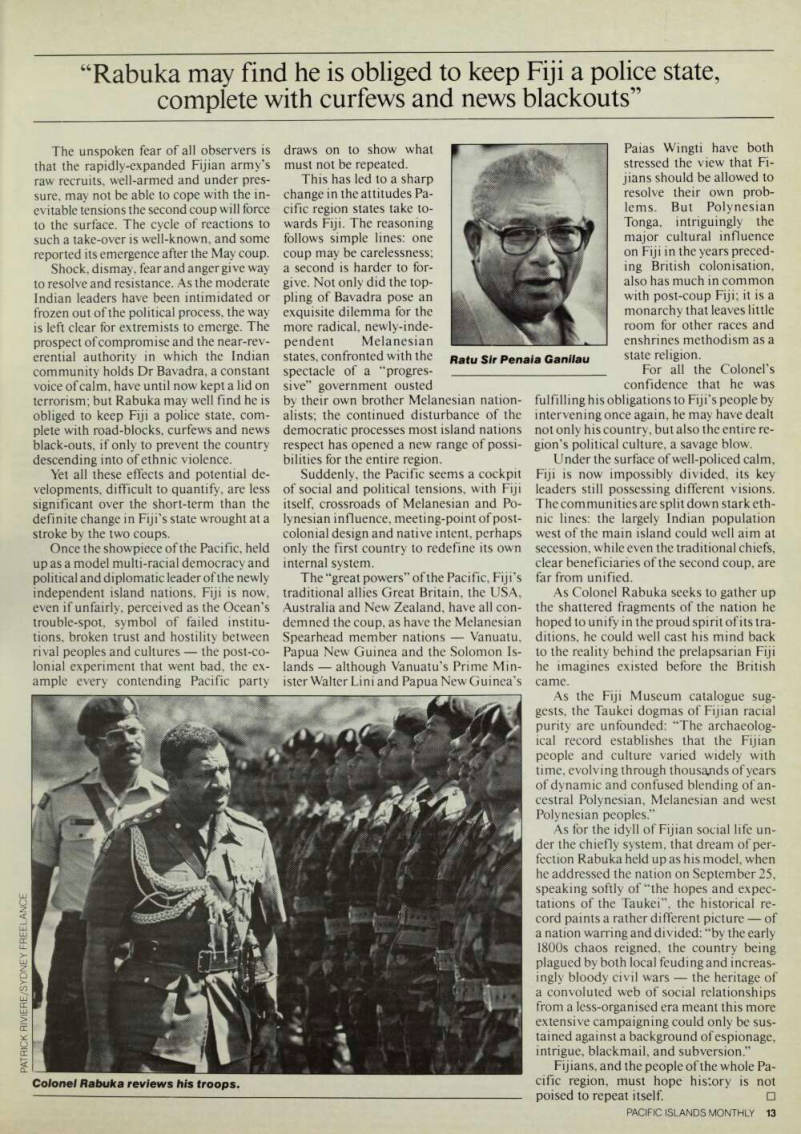
Colonel Rabuka reviews his troops.
Ratu Sir Penaia Ganilau