Palau struggles in wake
pp. 37-38 · Read in the full issue
of Compact defeat
A proposed Compact between Palau and the United States has gone down to defeat for the fifth time in as many years following a June 30 vote. Ten sion was high in Koror when the government laid off two thirds of its workers in response to a financial crisis which Presi dent Lazarus Salii blamed on the failure of the Compact to pass.
Heated debate between pro and anti-Compact leaders typi fied the run up to the vote, which was delayed a week when the Palau Supreme Court ruled that the government’s handling of absentee ballots was illegal, and voided all absentee votes cast.
The 67 per cent support shown for the Compact was once again short of the mini mum. The Constitution stipu lates that 75 per cent of the voters must approve any treaty allowing transit of nuclear war ships or storage of nuclear weapons.
In exchange for funds in excess of $5OO million the exact amount is strongly dis puted the Compact would have allowed the transit of nuclear powered vessels and US military use of land in the islands for a 50 year period.
However, most observers comment that internal political feuding, not opposition to US nuclear plans, led to the Com pact’s defeat. On a grass roots level feelings against future US military activity are strong. But most political leaders opposing the Compact are eyeing a “bet ter deal” within the confines of the proposed “free association” relationship. And free associa tion presupposes concessions to the US military.
A government financial crisis prior to the June 30 vote led President Salii to cut the work week to 32 hours, and to limit water and electricity services.
Compact opponents charged Salii with unfairly pressuring voters to accept the Compact with these tactics.
Within days of the vote, Salii declared Palau bankrupt and ordered the layoff of 900 gov ernment employees, nearly two thirds of the entire government workforce. Mr Salii cited a treasury nearly US$2 million short of funds to meet payroll until October 1. The action sparked finger pointing on both sides.
“It’s getting a bit ugly here,” said Mr Bena Sakuma, an aide to House Speaker Santos Oli kong, a leading Compact oppo nent. Most of the furloughed government workers have signed a petition calling for Mr
Olikong’s resignation, while Mr Olikong and his supporters have called on Mr Salii to resign.
While the Palauans fight it out, United States officials say the US has done its part by approving the Compact even though the Palauans ha ven’t and it’s up to Palauans to resolve the situation.
Whether the amount of fun ding offered by the US for 50 years is US$l billion, as Mr Salii claims, it promises to be a financial windfall for the islands with a population of just over 13,000. Funds for construction projects will abound.
Commented Pacific Daily News (Guam) writer Mr Bart Stinson: “Whoever is president
of Palau when a Compact is actually implemented will be able to take credit for it. Massive US spending for Compact re lated road building and other construction projects will pro vide an incumbent president with a patronage base that no opposition candidate could rival. ”
Compact opponents contend they could secure a better deal for Palau by further negotia tions with the US. Compact opponents point to the Mar shalls and Federated States, where the implementation of the Compact has brought sub stantial cuts in education and some other programs. Although some Compact opponents want to parlay their strategic
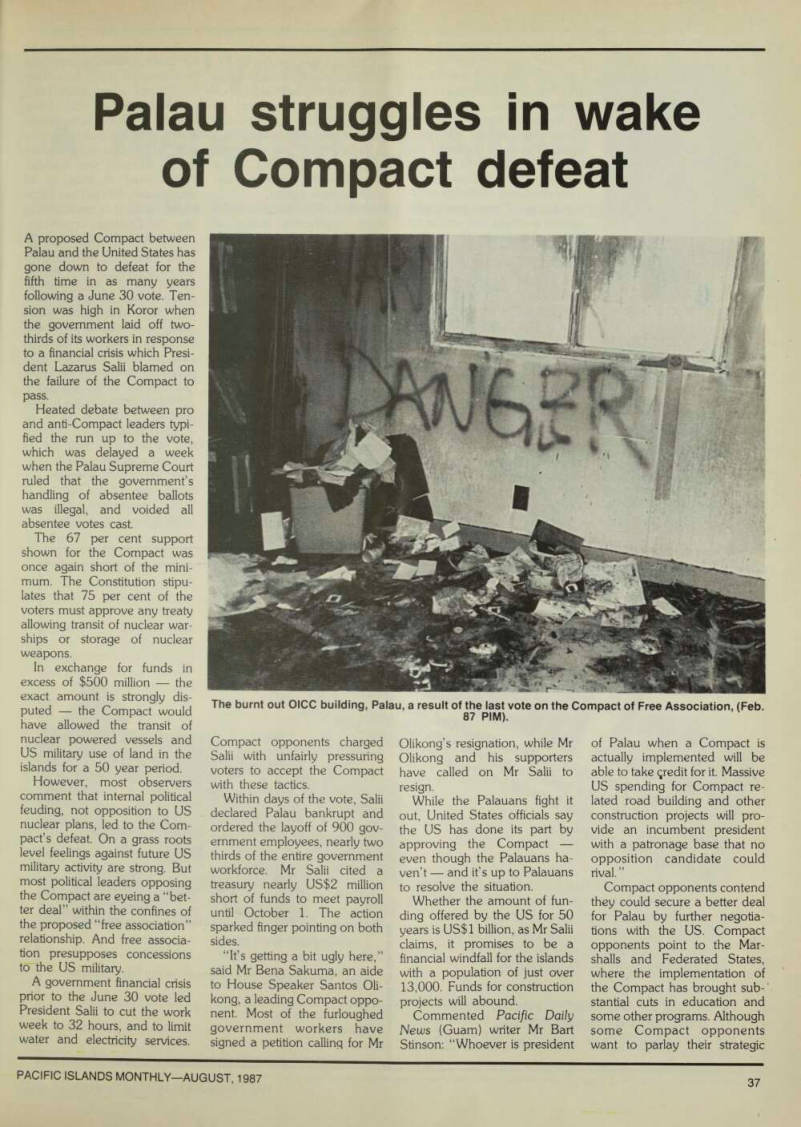
The burnt out OICC building, Palau, a result of the last vote on the Compact of Free Association, (Feb.
87 Pim).
location into better financial terms, the US says the defeated Compact is its final offer.
The failure of the Compact to reach a 75 per cent majority is unlikely to deter Mr Salii from continuing the quest for the Compact a document he has been involved in negotiating since the early 1970 s when he represented the Congress of Micronesia as chief political sta tus negotiator.
His sweeping action of laying off most government workers until the new fiscal year on October 1 is already causing widespread dissension in Palau.
Mr Salii’s aim would appear to be twofold; finger Compact opponents as the cause of the financial crisis and to create a backlash that will either support a constitutional amendment re moving the 75 per cent provi sion of a climate favourable for Compact passage in another vote.
People who have received government pay cheques every two weeks as far back as they can remember are not going to take a thfee month lay-off light ly. And with United States strategic interests at stake, the US is not going to jump to Palau’s assistance.
Mr Salii’s supporter, Mr John O. Ngiraked, the Compact elec tion commissioner who quit to campaign for the pact a few days after Palau’s court ruled his absentee ballot scheme ille gal, said of Compact oppo nents: “Each time they push for a defeat of the Compact, they
don’t offer an alternative.”
That fact may be the key to Mr Salii’s ultimate success. Most current leading Compact oppo nents have, at one time or another, backed the Compact.
None of the leaders, who have so effectively campaigned against the Compact, have come forward endorsing an other political option.
In fact, Mr Olikong took the clearly ineffective action of asking US Interior Department and United Nations officials for action to alleviate “the extreme ly serious and dangerous situa tion that has developed in Palau”. In a letter to the UN, Mr Olikong charged that Mr Salii’s mismanagement of funds and job furloughs will “throw Palau into chaos”.
Mr Salii, however, is certainly counting on United States offi cials to ensure the pressure remains on Palau. There is little sympathy in Washington for Palau’s budget woes, and no support for Compact oppo nents who are viewed as a threat to American security in terests.
The opponents’ response to Mr Salii’s challenge may well determine Mr Salii’s next step.
In the past, there have been political battles that have reached a climax with violent results in Koror: buildings have been firebombed and President Haruo Remeliik was the first Pacific head of state to be assassinated. Mr Salii has trans ferred the onus of responsibility onto the Compact opponents.
After five plebiscites all with majorites for the Compact, but none with 75 per cent the time is ripe for innovative policy moves. Independence is the only option that would satisfy anti-nuclear sentiment, but to date there has been no clear position from Compact opponents on what they would like in place of the Compact.
Mr Salii himself is in a unique position to make a move for independence, but it is doubtful that he will do so. With the US needing voter approval to legiti mise its military interests, an other vote on a Compact of similar specifications is to be expected Giff Johnson.
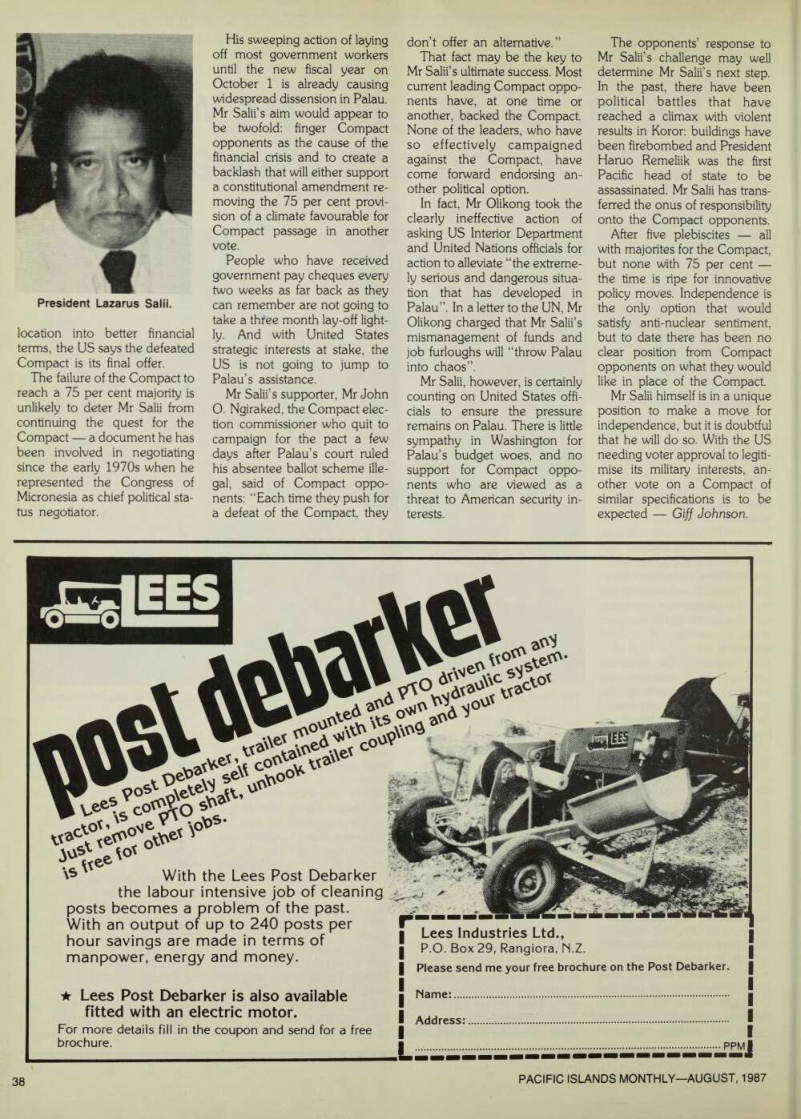
President Lazarus Salii.