Western Samoa:
p. 39 · Read in the full issue
A response to Albert Wendt
by Misa Foni Retzlaff, Attorney General of Western Samoa
■ take issue with Pacific Is lands Monthly’s treatment of our 25th Anniversary of In dependence. In your June 1987 edition, the cover shows our police band at Tiarau with the caption “W. Samoa 25 years on.” Expecting an exten sive, balanced and in-depth coverage of our 25 years of Independence, I found only two pages of coverage, an article by Albert Wendt: “W.
Samoa 25 years after: celebrat ing what?”
At the outset it is important to state that Albert Wendt is a favorite son of whom we are all justly proud. His literary achievements and his stature in the Pacific are matters that bring a special pride to us all.
It is for just this reason that when he decides to condemn our society as corruption-ridden and not worthy of his further indulgence, or indeed pres ence, that I feel compelled to make a statement in defence of all that is good in our Samoa.
Albert Wendt does not need to be apologetic about no longer living in the Samoa he states he both loves and des pises. This enigma must be difficult to resolve; for surely if he loves Samoa, then he should be here among us, dealing with those aspects of our society he so despises. His achievements and talent now require an environment we cannot provide. His special achievement and source of particular pride to us all is that he is the local boy making it big in the papalagi academic world.
He needs this environment to provide the security and in spiration for what are now his world acclaimed writings.
Specifically, if you reconsider your article, Albert, you will have to admit in your heart it is unfair. To begin with, you gen erally condemn an entire coun
try and race (and by implication yourself) of corruption for the acts of a few.
In generally condemning foreign investors you insult those foreign investors who are genuine and have made sub stantial investments in Samoa without greasing a single palm.
In this regard, for the record, we compare very favorably with our Pacific neighbors.
Your reference to the pro posed toxic waste plant is erroneous and quite unfair. It is unfair because it was strongly resisted by the entire public service machinery and particu larly the Attorney General’s Office. There were allegedly monies paid over (we tried but could not get any evidence with which to enable charges to be brought). It is erroneous as the subject never went to Parlia ment and was never close to Cabinet approval. The toxic waste promoters were working on MPs at a time when the budget was before the House.
They came to buy our princi pals and failed. It is a lesson other such investors must heed and a credit to us all that their proposal was devastatingly de feated.
Our police, for the first time in their history, were responsi ble for a death. They have suffered fatalities the other way around. They were charged with murder and, I regret to say, were recently discharged, but after due process of law. The fact is that they were charged, and we are presently consider ing an appeal while alternative charges have been laid.
When you take isolated inci dences such as toxic waste and police brutality and apply those to generally condemn society, you do a disservice to our society. We did have much to celebrate this June, a peaceful transition to independence. We
never expected economic inde pendence but as Third World countries go, our own particular economic system of Christian matai-ism has meant the gen eral economic well-being of our people. We are not perfect, but neither is our development poor compared to the rest of the region.
In condemning our electoral system you do not give credit to the long hours of discussion that resulted in the present system. We inherited the Westminster model of constit uencies and our constituencies still vote for what they feel is best for them service in the past and expected services in the future to the constituency.
This service does include their material needs, but we have plenty of incidences of matai returning from New Zea land or the United States with $20,000 to buy votes and re ceiving only ten votes for their trouble and their money. Our constituencies tend to be small (200-300 more or less on aver age) and this does lend itself to corruption. However the people usually vote for the politician they believe will best serve their needs, not neces sarily the nation’s, and who will serve their needs in the long term rather than the short term.
Upon achieving independ ence, most MPs were matais who lived and worked in their
constituencies/villages. They
did not need to buy their votes and their service was more in the form of time rather than money.
As carpet-baggers (out-of towners) started running for elections, their service was more in the form of money than time. There was the successful buying of votes for a while but that time is gone. Anyone hop ing to buy an election will leam this the hard way. The losing of
seats through post election corruption suits in recent years is another deterrent.
The point is there is still plenty of time for improvement, but how this will evolve without adopting the European system of proportional representation will have to be carefully and slowly staged.
Should we fight or flee? Who knows when and if any of us is no longer needed, we may all benefit from a few years abroad. The environment must allow for a contribution. If this is not so, it may be best to leave.
One is not always in a position to change society, but I often look at the plaque on my wall: “God grant me the mentality to accept the things I cannot change, courage to change the things I can, and wisdom to know the difference.”
You should not condemn generally your people for the acts of a few. All that is beautiful in Samoa is still beautiful. There is good and bad in Samoa as there is good and bad everywhere. It is still a beautiful place, the ultimate home to us all inspite of our travels.
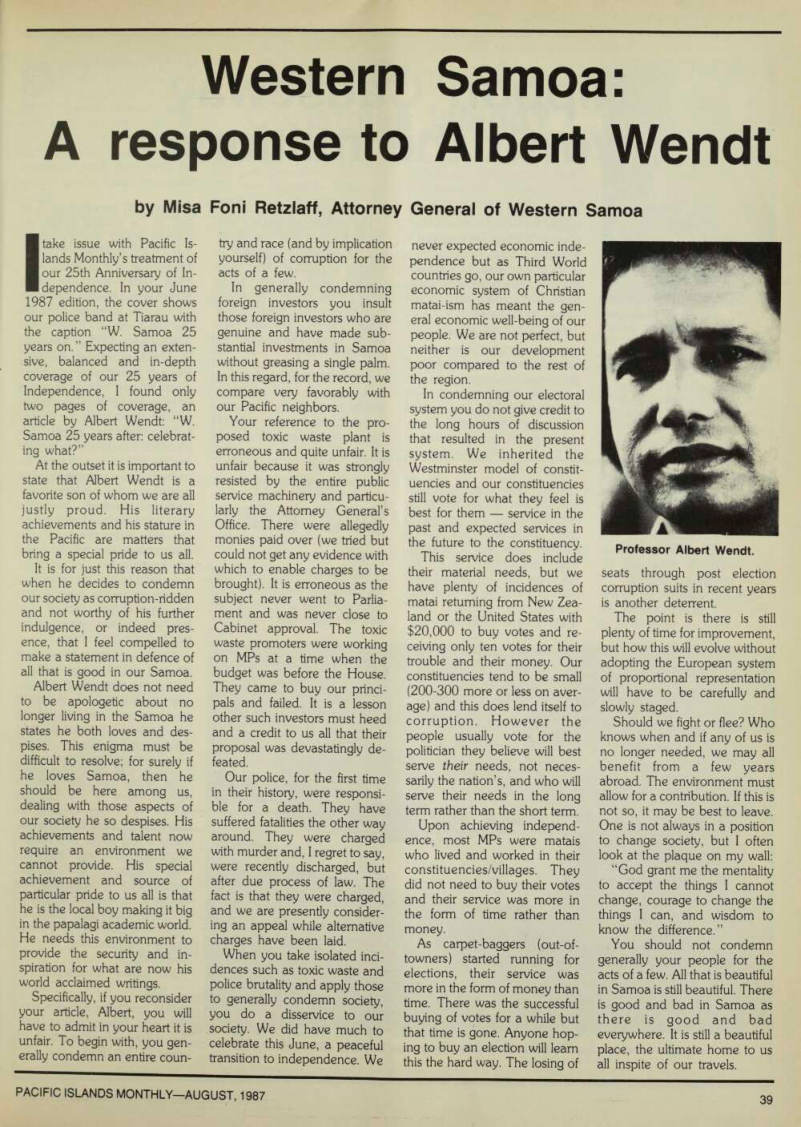
Professor Albert Wendt.