Uneasy calm in Noumea
pp. 35-36 · Read in the full issue
Alain Rollat, specialist writer for Le Monde on French Overseas Territories reports from Noumea on the lead-up to the September 13 referendum and on the risk of violent confrontation between the pro-and anti independence forces. Rollat finds that a uneasy calm reigns in New Caledonia today which he says brings to mind the story of the ant and the grasshopper, in which the ants toiled industriously for winter while the grasshopper made merry - and found himself without food in winter.
For carefree Noumea the party hasn’t stopped. Life is punctuated by fashion parades, beauty contests, bazaars and wind-surfing races off the Club Med beach. Be tween Anse Vata and Baie des Citrons joggers compete with cycling fanatics. At the casino the gleaming money machines are making a profit. Soldiers on leave queue up at the beach for the trip to Amadee lighthouse, the tourist destination on the coral reef.
On the commercial front too, all is well. The Employers’
Federation is pleased that pri vate investment has totalled over 71 million French franc s(Asl6.s million) since the be ginning of the year. Happiest though, are the property deve lopers, with construction going on everywhere. The city is holding up now - the local daily claims the “French record” for shops: 337 square metres of commercial space per 1000 inhabitants, (“three times high er than any department in France”).
The manna of the State is still falling: in 1986 France spent
1,575,678,886 Ff(A5366.4
million) on the territory, without counting subsidies given directly to the territorial budget.
The exceptional effort that the French Government de cided to put into reviving the economy brought the figure for development aid from the State to about 530,126,133 FF(ap prox Asl23 million). The municipality of Noumea obtained the biggest packet -14 million FF(AS3.2 million)- the Territorial Tourism Office also did well, getting 6 million FF(A -sl.4million) as did Air Caledo nie International with 5 million FF(ASI.2 million), and the Surf Hotel - in which anti-independ ence RPCR party leader Jac ques Lafleur is a shareholder received 2.8 million
Ff(A5651,163).
French Overseas Territories Minister Bernard Pons is happy with the level of metropolitan interest: his excursion to Ouvea
island, a pro-independence stronghold, went beautifully.
He was even carried in triumph upon his arrival. No-one dared to spoil his fun by telling him that the hired applause which greeted him had been brought over the night before from Noumea on the initiative of his RPCR friends.
But let’s not be too cynical.
No-one among the Noumea “grasshoppers” is willing to pay attention to the warning signals sounded by former centrist Senator, Mr Lionel Cherrier, against the “artificial prosper ity” of Noumea compared with “the notorious under-deve lopment” of the interior re gions. Cherrier denounces the “collusion between Mr Pons and the leaders of RPCR who also represent the principal for tunes of the territory”, and warns that “if the Government carries on in this pig-headed way then the Caledonian prob
lem will become another Leba non, but in miniature”.
Nobody gets excited any more (except Mr Lafleur and his lieutenants, who are irri tated) by the demands of the extreme right - which in the “Caledonian Weekly” recently attacked the forthcoming re ferendum as being in the in terests of profiteers who can’t be trusted to keep the tricolour flying.
Meanwhile, tucked away at the Bonde mission in the au stere hills of the north-east of the Grande Terre, Father Denis Jacquin is fighting the adminis tration for a cut-rate telephone to be installed. The parish accounts which are taped to the never-closed door of his office show a deficit of 2,9B4FF(ap prox A 5694).
This is the reality here. The largesse of the French Govern ment doesn’t extend to Bonde.
For 18 years this European
Marist missionary has served as a man-of-all-work for the Melanesian tribes above the town of Ouegoa. He puts such heart and faith into his work that watching him is enough to make one want to award him the Nobel Peace prize. He loves “his” Kanaks and they respond in kind. Not one FLNKS leader fails to turn up at Sunday Mass.
The office of deacon is even performed by the Union Cale donienne delegate and the FLNKS Mayor of Ouegoa pro vides a rich tone in the male choir.
Father Jacquin is not an independantiste. He knows that a break between New Caledonia and France could be a catastrophe for all Kanaks.
But when in autumn, along with many other Catholic priests, he signed an appeal for justice for his flock, it was because he also knows that the despair that grips the Kanaks of Bonde and elsewhere could bring an even worse catas trophe. He adds; “Its a sham to try and maintain a colonial situation in the name of demo cratic values.”
In November 1984 Father Jacquin rang alarm bells on the eve of the territorial elections which generated into insurrec tion. Nobody took him serious ly. This time he appears less alarmist: “The tension is not as high.
Everyone fears violence. But the Kanaks are cornered and the instruction to boycott will be followed because they have no choice. ”
Massed in front of the church, Father Jacquin’s con gregation - young and old agree. Two and a half years after the death of the FLNKS “chef de guerre”, portraits of Eloi Machoro adorn many tee shirts.
The new “Minister for Secur ity” in the “Provisional Govern ment” of Kanaky is Mr Aymard Bouanaoue. Mayor of Belep, one of the most hard-line FLNKS bastions, he has already won a measure of glory
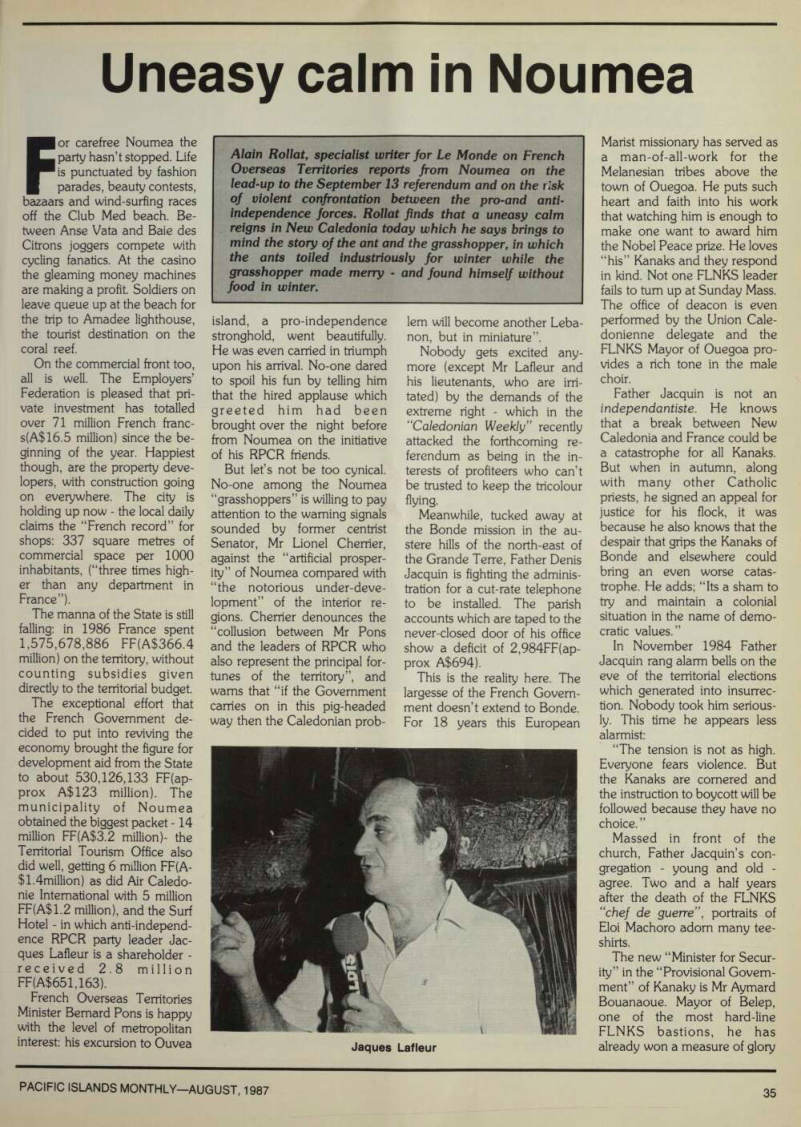
Jaques Lafleur
when last January he deman ded and got the departure of parachutists and gendarmes from his municipality - after they had disembarked, un announced, to “nomadise” the island.
Bouanoue is largely responsi ble for coordinating the arrangements for the “great march for independence in peace’’(and for the boycott of the referendum) that the inde pendence movement is organising to start on August 23 and to arrive, all going well, in Noumea on September 3.
Along the way FLNKS militants will hand out copies of the “Proposed constitution of Kanaky”to Caldoches, in a bid to prove their commitment to keeping New Caledonia a democratic and multi-racial so ciety.
FLNKS local committees, as disciplined as ants, are metho dically working away so that all Kanaky will swing into action throughout the Grande Terre at the end of August.
FLNKS leader Jean-Marie Tjibaou is aware of the risk of violence this strategy carries especially when the division of the march into many smaller parades will no doubt lead to numerous encounters between militants and police or militants and Caldoche self-defence groups. This is most likely at Bourail on the East Coast, where marchers from Poum and Pouebo in the north are due to converge on August 29.
References to the Algerian FLN (National Liberation Front) or to Colonel Gaddafi are finished - Tjibaou is now inspired by the pacifist farmers of Larzac in France: “if there is violence it won’t be from us”.
In the eyes of the UN which has endorsed the independ ence cause, Tjibaou can’t afford to be seen as an irresponsible trouble-maker. But he is also aware that Mr Pons and the French Government will take political advantage from a weak boycott. Thus he is taking the paradoxical gamble of a radica lisation...calmly accepting the risks of outbursts that his ambi guous instructions could en courage, all the more so be cause his own party, Union Caledonienne, does not have
enough staff to completely con trol the youngest and most warlike militants.
In any case the choice is not disputed. Among the leaders of the other FLNKS parties - Pali ka, FULK and UPM- no-one appears capable of competing with Tjibaou for influence. His position is even stronger than two years ago, unlike that of his number one political opponent Mr Jacques Lafleur, who has been weakened by dissent in the conservative camp.
In truth, the only real change within the FLNKS has been in the awareness of Tjibaou and his followers that independence won’t come tomorrow. In November 1984 with a Socialist government in power and with the stimulus given by Machoro many independantistes thought they could gain it on the ground by force, not being able to gain it legally through the ballot box.
“Today, with so many troops present here, the balance of forces has changed”,the FLNKS leader points out, “and we must adapt to this new context”.
So to prevent Mr Pons from being able to claim victory on the night of September 13, the FLNKS will use all means, including direct pressure, to dis suade Kanak voters from taking part in the referendum, to give the lowest participation rate possible.
The failure of the French Government will be evident if the abstention rate reaches 50%. And Mr Pons is not at all protected from such a setback.
If all independantiste voters had boycotted the September 1985 regional elections, the abstention rate would have been 50.39 %. Moreover, on the day of the poll the FLNKS militants will mobilise around the polling stations to stress the dubious character of the results of this high- risk referendum.
Tjibaou is preparing the movement for a long resistance beyond the date of the referen dum: “we must find a strategy that will create a new balance of forces,” he told his Union Cale donienne in January.
“Let the cowards stay in the forest So that all over New Caledonia we’ll find Kanaks on the road to say ’go no further’.
Plant supplies, stock up our shops and our cooperatives, buy radios, for a long and hard resistance. ”
Seven months later Tjibaou stresses that militants in the three FLNKS controlled regions are working “to increase the economic weight” of his move ment in order “to destabilise the colonial interests.”
In spite of the complaints expressed after the change of government in France last year, the three FLNKS regional presi dents have not done too badly
through skilfull use of the pow ers that were left to them after the Conservative changes.
In the Northern region Tjibaou personally forecasts a positive balance-sheet. Funds that he saved have, for exam ple, allowed him to back 511 mini-projects in several areas of economic development (agri culture, fisheries, cattle-raising, forestry, crafts, transport and commerce) to a sum of eight million FF(approx Asl.9 mil lion).
At the back of this is the new line of the FLNKS leader: since independence is not guaran teed at the point of a gun, it must be won through poultry and pork farms which give an all-important economic weight to their political action.
Since the uncertainties of the French presidential election in 1988 will send the application of the new autonomy statute of Mr Pons back to the bottom of the in-tray, New Caledonia’s ordeals are not over.
Especially not if, (as some elders of Bonde tribe murmur mysteriously), political leaders may be helped by the best sorcerers as a last resort They have already been asked by some militants “to rub stones, make leaves tremble and coco nuts fly” - to unleash with these magic rites the black forces of nature against Whites, though at the risk of their own lives.
Visiting Australia in late June for talks with Government officials and Kanak support groups, FLNKS leader Jean- Marie Tjibaou told PIM that he didn’t think the French Government would attempt to prevent the march for inde pendence planned by the
Flnks.
“It will be very difficult for them to stop it. We are hoping for a big media presence be cause its a security for the people.
“All action that could be taken against our march can only accelerate the movement towards independence...
“1 think if a confrontation occurs, we can keep our sang froid, even the most radical militants. I think so, because
the most important thing for us remains the objective of the march, which is to obtain talks at the end - our final aim is always that.”
Meanwhile, anti-independ ence leader, Mr Jacques Laf leur, has announced an anti independence “tri-colour” march. “We cure going to mobilise because it is our strong duty to mobilise for this referendum,” he said.
“We are going to show what we want in such a way that we will never have to show it again.
“We are going to unite to work out how to do it. We will go by car, by horse, by bicy cle, by whatever means, but we are going to show how many of us refuse the threats
of Mr Tjibaou. ‘Tor the moment we are preparing this march, prepar ing to be thousands of demon strators and marchers for liberty, for France and its excellent preparation for the
referendum.”
HF
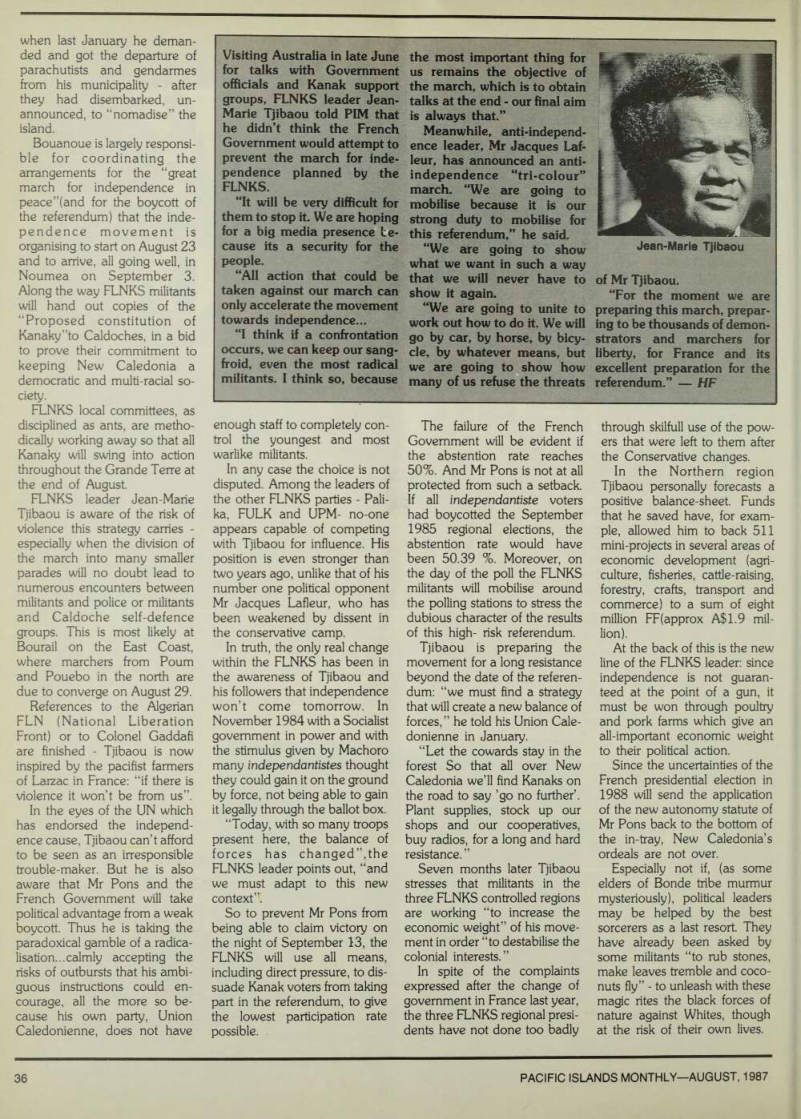
Jean-Marie Tjibaou