Fiji’s Governor General
p. 16 · Read in the full issue
appeals for peace and calm
On Sunday June 7, Fiji’s Governor General, Sir Ratu Penaia Ganilau, who is now the chief executor of the country, out lined in a nation-wide broadcast a plan of reconstruction in an effort to restore confidence on behalf of the nation’s 700,000 plus population.
In his address, the Governor General touched on a wide range of issues which were causing anxiety in the minds of the people.
Firstly, he said he wanted to assure the people of Fiji that the country had now moved away from the brink of despair and destruction on which it had been poised.
He said that in his travels in the Western Division of the country, whatever he had seen had given him great confidence that the people of Fiji were getting back to their old ways of tolerance and respect for one another. However he said he did not want to create the impression that the situation was no longer serious, and that it still demanded great under standing by all the people of Fiji who have Fiji’s best interests at heart.
He added, “My main appeal is that I would like all of you to put aside the politics of fear and racial aggression which had emerged over the last few weeks.” He said, “We have known from various govern ments such politics can only be destructive and in Fiji we have always been proud of our qual ities of decency and tolerance.
He also complained that foreign journalists were still writ ing about a military government in Fiji, but he said there was no military government in Fiji. He had taken on the sole executive authority for managing the affairs of the nation in line with the powers vested in the office of the Governor General by the constitution.
The Governor General said that the Royal Fiji military force and the Royal Fiji police force took their orders from him. The presence of the Royal military force at keypoints in the nation is in accordance with his orders and he said, “I reiterate to you today that these soldiers are there today to protect the public interest The soldiers have an imporant role to play during this time of emergency and I am anxious that the public should cooperate with them rather
than get into confrontational situations.”
However on the same day the Governor General addres sed the nation, eight armed soldiers broke into a house in a Suva suburb while the owners were away in a raid senior officers say they knew nothing about. The incident happened when soldiers broke louvred panes to enter the house of Mr Noor Alam while his family was on their way back to Suva. The owners of the house arrived to find their house turned upside down.
Three days earlier 36 year old bank officer, Mr Vinod Kumar was wounded after being shot by soldiers guarding the house of the Governor General’s advisor on education, Mr Filipe Bole.
There were conflicting re ports of the incident Relatives of Mr Kumar said he was driving home from a party at midnight when soldiers on guard stopped him and asked for cigarettes. An argument started and Mr Kumar tried to drive his car away and was fired upon.
However an agency report quoted senior police sources saying that the shooting hap pened after Mr Kumar had tried unsuccessfully to persuade a guard outside Mr Bole’s house to admit him. Sources say that another car with four or five men was driving up and down the street at the same time and when shots were fired that car drove off at high speed. Accor ding to the agency report, the first car could have been used to gain entry to Mr Bole’s house by breaking down the gate, enabling the other car to enter.
Earlier, Mr Bole was reported to have received a threateneing telephone call.
Two days earlier, in another incident, Royal Fiji military forces fired shots at a British High Commission landrover
and blew out two of its tires at the Suva wharf. The tires were shot out by two soldiers after the occupents of the car, both senior members of the British High Commission in Suva re fused the soldiers permission to search their vehicle.
The Governor-General, Ratu Sir Penaia Ganilau, met the British High Commissioner, Mr Roger Barltrop, and after pro tests from the High Commis sion, offered his profound apo logies for the incident. He said that Fiji acknowledged that it was an unfortunate incident which was in breach of the Vienna Convention and dip lomatic relations. He assured the High Commissioner that a full and thorough investigation into the incident had been ordered and appropriate action would be taken.
Meanwhile it was also re ported by the New Zealand High Commission that a letter had been sent by them in protest to the Governor Gen eral about how the New Zea land High Commissioner in Fiji, Mr Rod Gates, had been stop ped by soldiers at Suva wharf earlier in the week and had his car searched.
At a military parade at the army barracks later in the week, Ratu Sir Penaia Ganilau warned soldiers not to abuse their power.
Earlier in his travels in the Western Division, he had re ceived many reports of fear, uncertainty and anxiety among the people.
“This has come about be cause it is the first time they have come across seen the army being used to maintain the law and protect lives and property. They have expressed fear because they are not used to seeing or living with armed forces. I am asking you, the officers, non commissioned officers and soldiers to work within the law provided for you to work under. Abuse of these powers can give rise to alot of trouble which will be hard to stop,” Ratu Sir Penaia Ganilau said.
“With this in mind, I appeal to you all to go about your duties to the best of your abilities and help me with the task of nation building that is before us.“
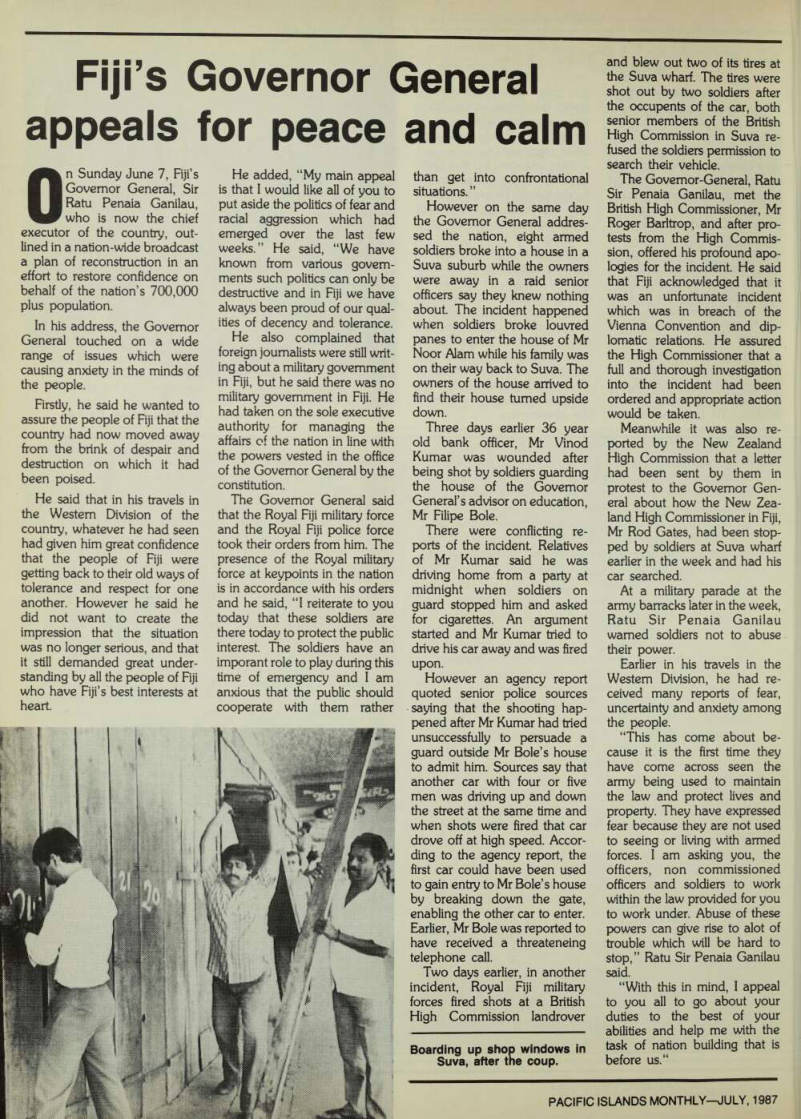
Boarding up shop windows in Suva, after the coup.