Fiji puts pressure
pp. 17-19 · Read in the full issue
on Forum
Australia’s Prime Minis ter Bob Hawke was named by the South Pacific Forum to head a possible special mission to Fiji for talks with all parties on the country’s political crisis.
The Forum which met in Apia, Western Samoa, at the end of May, admitted two new countries—Federated States of Micronesia and the Marshall Islands to its ranks, bringing membership to fifteen. Fiji was not represented “because of our pre-occupation with impor tant matters at home,” Gov ernor General Ratu Sir Penaia Ganilau wrote to the new Forum Chairman, Western Sa
moan Prime Minister Va’ai Kolone.
The Forum also named Solo mon Islands Prime Minister Ezekial Alebua and SPEC Director Henry Naisali as fellow members of the proposed mis sion. The idea of a Forum mission to Fiji had first been suggested by Western Samoan deputy PM, Tupuola Efi.
Expressing their “deep con cern and anguish” at the over throw of the Bavadra Govern ment, the 14 Forum leaders decided that “should the Gov ernor General of Fiji indicate that such a Forum initiative would be constructive and of assistance, the Forum would
send a mission to Fiji”. If accepted, the mission “would hold discussions with all parties in Fiji with a view to attempting to facilitate process leading to a resolution of the current prob lems”.
However, as expected by many at the Forum, the offer was declined by Fiji’s Gov ernor-General Ratu Sir Penaia Ganilau despite intitial indica tions that it might have been accepted. The Forum decision gave the Australian leader the domestic success he had sought Hawke had announced be fore the meeting that he wanted the Fiji issue to be tackled head-on and the decision on a
Fiji mission and its mention in the Forum final communique, was taken despite the reserva tions of several Forum mem bers, particularly those of the Spearhead group.
While all countries had de plored the coup in Fiji, the Melanesian countries had ex pressed reservations about in terference in Fiji’s internal affairs, preferring to offer assist ance to Fiji and wait for a request. Moreover, PNG dele gates told PIM, a mission of lower level officials would have been able to make preliminary contacts more successfully, with a Prime Ministerial mission stepping in afterwards.
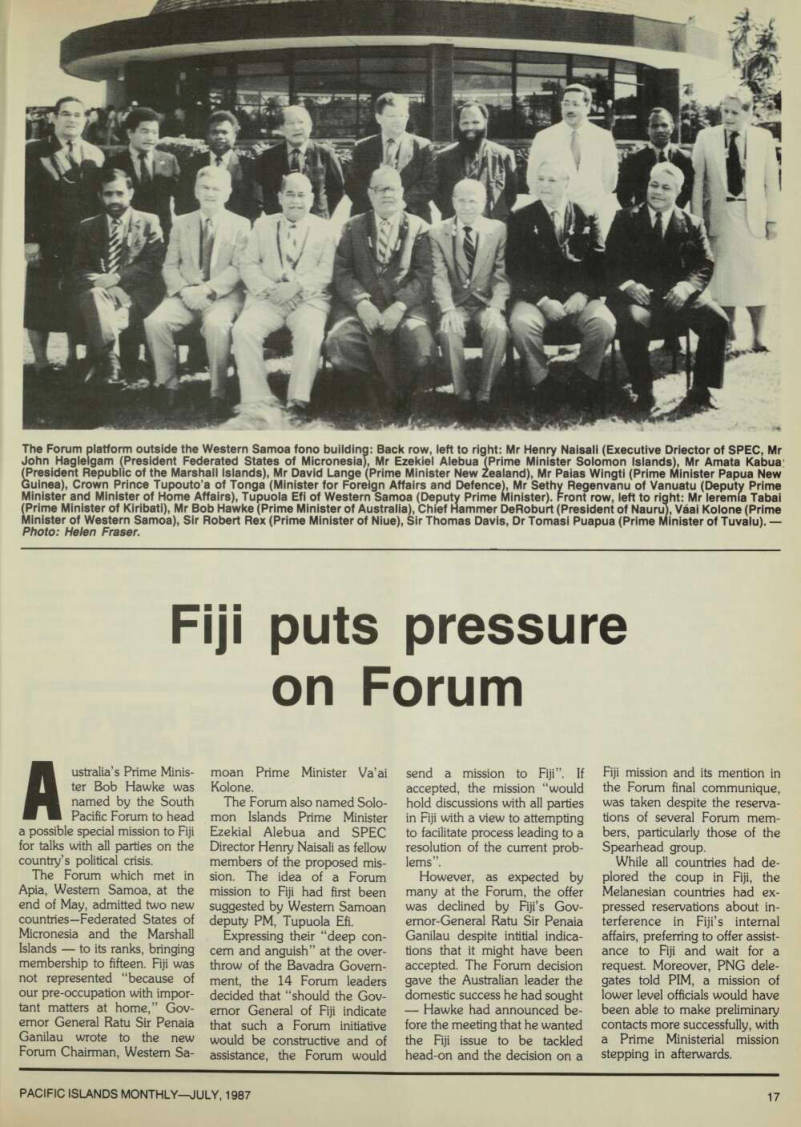
The Forum platform outside the Western Samoa fono building: Back row, left to right: Mr Henry Naisali (Executive Driector of SPEC, Mr John Haglelgam (President Federated States of Micronesia), Mr Ezekiel Alebua (Prime Minister Solomon Islands), Mr Amata Kabua (President Republic of the Marshall Islands), Mr David Lange (Prime Minister New Zealand), Mr Paias Wingti (Prime Minister Papua New Guinea), Crown Prince Tupouto’a of Tonga (Minister for Foreign Affairs and Defence), Mr Sethy Regenvanu of Vanuatu (Deputy Prime Minister and Minister of Home Affairs), Tupuola Efi of Western Samoa (Deputy Prime Minister). Front row, left to right: Mr lererma Tabai (Prime Minister of Kiribati), Mr Bob Hawke (Prime Minister of Australia), Chief Hammer DeRoburt (President of Nauru), Vaai Kolone (Prime Minister of Western Samoa), Sir Robert Rex (Prime Minister of Niue), Sir Thomas Davis, Dr Tomasi Puapua (Prime Minister of Tuvalu).
Photo: Helen Fraser.
At their earlier Rabaul meet ing the Spearhead Group had decided they would send a “mediatory” delegation to Fiji if called upon by the Governor General. Although not on the formal agenda of the Forum, the Fiji crisis occupied almost ten hours of Forum informal and formal discussion. The idea for a Forum mission was first raised at a private dinner for the 14 South Pacific leaders on board HMAS Tobruk, hosted by Mr Hawke on the eve of the Forum meeting.
However, the technicalities of making contact with Fiji’s Gov ernor General led to an ex change the following day be tween PNG Prime Minister Paias Wingti and Australian leader Bob Hawke; it had been agreed that Western Samoa’s Prime Minister, Va’ai Kolone would contact Ratu Penaia, but when communications failed contact was made through the intermediary of the Australian Governor General, Sir Ninian Stephen.
This led to an exchange in the meeting the next day that Wingti termed “heated discus sion” when he raised the ques tion of procedure with Hawke.
The latter reportedly later apologised to the Forum for his outburst. The Forum took a strong stand on the question of independence for New Caledo nia, expressing 44 grave disquiet
about the current policies of the Government of France with regard to New Caledonia”.
The Forum “completely re jected” the referendum which France plans to hold in mid- September for the territory, and noted that the “representative organisation” of the indigenous population, the FLNKS, had decided to boycott the poll.
“Such a referendum would be divisive, futile and a recipe for disaster”, the Forum com munique said, calling on France to abandon the “empty exer cise”. The Forum will call upon the UN Decolonisation Com mittee to recommend to the General Assembly “a UN-spon sored referendum in New Cale donia consistent with the uni versally accepted principles and practices of self-determination and independence”.
The Forum indicated again its willingness to send a delega tion to New Caledonia to talk with all parties on the territory’s political future, as well its “strong interest” in discussiong the issue with France if the latter is “genuinely interested in a dialogue to achieve a peaceful resolution”.
The Forum called upon the South Pacific Games Council to change the venue of the South Pacific Games, due to be held in Noumea in December, “in the interests of the safety and welfare of the participating
athletes.” PIM was told the Council will consider asking Western Samoa to host the games again (W. Samoa was host to the 1983 Games) which would mean waiving the rules about one country being host to two international events in the one year, or an approach to Australia for assistance with facilities for the Games-Austra lia and New Zealand are not participants in the South Pacific Games.
The Forum did not grant the FLNKS observer status as lob bied for by the Spearhead Group Australia, New Zea land and the Cook Islands argued that recognition for the FLNKS as de facto government was not in line with Forum procedures and rules.
PNG Prime Minister Wingti told PIM that if France went ahead with the referendum and the situation in the territory deteriorated, “we would have to have a series of practical measures, apart from express ing diplomatic feelings”. He said his country would look at trade union activity against France and French interests in New Caledonia as measures of this kind. 4 4 One option to be consi dered would be recognition of the (FLNKS) Provisional Gov ernment”, Wingti said. “Given the history of France dealing with other administrations, I’ve very little hope for dialogue”, he said, referring to the Forum offer of dialogue with France.
On the Libyan threat to the South Pacific Wingti said Aus tralia had failed to provide “hard facts to substantiate allegations about Libyan in volvement affecting the security of this region.”
However, Forum countries accepted an Australian propo sal to increase the sharing of security intelligence between member nations.
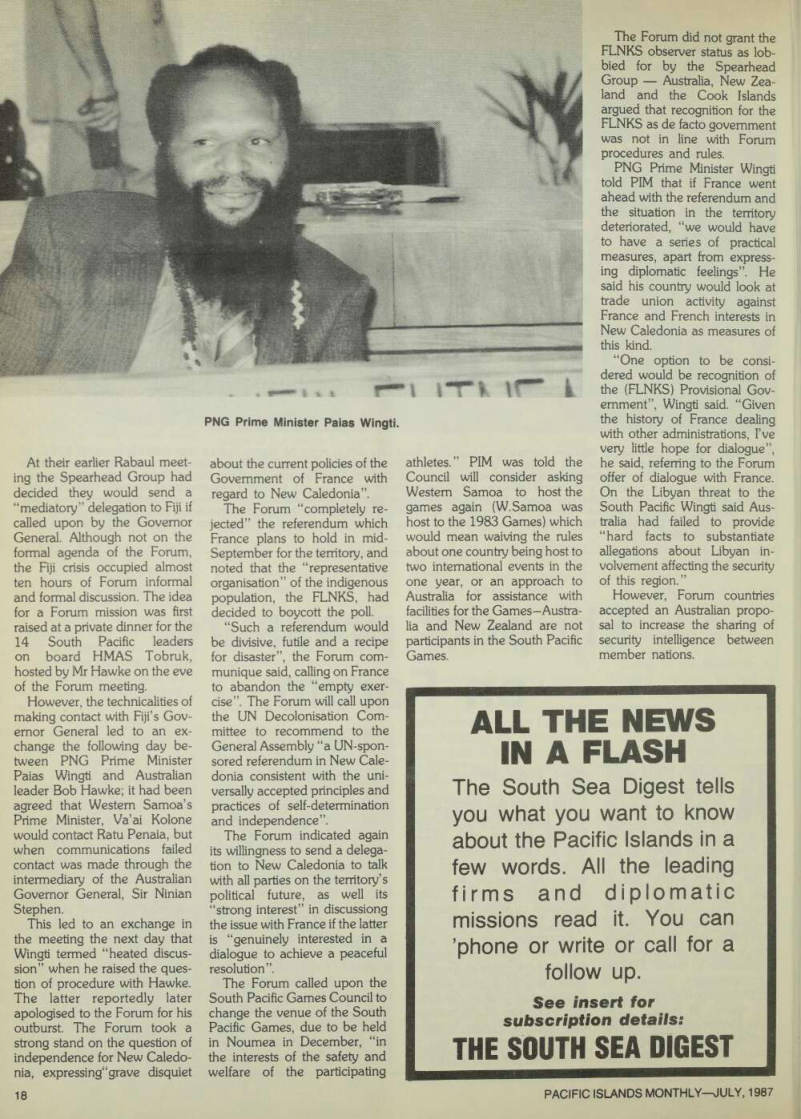
PNG Prime Minister Paias Wingti.
The Forum also decided to review its bureaucratic or ganisation with a view to mak ing the Forum the paramount regional organisation and in creasing its international recog nition as well as the Forum there are the secretariat, the South Pacific Bureau for Eco nomic Co-operation (SPEC), the South Pacific Commission (SPC) head-quartered in Noumea and the Forum Fisher ies Agency (FFA).
PNG’s Foreign Minister Ted Diro wants to see the Forum as a single regional organisation with its other arms answerable to it.
He told PIM that PNG wants to see all aid from donor coun tries to be channelled through the SPEC, to allow the Forum to have a political control over aid.
This would mean cutting down the role of the SPC, which was set up after World War Two by metropolitan countries.
The South Pacific Nuclear Free Zone Treaty was signed at the Forum by the Prime Minis ter of the Solomon Islands, Mr Ezekiel Alebua, leaving only two countries Vanuatu and Tonga that haven’t signed.
In the wake of the hijacking of the Air New Zealand plane at Fiji, the Forum decided to establish a working party to look at ways to enhance the capacity of Forum states to counter terrorism and hijacking.
Next year’s Forum meeting will be held in Tonga.