Fiji economy shattered
pp. 14-15 · Read in the full issue
Fiji, which had a buoyant economy with prospects of bigger and better things ahead, now faces the gloomy forecast of a sinking economy.
According the deposed prime minister, Dr Timoci Bavadra, the country’s economy is heading for disaster.
The sugar industry, the backbone of Fiji’s economy, is facing an uncertain future. Tourism, the second most important industry in terms of foreign exchange and employment, is at a standstill. The construction and building industry is also slowly grinding to a halt.
Despite the Governor General’s assurance to the cane farmers, the cane growers, who are mostly Indians, are reluctant to start harvesting.
The chief executive of the Sugar Cane Growers Council, Sir Vijay R Singh, and the chairman of the Sugar Commission, Mr Gerald Barrack, have been making every effort and holding meetings in the cane growing areas with farmers and mill workers to make them realise the situation and commence harvesting.
In his nationwide address, the Governor General said that the cane growers who supplied cane to the Fiji Sugar Growing Corporation in 1986 are assured they will receive their full share of the proceeds. He said Fiji’s traditional buyers have reaffirmed their commitment to purchase sugar and molasses for the 1987 crop.
The Governor General said “Our markets are intact. In view of the expected lower production, we will need the entire crop to meet all our commitments this year.”
He said when the 1987 sugar crop has been harvested and crushed, the growers will definitely be paid in accordance with the terms of their cane contract by the Fiji Sugar Corporation. He gave the farmers assurance that anyone who gave them advice to the contrary were either misguided or stupid. He said the forecast price of $23.50 for the committed 1987 crop still stood.
He said there had been talk of Fiji’s military forces
undertaking the havesting of cane but he reassured the cane growers and the people of Fiji that there was no intention at all of using the armed forces for that purpose. He said the role of the military forces was to maintain public security in the country and that was what they would do.
He said the country could not afford the destruction of the sugar industry which was the only source of livlihood for thousands of families.
Should harvesting and crushing not commence as planned, the consequences would be disasterous not only for 1987 but also in future years. Overseas markets could be forfeited if commitments were not met and there would be major layoffs in all the factories and the crop which is already suffering from drought would be wasted and lost.”
As far as the sugar industry is concerned, it retains the highest percentage of foreign exchange in comparison to the second most important industry, the tourist industry. It has a vital role to play in the country’s economy. 22,000 farmers around the country have given varying reasons for their reluctance to harvest cane. While some have said they feared the unrest in the country would disrupt the sugar crushing program in the sugar factory and incur losses for them, others have expressed doubt at getting proper and fair payment for their crop. Many others see their act as a political action to protest the overthrow of Dr Timoci Bavadra’s government. 70 per cent of the sugar cane farmers and 60 per cent of the millworkers are Indians. The disruption of this years harvesting and crushing has meant that 20,000 people have already lost wages.
The Fiji hotel industry could lose SFBO-100 million in revenue and a number of hotels could be forced to close down. According to the president of the Fiji Hotel Association, Mr Michael Dennis, the industry would be lucky to earn SFI2O million this year in comparison to the record revenue of SF2OO million last year.
The occupancy rate for the 400,000 hotel rooms in Fiji has dropped to as low as 10 per cent. It is not likely to improve in the near future as at this time of the year the occupancy rate is on average about 70 per cent.
Continental Airlines, the only United States airline flying into Fiji, has suspended its four weekly flights to Fiji until September 17th while the Australian airline, Qantas is only carrying Fiji nationals or reporters on its flights to Fiji.
Air New Zealand has also suspended flights to Fiji after one of its jumbo jets was involved in a hijack drama at Nadi International airport. The hijacker, a worker at the Fiji international airport at Nadi, attempted to seize the jet in order to seek the release of the detained members of the Bavadra Government. He was overpowered by the crew of the aircraft but the incident prompted Air New Zealand to suspend its flights to Fiji until further notice.
Air Pacific and Japan airlines are still flying regular schedules to Fiji and visitors have been recommended to exercise normal caution in making their arrangements.
The construction industry also faces a bleak future and in early June some 2,000 building workers were facing the prospect of being laid off.
According to the Fiji Markets Association, some drastic and positive measures have to be taken to restore the confidence of investors. The association’s President, Mr Malcolm Brain, says no new contracts had been signed since the coup and foreign investments have ceased. Manufactur ers of building materials such as cement have reported a drop of 50 per cent in their sales while others, such as roofing iron manufacturers, report a drop in sales of more than 80 per cent.
Besides the construction industry, the garment industry has been badly hit. Some five hundred garment workers are likely to lose their jobs.
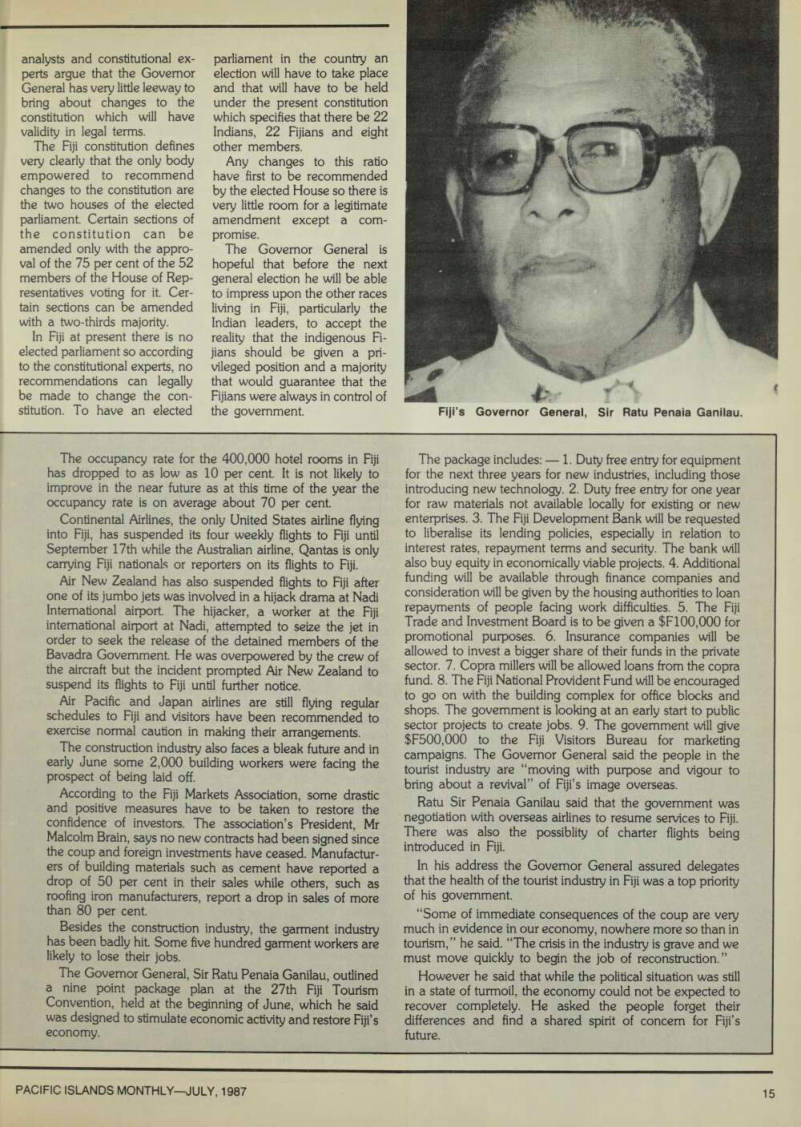
The Governor General, Sir Ratu Penaia Ganilau, outlined a nine point package plan at the 27th Fiji Tourism Convention, held at the beginning of June, which he said was designed to stimulate economic activity and restore Fiji’s economy.
The package includes: 1. Duty free entry for equipment for the next three years for new industries, including those introducing new technology. 2. Duty free entry for one year for raw materials not available locally for existing or new enterprises. 3. The Fiji Development Bank will be requested to liberalise its lending policies, especially in relation to interest rates, repayment terms and security. The bank will also buy equity in economically viable projects. 4. Additional funding will be available through finance companies and consideration will be given by the housing authorities to loan repayments of people facing work difficulties. 5. The Fiji Trade and Investment Board is to be given a SFIOO,OOO for promotional purposes. 6. Insurance companies will be allowed to invest a bigger share of their funds in the private sector. 7. Copra millers will be allowed loans from the copra fund. 8. The Fiji National Provident Fund will be encouraged to go on with the building complex for office blocks and shops. The government is looking at an early start to public sector projects to create jobs. 9. The government will give $F500,000 to the Fiji Visitors Bureau for marketing campaigns. The Governor General said the people in the tourist industry are “moving with purpose and vigour to bring about a revival” of Fiji’s image overseas.
Ratu Sir Penaia Ganilau said that the government was negotiation with overseas airlines to resume services to Fiji.
There was also the possiblity of charter flights being introduced in Fiji.
In his address the Governor General assured delegates that the health of the tourist industry in Fiji was a top priority of his government.
“Some of immediate consequences of the coup are very much in evidence in our economy, nowhere more so than in tourism,” he said. “The crisis in the industry is grave and we must move quickly to begin the job of reconstruction.”
However he said that while the political situation was still in a state of turmoil, the economy could not be expected to recover completely. He asked the people forget their differences and find a shared spirit of concern for Fiji’s future.