The Governor General’s dilemma
pp. 14-15 · Read in the full issue
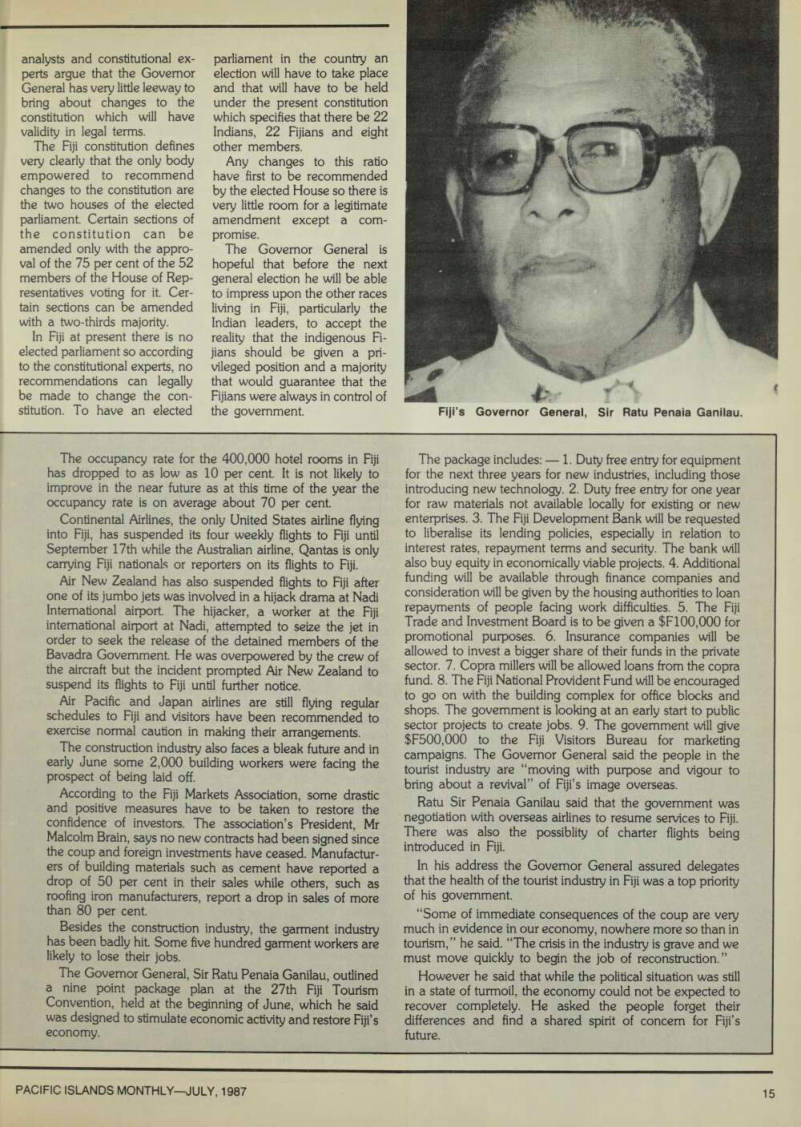
The Governor General of Fiji, Sir Ratu Penaia Ganilau, is presently faced with the most difficult and uneviable task of restoring the democratic rule in Fiji.
Since the May 14 military coup and since he resumed authority as Fiji’s chief execu tive, the 68 year old Governor General, a former soldier and politician, has been at pains to keep the various factions of the Fiji community satisfied and happy and to assure them that their interests and wishes are being protected.
The council of advisors has Sir Ratu Sir Kamisese Mara, the former prime minister and lead er of the Alliance Party who had led the country for 17 years
after independence in 1970, in the position of Advisor for Fore ign Affairs and Civil Aviation, while the coup leader, Lieute nant-Colonal Sitiveni Rabuka, is in charge of home affairs and disciplining the forces.
The governor of Fiji’s Re serve Bank, Mr Savcnaca Siwa tibau, is the advisor for finance and economic planning, a for mer commander of the army, General Paul Manueli, is re sponsible for posts and tele communications, and the chair man of the Public Service Com mission, Mr Bill Cruickshank is responsible for public service.
Retired diplomat, Ratu Josua Toganivalu, is responsible for Fijian affairs, a former lawyer, Mr Alipate Qetaki, is responsi
ble for crown law office and justice department and a former civil servant, Ratu Josua Cavalevu, is responsible for agriculture and fisheries.
Ratu Josaia Tavaiqia is in charge of forestry, Mr Livai Nasilivata is in charge of corpo rate and consumer affairs and Mr Filipe Bole is responsible for education, youth and sport.
The latter three were also responsible for these ministries as cabinet ministers in the Alliance Party. Another former cabinet minister of the Alliance Party, Dr Apenisa Kurisaqila, is responsible for land, energy and mineral resources. Mr Viliame Gonelevu is responsi ble for public works and road transport and Rev Tomasi
Raikivi is responsible for in formation and broadcasting.
Senator Mumtaz Ali is re sponsible for trade, industry and tourism and Mr done Veisa masama is in charge of rural development, rehabilitation, and rural housing. Rev Daniel Mastapha was responsible for housing and added affairs.
However, Rev Daniel Mas tapha resigned after attending the first meeting of the council, claiming that he could not do justice to his duties as a church minister while remaining an advisor to the Governor Gen eral.
While Ratu Sir Penaia has pledged that any changes to the constitution will be made using all legal means, political
analysts and constitutional ex perts argue that the Governor General has very little leeway to bring about changes to the constitution which will have validity in legal terms.
The Fiji constitution defines very clearly that the only body empowered to recommend changes to the constitution are the two houses of the elected parliament Certain sections of the constitution can be amended only with the appro val of the 75 per cent of the 52 members of the House of Rep resentatives voting for it. Cer tain sections can be amended with a two-thirds majority.
In Fiji at present there is no elected parliament so according to the constitutional experts, no recommendations can legally be made to change the con stitution. To have an elected
parliament in the country an election will have to take place and that will have to be held under the present constitution which specifies that there be 22 Indians, 22 Fijians and eight other members.
Any changes to this ratio have first to be recommended by the elected House so there is very little room for a legitimate amendment except a com promise.
The Governor General is hopeful that before the next general election he will be able to impress upon the other races living in Fiji, particularly the Indian leaders, to accept the reality that the indigenous Fi jians should be given a pri vileged position and a majority that would guarantee that the Fijians were always in control of the government.
Fiji’s Governor General, Sir Ratu Penaia Ganilau.