US forced Marshall Islands
p. 44 · Read in the full issue
to sign nuclear settlement
The United States used economic pressure to force the Marshall Islands government to sign away the rights of its citizens to sue the United States for nuclear testing damages, a high level Marshalls official said in a sworn court affidavit.
The statement by former chief Compact of Free Associa tion negotiator and now Minis ter of Health Tony deßrum was the first by a Cabinet level official concering the controver sial provision in the Compact which seeks to bar the currently pending $5 billion in lawsuits.
U.S. attorneys state that the Compact treaty with the Mar shall Islands, which limits nuc lear testing compensation to $l5O million, represents full and final compensation for nuc lear testing which occurred be tween 1946-1958. If the provi sion is upheld by the judge presiding over the current legal dispute it would prevent the Marshallese claims for nuclear damages from coming to trial.
Mr deßrum stated that the nuclear claims part of the Com pact was not the product of mutual agreement. During the negotiations the U.S. “could and did provide or withhold funds for public purposes in order to pressure the public officials of the Marshall Islands into political positions desired by the United States,” said deßrum, the Marshalls’ chief negotiator from the mid-1970s through 1982.
The Compact, implemented last October, provides the Mar shalls with about $1 billion in economic aid over 30 years in exchange for use of the Kwaja lein missile range and Mar shalls’ government “espousal” of nuclear test claims by its citizens.
“I pointed out to the United States delegation (during the negotiations) that espousal by the government of the Marshall
Islands was under our custom, law and constitution, illegal and unconstitutional, ” said deßrum.
“. . . We insisted that any settle ment of the nuclear claims be approved by the individual claimants.”
Mr deßrum said that U.S. officials told the Marshalls it “should trade off the rights of the claimants for other conces sions from the U.S. in other parts of the Compact.”
The Marshall Islands was a United Nations Trust Territory governed by the U.S. during the Compact negotiations.
Nearly all of the Marshalls financial aid came from the U.S.
Mr deßrum said that the U.S. held out the “carrot” of Trusteeship termination in 1981. Relying on these prom ises and with the backing of U.S. officials, the Marshalls took multi-million loans for infras tructure a power station, new dock and airplanes “necessary to an independent government”.
“Once the government of the Marshall Islands was burdened with this debt the carrot was
removed, the trusteeship was not terminated and the govern ment of the United States re fused to assist with relief of the burden assumed in reliance upon American promises,” he said.
During the early 1980 s the U.S. began using the Marshalls debt to press the north Pacific island group to agree to the nuclear claims settlement that would bar citizens from suing the U.S.
To gain the Marshalls sup port, deßrum asserted, the U.S. included a variety of financial incentives in the Compact, in cluding free importation rights, tax concessions and authority to control territorial waters.
“After the plebiscite (which approved the Compact), the U.S. unilaterally changed the provisions of the Compact through its internal legislative process by withdrawing from the Compact these provisions which had induced some of us to support the Compact plebis cite, thereby making a mockery of the Marshallese people’s act of self-determination,” he said.
Giff Johnson.
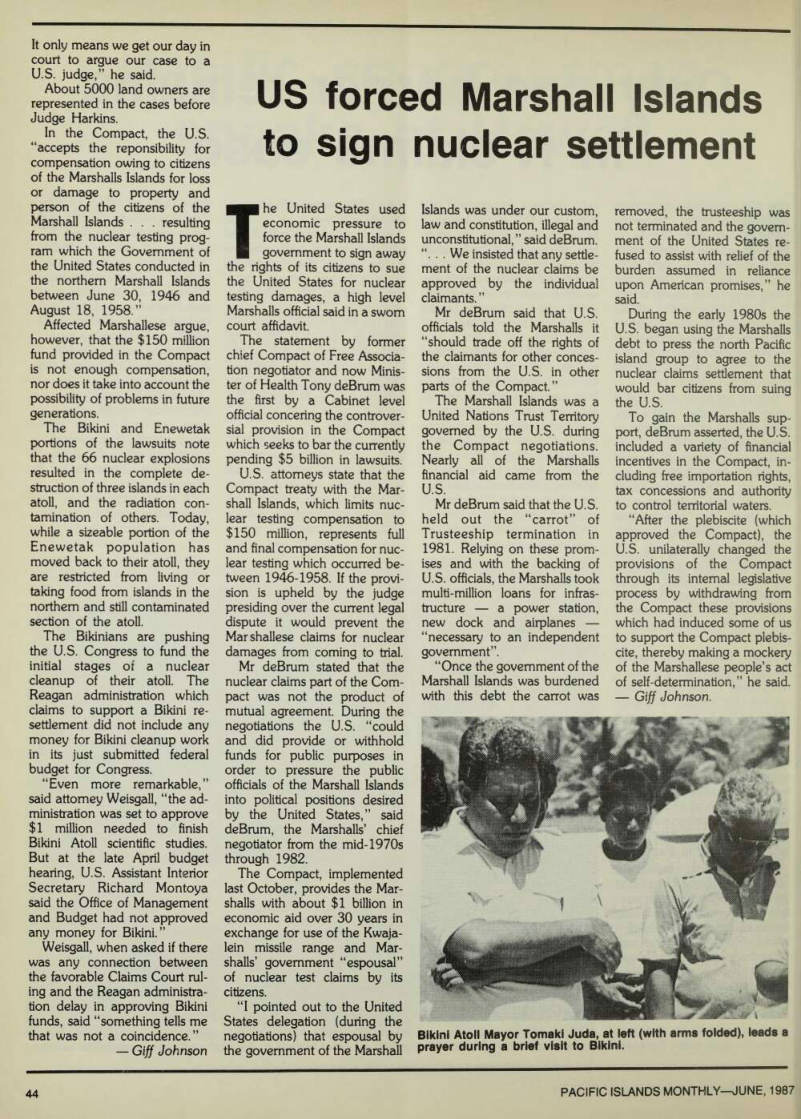
Bikini Atoll Mayor Tomaki Juda, at left (with arms folded), leads a prayer during a brief visit to Bikini.